
Aubrey "Drake" Graham: The City and The Boy
A look at Toronto’s defining narrator, an empire built on relentless reinvention, and a generation raised inside his soundtrack.

It feels like it was just yesterday I woke up like The Undertaker to catch VH1’s “Best I Ever Had” MV premiere, the world still small enough not to need defenses against what it would later become—performative social media, AI everywhere, and everything else slowly sanded flat.
Nearly 20 years on, it plays back like signal bleed, and you catch yourself wondering what kind of hustle time has been running on us—because somehow we’re all still here, just older.
Way older. Old enough to wonder whether we’re even supposed to still care about any of this.
Then out of nowhere, a Drake record comes on, and the years collapse in real time—like somebody found a way to smuggle your entire 20’s through airport security.
Started From the Basement
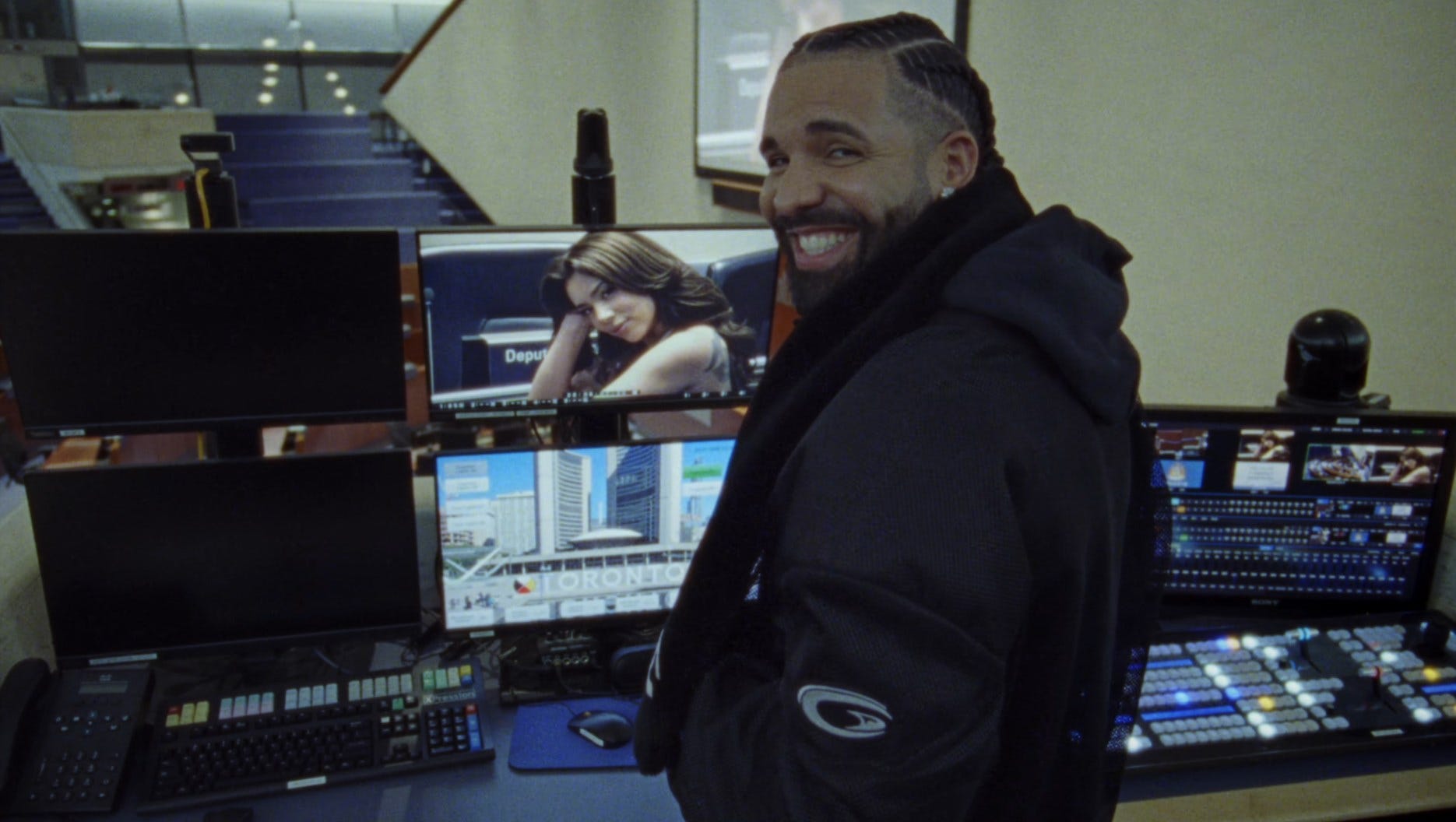
A 13-year-old Aubrey “Drake” Graham slept in the basement of a Forest Hill duplex in 2000, his mother on the first floor. He was cast as Jimmy Brooks on Degrassi: The Next Generation on the recommendation of a classmate’s father from the Forest Hill Collegiate Institute.
By May 2026, OVO Sound was a decade into paying out, and a significant share of Toronto’s rap economy moved through its catalog. The NBA had fined the Raptors $25,000 in August 2014 after Drake used a Toronto concert to pitch Kevin Durant on signing in the city.
He was also on appeal at the Second Circuit that May. The Yale Law School Floyd Abrams Institute had filed an amicus brief asking the appeals court to affirm dismissal on the alternative ground of consent:
Suppose a self-assured boxer challenges the world champion to a prize fight, is knocked out on live television, and, with bruised ego and body, files a lawsuit for battery.
Drake’s Stake.com endorsement had ruptured publicly the previous August; Financial Times sources had pegged it at $100 million annually. A federal RICO complaint in the Eastern District of Virginia, filed December 31, 2025 by plaintiffs LaShawnna Ridley and Tiffany Hines, accused him of routing endorsement money through Stake’s P2P Tipping function to pay bot vendors to inflate his Spotify streams.
Bloomberg Businessweek had reported, roughly two and a half months earlier, that he won big on Stake’s Easygo-built slot games—Stake’s in-house (1P) titles—at roughly 400% the rate of comparable players. His trilogy on May 15th (Iceman, Habibti, Maid of Honour) were widely read as a contract-discharge maneuver to exit the 2022 UMG deal, on the structural model of Frank Ocean’s Endless / Blonde split in 2016: deliver the requirements in a compressed burst, ‘satisfy’ the major-label paperwork, then move on without owing another album.
More Life gave the playlist-as-album its name in March 2017, and the long-runtime deluxe-reissue held through Scorpion, Certified Lover Boy, Honestly, Nevermind, For All the Dogs, and the May 2026 trilogy. OVO Sound launched in 2012 with 40 and Oliver El-Khatib, signing PartyNextDoor, Majid Jordan, Boi-1da, Noah Shebib, and Naomi Sharon over the next decade.
A biracial Forest Hill kid singing about his feelings moved hip-hop's emotional center into mainstream pop and held it for 17 years.
The playlist-as-album format widened the intake further: Houston syrup, Memphis ache, Atlanta trap, Jamaican patois, Newark bounce, even Lagos rhythm. Drake trained listeners to treat songs like diary entries. The audience turned Drake’s life into a shared canon—every relationship, every vacation photo, every subliminal, every courtside appearance made it into his catalog and fans’ Instagram bios. The bios usually got there first.
Word On Road
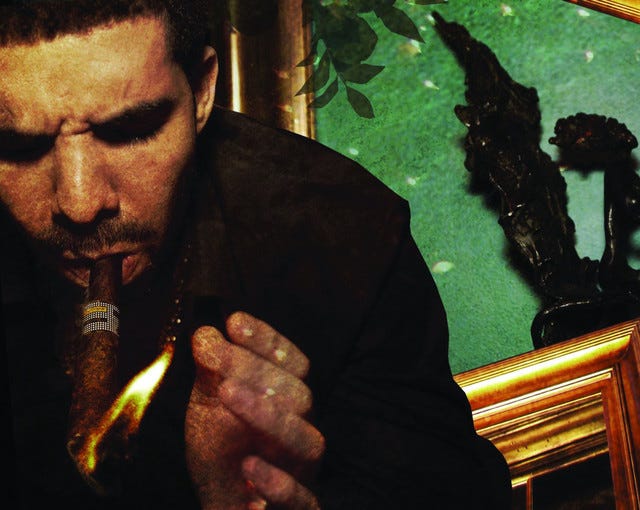
Forest Hill in 2000 was a Toronto Jewish neighborhood with a negligible Black population, median household income among the highest in the city, and detached single-family housing dominant. The class slope extended NE from Forest Hill into the Bridle Path, where Drake would later buy his Beaux-Arts manor at 21 Park Lane Circle, and SW into the working-class Toronto that fed the OVO Sound roster.
Weston Road was the other Toronto: working-class, Caribbean and Black Canadian at its center, with Italian and Portuguese pockets still hanging on block by block. Drake played minor hockey there with the Weston Red Wings before he turned 12. He spent childhood moving between the city’s different worlds, with Memphis summers layered over all of it like a second passport.
Denham Jolly’s Milestone Radio had won its CRTC license fight after three applications across an 11-year period (1990, 1997, 2000) and put Canada’s first commercial Black-owned urban-contemporary station, Flow 93.5, on the air at 9:35 p.m. on February 9, 2001. Toronto listeners had tuned to WBLK out of Buffalo before that, and the Canadian-content regulatory environment had treated hip-hop like a rumor until then.
Complex Canada’s Hip-Hop 50: 10 Early Trailblazers retrospective follows the scene through small venues and local joints—the Kool Haus on Queen’s Quay where Drake opened for Ice Cube on August 19, 2006 for $100; MuchMusic on Queen Street; the Battle of the Beatmakers competitions; the streetwear shop Lounge across from the MuchMusic studios, where a buyer named Oliver El-Khatib worked the floor and a producer named Matthew Samuels won the Battle of the Beatmakers in 2006, 2007, and 2008 under the name Boi-1da.
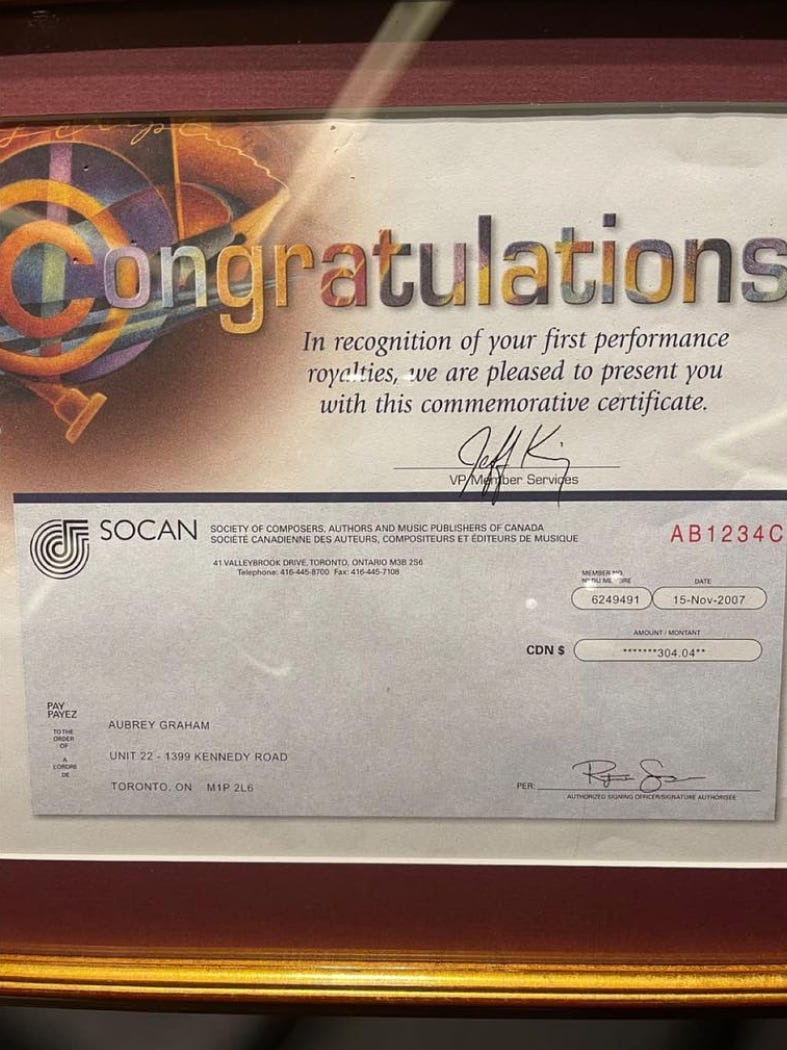
Boi-1da, born in Kingston, Jamaica on October 12, 1986, had moved to Toronto at age three and produced material on Drake’s debut mixtape Room for Improvement, which sold roughly 6,000 physical copies for an exact royalty payout of $304.04. Drake posted the royalty statement to Instagram in 2013 with the caption “Came a long way from 3 bills in royalties.”
Noah “40” Shebib began working with Drake as an engineer in 2005. His father Donald directed Goin’ Down the Road (1970), the foundational text of English-Canadian cinema; his mother Tedde Moore played Miss Shields in A Christmas Story (1983). Charles Holmes’s 2020 Rolling Stone profile dates 40’s multiple sclerosis diagnosis to age 22, the same year. He went on to produce every Drake album from So Far Gone (February 13, 2009) forward.
In a 2016 Native Instruments interview and Paul Tingen’s Sound on Sound breakdown of “Headlines,” 40 explained that the signature Drake sound is achieved by reducing the source sample rate from 44.1 kHz / 24-bit to roughly 22.05 kHz / 16-bit, the high end gone before it reaches the mix: “those frequencies from the top end… they’re not even getting sampled in the first place. They don’t even exist.”
He continued to frame it as ideological:
When you take out that pristine high end and sort of lower the sample rate, it would become a little more authentic almost, different, like it was sampled or like it was taken from somewhere. […]
I was carving out an entire space in the frequencies, […]
…In a way that nobody would do it.
The signing was from Jas Prince, son of Rap-A-Lot founder James Prince, who found Drake’s brown-and-beige MySpace page in 2006. In Prince’s June 11, 2015 FADER interview, he brought the tracks to his father (who passed on it) and then to Lil Wayne, whose initial verdict was “Jas, don’t ever play this for me again. He sucks!” Prince ignored it. In a car en route to Wayne’s jeweler in Houston, Prince played “Replacement Girl,” Drake’s “A Milli” freestyle, and “Brand New,” and Wayne demanded a phone call.
Drake flew to Houston in November 2008. The Cash Money / Young Money deal closed June 29, 2009.
It was structured through Aspire Music Group, which had signed Drake to an exclusive recording agreement in 2008. Filings in Aspire v. Cash Money / Young Money / Universal lay out the agreement: Aspire’s share was for 1/3 of net profits and 1/3 of master-recording copyrights on Drake’s first six albums—So Far Gone, Thank Me Later, Take Care, Nothing Was the Same, If You’re Reading This, and Views. Distribution was through Universal Republic.
Drake did not own his masters; Aspire owned 1/3; Cash Money owned the remainder.
Court filings later alleged that Cash Money had received roughly $100 million in advances from UMG and then applied double deductions against Aspire’s accountings, producing statements showing zero amounts owed across all six albums. Justice Ostrager held at trial that Aspire had adequately pleaded UMG as a potential “alter ego” of Cash Money. The Appellate Division First Department reversed that finding on February 7, 2019, writing that the allegations described “legitimate business conduct.” The remaining claims settled on undisclosed terms in July 2019.
So Far Gone arrived as a free mixtape on February 13, 2009 and was reissued as a commercial EP on September 15, 2009. Pitchfork retrospectively called it “one of the most compulsively listenable mixtapes of a great year for mixtapes.” “Best I Ever Had” climbed to Hot 100 #2 in July 2009; the climb had begun on free-mixtape strength before the Young Money deal closed June 29. “Successful” with Trey Songz and Lil Wayne peaked at #17. The EP debuted at #6 on the Billboard 200 with 73,000 first-week units. Drake won the 2010 Juno Award for Rap Recording of the Year. The most memorable lyric, from “Say What’s Real,” recorded in 2009 for the promo mixtape Heartbreak Drake:
Always said I’d say it all on the right track
But in this game you only lose when you fight back.
“Successful,” verse two:
Yeah, I want things to go my way
But as of late, a lot of shit been goin’ sideways
And my mother tried to run away from home
But I left something in the car and so I caught her in the driveway
And she cried to me, so I cried too
And my stomach was soakin’ wet, she only 5’2”
And 40, that was all before I showed up.
The track has the shape of every later Drake song: first-person voice, a named time, family on the line, a specific personal detail delivered directly into the listener’s ear, and silence used as percussion.
Drake didn’t invent the singing-rapper hybrid, though. Cee-Lo Green had carried it on Gnarls Barkley’s St. Elsewhere; André 3000 had carried it on The Love Below; even Kanye West had carried it on 808s & Heartbreak, three months before So Far Gone. Drake covered 808s’ “Say You Will” on the mixtape. He told Complex in 2009 that Kanye was “the most influential person on his sound.” The Los Angeles Times’ Todd Martens later wrote that 808s was “the template for essentially the entirety of Drake’s young career.” Earlier records had treated singing-rapping as a side experiment inside an album of straight rap. So Far Gone opened with “Lust for Life” and carried it across the full mixtape. From “Best I Ever Had” forward, the genre stopped moving in straight lines and started swallowing whatever was left in its path.
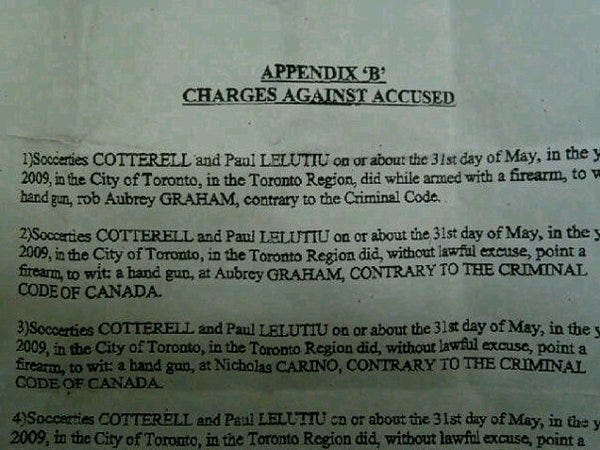
On May 31, 2009, three months after So Far Gone and one month before the Young Money signing, Drake was robbed at gunpoint outside a restaurant at College and Beatrice in Toronto’s Little Italy, surrendering an Audemars Piguet watch, a gold-and-diamond necklace, and $2,000 USD. Per The Globe and Mail’s November 2010 reporting, police arrested Soccerties Cotterell and Paul Lucian Lelutiu; a second gunman escaped.
15 years later, on “Family Matters”—
I mean, it's true a nigga slimed me for my AP.
In January 2010, the serious armed-robbery and weapons charges against the defendants were withdrawn after Drake cooperated with the Crown investigation.
A lawyer close to the case told the paper Drake “was available to take the stand” but didn’t have to.
The culture-vulture critique didn’t appear after the fact. It was documented in real time: Hanif Abdurraqib at BuzzFeed News and MTV News across 2016 through 2018, Justin Charity at The Ringer across the same window, Wesley Morris at the Times, and Grant Rindner on the Jersey-club moment in 2022, plus a wide body of video-essay work via “critics” on YouTube.
Drake’s catalog also finds itself in Houston chopped-and-screwed, Atlanta trap, Jamaican and Trinidadian patois, London road-rap, Newark Jersey club, South African house, and Arab pop visuals—regional vernaculars he has no claim to. The scale of the business depended on Black regional aesthetics traveling upward into the global market at a rate the originating scenes couldn’t match.
Sandi Sher-Graham—Latvian-Russian Ashkenazi, raising her son in Forest Hill, historically a Toronto Jewish enclave with a Black population near zero.
Dennis Graham—Black American, from Memphis, not Caribbean or East African like most fathers of Toronto’s mixed Black kids in the late 1990s.
The Memphis summers from age 5 to 17 gave him a Southern Black inheritance most Canadian kids around him weren’t getting, while the Forest Hill weekdays left him orbiting a Jewish enclave he never fully belonged to either.
The identity conflict is everywhere in the catalog. “Look What You’ve Done”turns Sandi’s RA and the money pressure around it into early mythmaking. “You & the 6” unfolds like a voicemail to his mother, the closest the catalog gets to a Jewish-mother inflection inside rap’s established Black-mother tradition. “March 14” makes Adonis public record, folding family exposure into album design. Across these moments, the private life is the work’s recurring subject. Critics—Abdurraqib at BuzzFeed, Charity at The Ringer, Morris at The New York Times—treat that staging itself as political content.
All the arguments about cultural borrowing eventually run into the same limit: the man in the frame. Memphis, Houston, Atlanta, Kingston, London, Newark. The self is the only site that remains uncontested. Whether that’s retreat or relocation is up to you. Either way, the camera turns inward once the rest of the map stops feeling livable.
The Drake-Kendrick exchange in May 2024 turned the question into a single bar. Drake’s “Family Matters” accused Kendrick of policing Blackness from a position of insecurity; Kendrick’s “Not Like Us,” less than 24 hours later, reframed Drake as a tourist with a platinum card—someone moving through Black culture, not of it.
Kendrick beat Drake outright in the 16-day exchange of eight diss tracks from March 22 to May 5, 2024. Justin Charity, writing in The Ringer on May 9, 2024 under the headline “Why Drake Lost”, pointed to the sprawl of “Family Matters” and the exhausted concession tone of “The Heart Part 6.”
Drake’s three highest-profile feuds came from fights he didn’t start: Pusha was Kanye’s first; Meek picked the moment; Kendrick was on Future and Metro Boomin’s “Like That” answering Cole’s “First Person Shooter” verse.
One criticism arrived almost from the start: too inward, too willing to leave the lights on and the blinds half-open while almost everybody else in hip-hop was still pretending the house was empty. It starts in 2009, with “Best I Ever Had” climbing to Hot 100 #2 on mixtape strength alone, and by the time Pitchfork’s 8.6 review of Take Care in November 2011 dropped, the case against him was already folklore set in stone.
Thank Me Later arrived on June 15, 2010 and debuted at #1 on the Billboard 200 with 447,000 first-week units. Drake later described it as rushed. The album’s chart-leading single “Find Your Love” was filmed in Jamaica; the Jamaica Tourism Board’s then-minister publicly criticized the video for its association with garrison politics:
We just have to say that care has to be taken by all, including our creative artists, in portraying images of our destination and people, […]
Gun culture, while not unique to Jamaica, is not enhancing [the island’s image], …
Take Care released November 15, 2011, with 40 on primary production and T-Minus, Jamie xx, Boi-1da, Just Blaze, Illangelo, Doc McKinney, and Supa Dups shaping the spaces around him. Features from The Weeknd (then performing on the OVO blog), Rihanna, Kendrick Lamar, Stevie Wonder, André 3000, and Nicki Minaj. It won Best Rap Album at the 2013 Grammys. NPR’s Ann Powers and Frannie Kelley framed it as “minimalist reworkings of TLC’s minor-key soul” set inside “trancey rhythms that land somewhere between paranoid Sly Stone and smoked-out Maxwell.”
Pitchfork’s Ryan Dombal pinned it “between UGK’s deep funk, quiet-storm 90s R&B, and James Blake-inspired minimalism.”
By 2011, music criticism in general had become its own dialect—half MFA seminar, half smoke cloud hanging over a MacBook Pro.
“Marvin’s Room,” released June 9, 2011 via the OVO blog. A 24-year-old calls an ex, drunk, at 1AM. The chorus comes back as the ex’s reproach:
I’m just sayin’, you could do better. […]
Talk to me, please, don’t have much to believe in
I need you right now, are you down to listen to me?
The later timestamp songs (“9 AM in Dallas,” “5 AM in Toronto,” “6 PM in New York,” “8 AM in Charlotte”) do the same thing, and “Hold On, We’re Going Home,” co-produced by Majid Jordan, Nineteen85, and 40 on Nothing Was the Same, does it as a ballad.
Drake glides on “Marvin’s Room,” in declarative rap on “Back to Back,” in melodic dancehall on “One Dance,” in pop on “Hotline Bling,” in trap on “God’s Plan,” and in bounce on “In My Feelings” as if they all belong to the same language—yet, four still hit #1 or #2 on the Hot 100. Genre was, at least statistically, no longer an obstacle for Drake. Most artists pick a lane; Drake recorded the highway.
Drake gave “Marvin’s Room” away free on the OVO blog in June 2011, five months before Take Care shipped. The prototype for the next decade of confessional rap was a blog drop. Bryson Tiller, PartyNextDoor, dvsn, Roy Woods, half of Brent Faiyaz’s catalog—all working off it.
“Headlines” led Take Care as the album’s first single. Its second verse—the defining Drake verse, the one half the internet can still recite from memory—was the first time he stated the audience pressure out loud instead of through the cracks:
I be yellin’ out, ‘Money over everything,’ money on my mind
Then she wanna ask when it got so empty
Tell her I apologize, happened over time
She says, ‘They miss the old Drake,’ girl, don’t tempt me
‘If they don’t get it, they’ll be over you
That new shit that you got is overdue
You better do what you supposed to do’
I’m like, ‘Why I gotta be all that?’
But still, I can’t deny the fact that it’s true.
At 25, on the album that would define his sound, he was already staging the “old Drake” complaint inside his own music and admitting the audience might be right. The same accusation surfaces again in “Emotionless” on Scorpion, in the genre-pivot of Honestly, Nevermind, and in the trilogy’s “What died back in 2024 was a big piece…” confession on “Make Them Cry.”
T-Minus, the third member of the Toronto-suburb production trio behind Drake’s first decade with 40 and Boi-1da, has gotten less critical attention than either. Born Tyler Mathew Carl Williams in 1988, he came up at Pickering High School in Ajax, the same Toronto-suburb high school Boi-1da attended. He produced five tracks on Take Care, more than any non-40 producer on the record.
Williams returned for “March 14” on Scorpion in 2018, the outro track that turned the family material into a recurring catalog subject for the rest of the decade. The cross-label reach inside the same window (Kendrick Lamar’s “Swimming Pools (Drank),” Lil Wayne’s “She Will,” Nicki Minaj’s “Moment 4 Life,” DJ Khaled’s “I’m On One” with Drake and Rick Ross) established T-Minus as an elite producer working without a tag.
Majid Al Maskati, signed to OVO Sound in 2013, told CBC’s Q on November 10, 2023, 12 years later, what Drake’s sponsorship had meant:
He was the reason why I emigrated to Canada.
He sponsored me [and] he gave me a work visa. So he got me a work visa and then bought my first laptop for me.
He gave me a monthly allowance to get settled, found my first apartment for me and changed my life.
The 2010 inaugural OVO Fest at Molson Amphitheatre had brought Jay-Z and Eminem to the stage as surprise guests. The 2011 OVO Fest had a Stevie Wonder surprise mid-set takeover, a half-hour solo set. The festival economics, per Enigma Research, were already estimated at $5 million to $20 million in annual local Toronto business impact.
Nothing Was the Same (September 24, 2013) opened with “Tuscan Leather”:
Started from the bottom, now we here, nigga, we made it
Yeah, Tom Ford Tuscan Leather smellin’ like a brick.
The album’s chart performance, 658,000 first-week units, #1 Billboard 200, read to critics as consensus. The “Worst Behavior” video, shot at Royal Studios in Memphis with Director X, featured Teenie Hodges, the Hi Records guitarist who had co-written Al Green’s “Take Me to the River” and was Dennis Graham’s first cousin.
On September 30, 2013, the same day Toronto won the 2016 NBA All-Star Game, the Raptors named Drake Global Ambassador. OVO logos on Game 1 fan T-shirts during the 2019 Championship run; the OVO Athletic Centre naming-rights deal of March 14, 2019 (financial terms undisclosed); the OVO Raptors uniforms; and the Sher Club on Scotiabank Arena’s third floor, opened May 2015 and named for Drake’s maternal grandparents Reuben and Evelyn Sher, with chandeliers carrying more than 2,500 hand-blown glass balls in a blood-droplet pattern, designed by Ferris Rafauli.
By the Nothing Was the Same era, 40’s Toronto sound was a recognizable signature. OVO Sound was preparing to carry the wider Toronto music scene through the next decade: PartyNextDoor, Majid Jordan, dvsn (formed 2015), Roy Woods (signed 2015), Baka Not Nice (signed 2017), Popcaan (signed 2018), Smiley (signed 2021), Naomi Sharon (signed January 20, 2023, the label’s first female artist).
“Hold On, We’re Going Home,” co-produced by Majid Jordan, Nineteen85, and 40, added a sung hook over a four-chord progression while keeping the empty-top-end mix that left the vocal alone at the top. The song became a wedding-circuit standard inside 18 months of release.
More Life’s “Passionfruit” (March 2017), produced by Nana Rogues with 40, was the Caribbean tempo pull. The bpm sits around 112; the bass walks rather than hits; Drake’s vocal stays in the upper-mid range; Moodymann’s “Don’t You Want My Love” supplies the bass figure. The song runs as four minutes of mood, designed for the streaming loop in a way the earlier album cuts had not been.
“Nice For What,” produced by Murda Beatz and BlaqNmilD, samples Lauryn Hill’s “Ex-Factor” from The Miseducation of Lauryn Hill (1998), porting the post-Fugees confessional voice into a New Orleans bounce production. The track hit #1 on the Hot 100 in May 2018 and stayed at the top for eight weeks. Hill’s catalog had been quiet since the 2002 Unplugged live record; the Drake placement returned her vocal to the chart she had not visited in 20 years.
“Sticky” on Honestly, Nevermind kept Drake’s vocal in the upper-mid range while the underlying production carried a Newark Jersey-club rhythmic pattern at the low end. The vocal positioning that 40 had built on Take Care 11 years earlier survived the genre change intact.
Actin’ Days Are Over
If You’re Reading This It’s Too Late surprise-released on February 13, 2015, six years to the day after So Far Gone. The project carried an official commercial-mixtape classification, debuted at #1 on the Billboard 200 with 535,000 first-week units, and went 5× Platinum in the U.S. across digital sales and streaming-equivalent units. Pitchfork’s Ryan Dombal called it “a stark, often gripping reflection of Drake’s outsize commercial moment.” The release clarified what streaming-era rap projects were becoming. Track two, “Energy,” delivered the era’s mission statement:
I got rap niggas that I gotta act like I like
But my actin’ days are over.
At 28, Drake was pointing back at the industry he had entered as Jimmy Brooks. The release also surfaced the ghostwriting question. On July 21, 2015, Meek Mill tweeted:
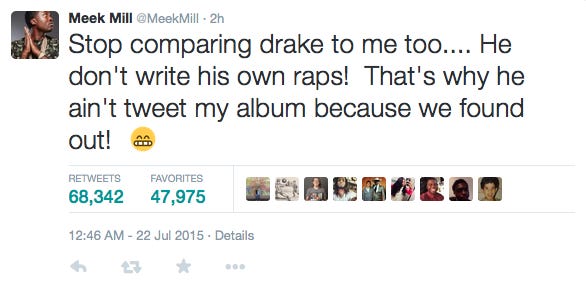
Mill named Quentin Miller and Roscoe Dash. On July 28, Funkmaster Flex broadcast Miller’s reference track for IYRTITL’s “10 Bands” on Hot 97. Additional reference tracks for “Know Yourself,” “Used To,” and “R.I.C.O.” on Meek Mill’s Dreams Worth More Than Money followed. Drake’s response tracks “Charged Up” and “Back to Back,” the latter Grammy-nominated for Best Rap Performance, closed the exchange in Drake’s favor inside the rap industry. Critics widely judged Meek Mill’s “Wanna Know” as lackluster.
Miller publicly stated he was proud of the collaborations but could not “take credit for anything other than the few songs we worked on together.” He has separately stated that he received no publishing income from the work owing to a Tricky Stewart publishing contract he was locked into through 2019.
Drake’s most candid public position appeared in The FADER’s September 2015 cover interview with Leon Neyfakh:
‘I need, sometimes, individuals to spark an idea so that I can take off running,’ he says. ‘I don’t mind that. And those recordings—they are what they are. And you can use your own judgment on what they mean to you.’
‘There’s not necessarily a context to them,’ he adds, when I ask him to provide some. ‘And I don’t know if I’m really here to even clarify it for you.’ […]
‘If I have to be the vessel for this conversation to be brought up—you know, God forbid we start talking about writing and references and who takes what from where—I’m OK with it being me,’ he says.
Miller’s reference tracks had shaped four songs on If You’re Reading This It’s Too Late and one on Meek Mill’s Dreams Worth More Than Money; PartyNextDoor’s reference-track work followed on “Legend” and “Mob Ties.” The model is now standard across major-label hip-hop. Critics in 2015 used “ghostwriter” and “authentic” as the available terms; the evidence fit neither if you’ve ever peeked behind the curtain.
What a Time to Be Alive, the joint mixtape with Future, came together in six days at Metro Boomin’s Atlanta studio and debuted at #1. The partnership tested the regional-collaboration approach Drake would later apply to dancehall, Jersey club, and Afrobeats. Views delivered the verdict: 1.04 million first-week units; 13 weeks at #1 on the Billboard 200. “One Dance” with Wizkid and Kyla peaked at #1 in 15 countries, spent 10 non-consecutive weeks atop the Hot 100, became on December 16, 2016 the first song ever to cross one billion Spotify streams, and made Wizkid the first Nigerian artist credited as featured on a Hot 100 #1. Views gave Drake a then-record 20 simultaneous Hot 100 entries, breaking The Beatles’ 14, held since April 11, 1964.
Nielsen Music’s 2017 Year-End Report, relayed by Billboard’s Keith Caulfield on January 3, 2018, recorded: “The R&B/hip-hop genre represented 24.5% of all music consumption in the U.S.—the largest share of any genre and the first time R&B/hip-hop has led this measurement for a calendar year.” Drake topped Nielsen’s overall artist list that year, the biggest individual driver of the shift.
iLoveMakonnen, on the extraction side, told The FADER in March 2017 about his OVO Sound tenure:
Can y’all tweet out my mixtape? Can I get a feature? Can I get production?
No, no, no.
So I’m just over here in prison?! Am I in prison?!!
Wizkid kept working with Drake after “One Dance.” He landed an international touring base and a Sony Music Africa flagship deal, and the collaboration carried into 2024. The Jamaican dancehall case was more complicated. Drake leaned into Mavado, Beenie Man, and Popcaan across Views; Vybz Kartel, whose Patwa phrase “more life” Drake would later use as the title of his 2017 playlist-album, had been in custody since 2011, was convicted on March 13, 2014 and sentenced to life on April 3, 2014, and remained imprisoned until the UK Privy Council quashed his conviction on March 14, 2024. He was released July 31, 2024 after Jamaica’s Court of Appeal declined to order a retrial.
Drake’s playlist had banked seven years of streams by the time Kartel walked out.
A Single Slab of Black Marble
More Life released on March 18, 2017 as “A Playlist by October Firm.” 22 tracks, 81 minutes. Features pulled from UK road-rap (Giggs, Skepta), London soul (Sampha, Jorja Smith), and Atlanta trap (Quavo, Travis Scott, 2 Chainz, Young Thug)—three regions on the credits before the first track plays. More Life named the format streaming had already been releasing without one: long, curated, multi-mood drops that acted as playlists rather than albums. The FADER’s Duncan Cooper, MIDiA Research’s Mark Mulligan, and NPR’s Sidney Madden all clocked it at release.
Drake names two facts about the playlist inside his own verses on it. The closer, “Do Not Disturb,” credits the producer by name:
Steady doin’ double shifts
1da doin’ the beat and I open up like a double click.
Boi-1da credited inside Drake’s verse on the playlist’s last track. “Nonstop” would make the same move a year later at higher volume. Track five, “Get It Together,” is produced by South African house veteran Black Coffee, features UK soul singer Jorja Smith on lead, and closes with a Burna Boy outro carrying the project’s borrowed title phrase:
[Outro: Burna Boy & Drake] Hold one vibes
Pree more life
Cuh we ah pree more life
Dun know already, cus’.
The track puts South African house, UK soul, Nigerian Afrobeats, and Toronto rap together. For Black Coffee, who had spent two decades inside South African house, “Get It Together” was the production credit that put him on a US chart project. Jorja Smith’s lead vocal was her first major Drake feature. The “more life” phrase, borrowed from Vybz Kartel’s Patwa, returned through Burna Boy’s voice.
After More Life, rap albums started releasing as playlists. More Life was followed by Scorpion (the first album streamed more than one billion times in its release week; 745.92 million on-demand streams), Certified Lover Boy (opening with 743.67 million streams and placing nine of the Hot 100’s top 10 simultaneously), and For All the Dogs. Four of the top five largest streaming debut weeks ever, as of late 2023, were Drake albums. The long-runtime deluxe-reissue surprise-drop pattern was optimized for Spotify’s and Apple Music’s payout math (I’m looking at you, K-pop).
Pusha T released “The Story of Adidon” on May 29, 2018, two days into the Scorpion press cycle. The track explicitly named Adonis Graham, a son Drake had not publicly acknowledged. The cover art used a 2007 photograph of Drake in blackface, shot by David Leyes on Drake’s concept; the clothing was from Toronto streetwear brand Too Black Guys’ “Jim Crow Couture” line, though Too Black Guys founder Adrian Aitcheson has publicly clarified the shoot was not a Too Black Guys campaign. Drake’s Instagram statement of May 30, 2018:
This was not from a clothing brand shoot or my music career. This picture is from 2007, a time in my life where I was an actor and I was working on a project that was about young black actors struggling to get roles, being stereotyped and type cast.
Drake framed the image as part of a commentary on Black casting stereotypes. Pusha’s follow-up question, on The Breakfast Club: “I really need to understand what makes you take a photo like that. I’m not ready to excuse that. This isn’t so long ago.”
Adonis Graham was born October 11, 2017. Scorpion tracks “Emotionless” and “March 14” acknowledged paternity. “Emotionless,” verse two:
I wasn’t hidin’ my kid from the world
I was hidin’ the world from my kid.
The verse continues:
I’m exhausted and drained, I can’t even pretend
All these people takin’ miles when you give ’em an inch
All these followers but who gon’ follow me to the end?
I guess I’ll make it to the end and I’ma find out then.
Hanif Abdurraqib, in his July 2, 2018 BuzzFeed News piece “Drake Is Tired Of The Intimacy That Made Him Famous,” read the Scorpion verses as the moment the mode became labor: “Drake sold intimacy and accessibility for as long as he could. Then, when he seemingly stopped believing in those things in his own life, he appeared to just stop working toward anything else.”
On the album’s track two, “Nonstop,” Drake names who runs the operation in plainer terms than anywhere else on record:
Future took the business and ran it for me
I let Ollie take the owl, told him brand it for me
I get 2 million a pop and that’s standard for me.
Pusha T appeared on the Joe Budden Podcast in October 2018 and named the source of the Adonis information not as Kanye West, the prevailing public assumption, but as Noah “40” Shebib’s romantic partner—the details walked from 40's studio to his pillow to Pusha's verse. The attribution has been verified across Billboard, Rolling Stone, The FADER, and Vice. Drake conceded the loss on the Rap Radar Podcast in late December 2019: “warranted my first quote-unquote ‘loss’ in the competitive sport of rapping.”
Drake and Scooter Braun co-led the Series A funding round for 100 Thieves (the esports organization founded by Matthew “Nadeshot” Haag) on October 23, 2018, alongside Cleveland Cavaliers chairman Dan Gilbert and Sequoia. Earlier that year, on January 17, Drake and MLSE had announced Welcome Toronto, a $3 million CAD partnership. He spent $6.7 million on Park Lane Circle and $100 million-plus on Luna Luna.
DreamCrew, Drake’s production company co-founded with manager Adel “Future the Prince” Nur, hired Endeavor Content partner Mark Ankner as CEO. In 2022, DreamCrew acquired the 44 shipping containers of Luna Luna. The DreamCrew + Live Nation co-led production investment exceeded $100 million per NPR.
Drake on “Dust”:
I’m with the mob at Graycliff, twenty cigars and they fuckin’ my eyes up
I am not better or wiser, Future the Prince is my trusted advisor
The 21 Park Lane Circle estate (“the Embassy”) was purchased on September 30, 2015 for $6.7 million through Nova Scotia Company. Drake demolished the existing bungalow and commissioned Ferris Rafauli, the same designer who had built the Sher Club, to construct a 50,000 sq ft Beaux-Arts / Art Deco hybrid. Architectural Digest’s May 2020 cover feature, photographed by Jason Schmidt, catalogued the materials.
The bathtub is carved from a single slab of black marble.
On UMG’s Q1 2022 earnings call (May 3, 2022), Lucian Grainge confirmed an “expanded portfolio” partnership with Drake covering recordings, publishing, merchandise, and visual media. Variety reported the deal at “close to $400 million,” corroborated by Drake’s own lyrics on “Lemon Pepper Freestyle” the year prior:
360 upfront, it all comes full circle.
Drake also signed his brand-ambassador deal with the crypto-gambling platform Stake.com in 2022. The UMG re-up and the Stake endorsement funded the post-2022 catalog; the Stake deal ruptured in August 2025, and the UMG deal became the subject of defamation litigation over “Not Like Us.”
Honestly, Nevermind released on June 17, 2022 as a surprise drop, executive produced with South African house producer Black Coffee, with Gordo (the former Carnage) as the central in-house collaborator. The Newark Jersey-club move on “Sticky” and “Currents” used the genre’s signature triplet-kick pattern without crediting Newark originators. In Grant Rindner’s June 30, 2022 piece for The Ringer, Newark Jersey club producer Jayhood put it to Rindner:
You can tell that it was more so imitated as opposed to getting it from the actual source, because if he would’ve gotten it from someone from Baltimore or Jersey, you would hear the full-on sound the way it was supposed to sound.
Rindner pins the line to Drake’s 2017 DJ Khaled collaboration “To the Max”; it sits inside his broader Honestly, Nevermind frame. The 2022 case extends a 2017 pattern. Bandmanrill, the Newark artist most identified with the Jersey drill/club fusion, was not credited. R3LL, a Jersey producer, released an unofficial remix of the album within two hours.
The Beef
For All the Dogs (October 6, 2023) opened with 514.01 million on-demand streams in its release week. “First Person Shooter,” the J. Cole feature, included Cole’s verse naming “the big three”:
Love when they argue the hardest MC
Is it K-Dot? Is it Aubrey? Or me?
Six months later, on March 22, 2024, Future and Metro Boomin’s We Don’t Trust You released. The third track, “Like That,” carried Kendrick’s verse:
Motherfuck the big three, nigga, it’s just big me.
Kendrick was rejecting Cole’s “big three” framing, not naming Drake specifically.
The 16-day exchange that followed spanned eight diss tracks between April 13 and May 5, 2024. Drake’s April 19 “Taylor Made Freestyle” used AI-generated vocals of 2Pac and Snoop Dogg, including the 2Pac line “Talk about him likin’ young girls, that’s a gift from me.” Kendrick’s “Not Like Us” opened: “Say, Drake, I hear you like ’em young.”
“Not Like Us” debuted at Hot 100 #1 on the chart dated May 18, 2024 with 70.9 million U.S. streams, 5 million radio impressions, and 15,000 sold in a five-day tracking window: the first rap song ever to top the Hot 100 with a shortened five-day week. It crossed one billion Spotify streams in roughly 249 days, the first diss track ever to do so, and topped the Hot 100 in three separate windows. On February 2, 2025 it won all five of its Grammy nominations.
On February 9, 2025 Kendrick performed “Not Like Us” at the Super Bowl LIX halftime. Fox Sports reported 133.5 million viewers, the most-watched Super Bowl halftime show in history. Samuel L. Jackson appeared as “Uncle Sam”; SZA performed “Luther” and “All the Stars”; Serena Williams crip-walked through the chorus.
On January 15, 2025, Drake had filed suit against UMG, not Kendrick, in the Southern District of New York for defamation, harassment, and violation of New York General Business Law Section 349. The complaint alleged that UMG had “decided to publish, promote, exploit, and monetize allegations that it understood were not only false, but dangerous.” UMG’s motion to dismiss called the suit “no more than Drake’s attempt to save face for his unsuccessful rap battle.”
On October 9, 2025, Vargas granted UMG’s motion to dismiss: “the allegedly defamatory statements in ‘Not Like Us’ are nonactionable opinion.”
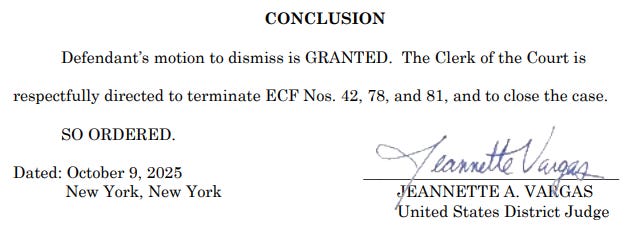
The ruling situated the lyrics inside the forum doctrine of rap diss tracks, characterized as analogous to opinion columns or YouTube comments—forums where the audience anticipates “epithets, fiery rhetoric or hyperbole” rather than verifiable factual claims. The page-28 finding was load-bearing: Drake had prompted the very accusation he sued over. The Yale amicus brief reads the finding as consent.
Some Sexy Songs 4 U, Drake’s joint album with PartyNextDoor, debuted at Billboard 200 #1 with 246,000 album-equivalent units and 287.04 million on-demand streams: the largest streaming week of any album in 2025. Drake’s 14 #1 Billboard 200 albums tied Jay-Z for the most by a male soloist; Taylor Swift broke any tie in October 2025 with The Life of a Showgirl, her 15th #1. Per the RIAA’s April 8, 2025 Chart Data tweet, Drake became the first artist in American music history to surpass 500 million certified record-units across albums, singles, and features.
Billboard’s 2025 year-end rap-touring ranking gave the top spot to Kendrick Lamar & SZA’s Grand National Tour, which grossed $369.6 million across 42 shows and 1.9 million tickets, overtaking Drake’s It’s All A Blur tour ($320.5 million / 1.3 million tickets) as the highest-grossing hip-hop tour of all time.
Kendrick hasn’t spoken publicly about Drake since “Not Like Us” finished its third Hot 100 run in February 2025. GNX released through UMG’s Interscope—the same UMG distributing Drake on the other side of the appeal—and debuted at Billboard 200 #1 with 319,000 first-week units, the year’s sixth-largest debut frame per Billboard. The Vargas ruling treats the “Not Like Us” pedophile accusation as nonactionable opinion under the diss-track forum doctrine. If the Second Circuit affirms, that ruling also survives Drake’s appeal.
The Trilogy
On May 15, 2026, Drake didn’t freeze the world, but he probably made a few people in glass offices pause mid-nightcap and check their phones twice.
Iceman debuted at #1 on the Billboard 200 with 463,000 equivalent units, Habibti at #2 with 114,000, and Maid of Honour at #3 with 110,000. The first time ever for an artist of any genre.
ICEMAN
The Michael Jackson glove which Drake—now 39—had acquired for roughly $120,000 per Sibanee Gogoi at Mandatory, graced the cover that tied Michael Jackson for Hot 100 #1’s.
“Make Them Cry” opened without warning, on the family role-reversal:
I’m an only child, no one could’ve made another
I have to father my mother and treat my son’s grandfather like my older brother.
With a mention of 40, then a response to the beef:
Feel like 40 won’t even listen to my words when he knows I’m in a load of trouble. […]
What died back in 2024 was a big piece
So it’s like, this shit is me, but it isn’t me
Y’all keep on asking me what it did to me, that’s what it did to me. […]
Fuck it, I’ll battle the label
Fuck it, I’ll battle the majors, I’ll battle the stations ’til my ass is back in rotation.
The label fight had been there since So Far Gone.
On Nothing Was the Same’s “From Time,” Drake had said what he was looking for:
I want to get back to when I was that kid in the basement
I want to take it deeper than money, pussy, vacation.
It took him 13 years to get it back on Iceman’s opener.
One line claims Drake’s father has cancer (“My dad got cancer right now, we battlin’ stages”). Dennis Graham, tracked by paparazzi outside Bar Jubilee in West Hollywood the same day Iceman dropped, told TMZ and Billboard on May 15, 2026: “No, that was a while back. I’m OK now. I’m wonderful.”
“Janice STFU,” built around an interpolation of Lykke Li’s 2011 single “I Follow Rivers,” overtook “Make Them Cry” as the trilogy’s streaming favorite by Saturday and projected to debut atop the Hot 100. Their friendship goes back just shy of two decades.
Variety’s Peter A. Berry called Iceman “theatrical, nakedly transparent and relentlessly vindictive.” Pitchfork’s Jayson Greene—a review that observed the artist far more than the album’s contents—gave Iceman 4.8 out of 10.
Iceman isn’t a comeback record. It feels like a catalog memorial, made in real time by someone who knows the thing that built him isn’t fully available to him anymore. He still reaches for it—the cadence, the looseness, the old way of sliding into a pocket no one else could (more on that in 40’s interview with Pensado’s Place)—but it doesn’t land the same. Not because he’s stopped trying, but because you can hear the effort.
What used to feel weightless has friction in it. The record isn’t about getting back to a peak, it’s about standing next to it and trying not to look away, reconciling with the fact that you’re not quite there anymore. On the album’s opener “Make Them Cry”:
I'm 'bout to turn 40, dog, I'm battlin' agin'
More than anything, 20 years into his career, Drake is a curator.
The opener goes back to From Time’s basement 13 years later. “Whisper My Name” echoes the per-show fee from “Started From the Bottom”—“half a million for a show” in 2013—inverted to the price of skipping a dinner: “I’ll take 500K, not the dinner, I never could learn shit from none of y’all.”
$500,000 in 2013 was the going rate to put Drake on stage; in 2026 it’s what he charges to stay off it. “Firm Friends” reconstructs the 2010 roll-call—nine handles cited across So Far Gone, Thank Me Later, and Take Care—shrunk to one name sans Chubbs (“Chapo”) on “Burning Bridges”: “Look at me and Neeks for instance. Twenty years passed, he’s still the same guy.” “Make Them Cry” returns to the family register the catalog has been documenting since “Successful” in 2009.
The four “Make Them” imperatives are the curator’s labels:
“Make Them Cry” opens
“Make Them Pay” weaponizes the catalog
“Make Them Remember” puts Lucian Grainge in possessive form—“I’m the golden goose, shakin’ things up at Lucian’s house”
“Make Them Know” closes
Drake spent 17 years building a kind of army out of listeners—people who showed up for every drop like clockwork, soldiers in tandem posted at different points in his catalog, waiting for the next signal to glaze. Iceman sorts them. Others have already drifted out of formation without announcing it, somewhere back around Take Care or Views, just quietly gone. Then you realize he’s not counting who stayed. He’s tracking who left—and somehow, that’s where the story’s been the whole time.
“Lemon Pepper Freestyle” had named the 2022 UMG deal a year before it closed: “360 upfront, it all comes full circle.” The trilogy is the museum closing for the public so the curator can finish hanging the labels.
A groom in Florida named Adler Marchand walked down the aisle to a custom remix of “Not Like Us” on March 1, 2025, in front of 206 guests at the Hilton Miami Aventura. His sister’s TikTok of the entrance cleared 18 million views; fittingly, the groom wore a glaze-colored suit.
“Make Them Know” closes the album with Drake’s own voice on the question the critics had been asking for 15 years:
What happened to Drake from 2009
When all of the moments was intimate?
What happened to Drake with the innocence?
I don’t think we’ll be seein’ him again.
حبيبتي
The first line of audio is Drake’s, on “Rusty Intro,” over DJ Frisco954 production and “The Parting Glass” under it:
It’s been a while though, I’m a little rusty, I’m a little rusty.
The man who turned a drunk call into a genre on “Marvin’s Room” is 39 now, and it opens like a quiet confession that the line’s frayed—the same parasocial wire he built is finally starting to crack where it first connected.
On “White Bone,” he sketches a domestic fantasy like he’s walking through a house still under construction—white dress, wine stains, limestone plans, a Clydesdale idling in the driveway, Scottsdale half-joke, half-vision. It moves like Vincent Vega in Mia Wallace’s house in Pulp Fiction—quietly drifting room to room, taking inventory of a life that isn’t fully his yet, but already feels lived in.
Then it breaks:
Someone please take my phone away from me.
The interior is a U.S. tour-bus diary that names Little Rock, New Haven, Fisher Island, Sulphur Springs, Scottsdale, the Bahamas, JFK, LA, Las Vegas, and the Ninth Ward. “Fortworth” has Drake getting booked in “places where they probably still fly the Confederate” and counting La Quintas out a tour-bus window with the AC broken: “I’m all alone in the United States of America.”
Maysa Mustafa, in New Lines Magazine:
…a pattern of a proximity to Arabness that’s part of a broader branding strategy that allows him to move seamlessly through different cultures and aesthetics without having to commit to any.
Arabness slips into the same rotating map More Life was already moving through—UK road-rap, Atlanta trap, Jamaican dancehall, Newark Jersey-club. Habibti doesn’t bother hiding the method anymore; the plans are left out on the counter like it’s part of the kitchen now. What once looked like curation has settled into habit. The aesthetic is worn-in, almost lived-in, but fully fluent. Drake isn’t reaching for places anymore—he’s working through them. It’s Tuesday, and the club’s still going up.
Qendresa, the Kosovar-Albanian singer Drake credits on “Slap The City,” gets the only female lead vocal on the album that isn’t Sexyy Red. Her chorus is the only Balkan ethics statement Drake has ever shipped: “Loyalty is everything where I’m from / That’s why I don’t play around / I’m either in or I’m out.” Drake goes on to name Queen’s University and the dating apps by company. The most location-locked verse on the album titled Habibti is a Toronto dating-economy report.
The catalog’s elder collaborators show up smaller in the frame. PARTYNEXTDOOR—fresh off Some Sexy Songs 4 U three months earlier—lands on “Fortworth” not as a feature so much as a familiar fixture, rebuilding the same chorus scaffolding he and Drake were already passing back and forth on the joint record. No introduction, no recalibration. Just the sound of two people slipping back into a routine they never really left: “Don’t let your friends turn you against me / And convince you the time that we spent / Wasn’t worth nothin’.”
The Habibti frame is seemingly cosmetic; the interior co-writer is unchanged from $$$4U. Lil Wayne shows up in the same song as a liquor delivery: “Tunechi got some drank and I might help myself.” No Wayne verse, no Wayne credit, no Wayne tag. The mentor whose 2009 phone call closed the Cash Money signing is the name attached to the bottle on the tour bus.
“Gen 5” opens its verse with a Christmas gift from Dennis: “Swear my daddy got me a Christmas gift / It’s a Gen 5 and that bitch is modified.” Across Take Care, Scorpion, and Certified Lover Boy, Dennis Graham showed up as bourbon, blues, and Memphis paternity. On Habibti he’s the source of a modified Glock.
“High Fives,” track four, folds the album’s emotional thesis into a club-rap shell: “I’m so loved and I’m so hated, so conflicted, I’m so jaded. Come back to the crib, first night, baby, nobody’s judging.” It’s the whole record in one breath—adulation and exhaustion sharing the same air, no separation left between them.
Then “Prioritizing” closes on Terry Fox—“They want me on my last leg, some Terry Fox vibes”—and suddenly it’s not inspiration, it’s something colder. The Canadian kid running across an entire country on a prosthetic while his body is giving out becomes less a symbol than a warning sign that endurance itself can turn into compulsion. The album opens on a slightly cracked drunk-dial. It ends there too, but now it sounds like something refusing to stop moving even after it probably should have.
“Life right now is terrifying.”
Drake framed the Habibti release on the Iceman: Episode 4 livestream:
I made this so that I could make this.
A love letter to Maid of Honour, it points to a quieter truth underneath all of it—that nothing here exists on its own anymore. A step that makes the next step possible, as if the work has stopped becoming a destination and has become its own escape route.
MAID OF HONOUR
Maid of Honour is Drake’s only album about the women in his life—not as fable, but inheritance. The women in his life are his mother, his memory of his mother’s marriage, and the partners he didn’t keep.
The cover showed Sandi in a slip and bridal bouquet, holding the photograph of 4-year-old Aubrey with Dennis. Sandi Sher-Graham was from Toronto, the daughter of Reuben Sher, who had owned a furniture factory in which the teenage Drake worked Saturdays. She had rheumatoid arthritis, sometimes bedridden, per Drake’s accounts in Heeb and Complex. She had met Dennis Graham at Club Bluenote in 1983; they married in June 1985, and by the time Aubrey was 5 the marriage was over. Dennis went back to Memphis. Sandi raised the boy alone. Drake to Complex:
She found us half of a house we could live in. The other people had the top half; we had the bottom half. I lived in the basement, my mum lived on the first floor. It was not big, it was not luxurious. It was what we could afford.
Drake opened the Sher Club on the third floor of Scotiabank Arena in May 2015 and carved her parents’ names into the door of the 4,000-square-foot members-only space. His Instagram caption at the opening:
Rest in peace to my grandparents Rueben and Evelyn Sher. My grandmother was the first person to ever play catch with me and my grandfather was the biggest sports fan in the world. I opened this club in the memory of both of you.
The opening track, “Hoe Phase,” begins with Sandi’s voice:
Settling down soon for me, settling down. I don’t want you all over the world no more, you’ve seen all of that stuff. You did enough, it’s time for you to settle down and give me them grandbabies.
“Road Trips” track 2 carries the album’s only parent-voice—and it’s Drake’s, not Sandi’s:
All those nights in my kitchen giving you my advice / I’m supposed to be the one whose heart is made of ice.
Sandi held the kitchen-counsel role in Drake’s childhood. Maid of Honour puts Drake in her chair on the second track.
The album turns toward married women in its middle stretch. “Where’s Your Stuff Interlude” has a woman dismantling the wife-life and “Goose and The Juice” has Drake telling a 10-year girlfriend it’s time: “Ten whole years, you’ve waited for him to be someone new. Take that ring off and move.” Drake at 39 cast himself as the maid of honour because he doesn’t get to be the groom.
The closer, “Princess,” itemizes a partner’s week: “work all week at the Equinox just to complain when I go,” “shop until you drop in Bal Harbour,” and “ten milligrams, twenty milligrams.” The album opened on Sandi asking for grandbabies, then closes on a Bal Harbour pharmacy receipt. The mother asked for a wife and a grandchild. Drake delivered a benzo-prescription girlfriend and a son the album doesn’t name. The album is seemingly the distance between.
Rolling Stone’s Jeff Ihaza, in his May 18, 2026 review called Maid of Honour “the trifecta’s crown jewel” and “Drake’s strongest work since More Life.” He named the album’s regional-genre absorption diasporic maximalism:
…the album’s underlying argument is not that identity no longer matters, but that culture itself has become too unstable, interconnected, and diasporic to survive the authenticity politics that ‘Not Like Us’ briefly restored to the center of rap discourse.
Across the trilogy, Ihaza argued, Drake “reframes Kendrick Lamar’s victory as a symptom of the internet’s increasingly rigid authenticity politics” and “survived it by becoming even more himself”—the strongest pro-Drake critical reading published since Not Like Us.
Pitchfork’s Alphonse Pierre rated Maid of Honour 8.0, a 3.2-point gap with the same publication’s Iceman rating, on records released by the same artist on the same day.
The second-to-last track on Scorpion, “March 14” produced by T-Minus:
I used to challenge my parents on every album
Now I’m embarrassed to tell ’em I ended up as a co-parent.
“God’s Plan”:
She say, ‘Do you love me?’
I tell her, ‘Only partly, I only love my bed and my mama, I’m sorry.’
Now We’re Here
17 years of reinvention stacked until it eventually became maintenance: the playlist-album, the timestamp tracks, the regional pickups from Houston to Lagos to Newark, Honestly, Nevermind’s hard left, For All the Dogs’ deluxe surprise drop, and now the trilogy.
A Lobmeyr Metropolitan chandelier carrying 20,000 hand-cut Swarovski crystals over the foyer of his compound. A Murakami-signed Bösendorfer 280VC grand piano as you walk through the door like the kind of thing a human being could accidentally get used to.
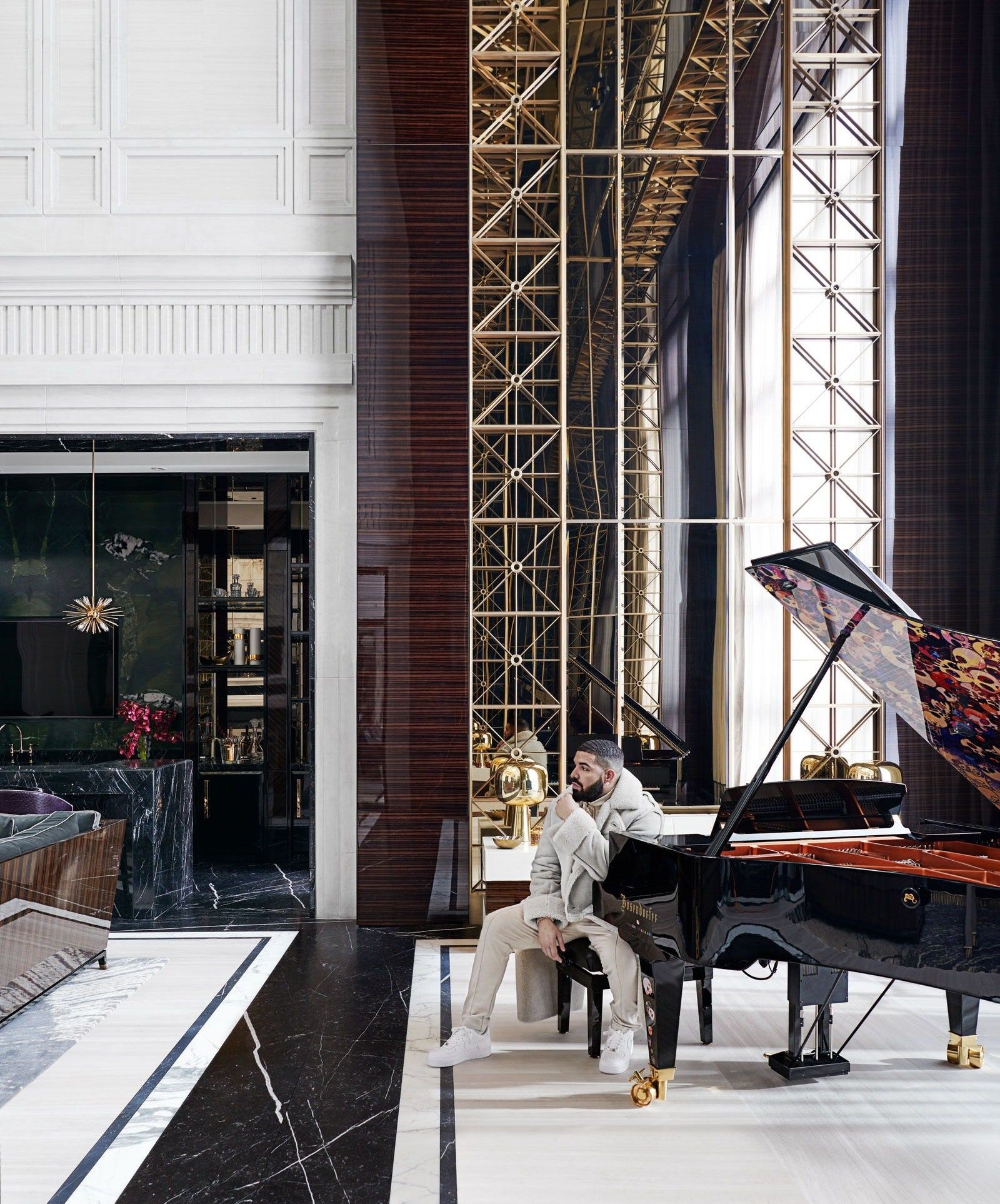
The critics have been writing Drake’s obituary since Take Care dropped in 2011, and it never sticks long enough to publish.
Somewhere inside the trilogy is the sound of a city staying awake later than it should, and the strange comfort of hearing the guy who narrated everybody else’s sleepless 20’s finally starting to sound tired too.
The City and The Boy was always the same map drawn twice: once from a basement apartment in Forest Hill, once from inside a mansion in the Bridle Path.
In 2000, 13-year-old Aubrey “Drake” Graham slept in the basement of a Forest Hill duplex.
In 2026, 39-year-old Aubrey “Drake” Graham lives in a 50,000-square-foot Beaux-Arts manor in the Bridle Path.
Eventually, the distance between them stopped measuring money. Then fame. Then reception.
Now, it’s just time.