
David Choe: The Dirty Saint of Spray Paint
A story of soy sauce, blood, Krylon, stock options, trading cards, and David's long, self-inflicted crawl from his head to his heart.

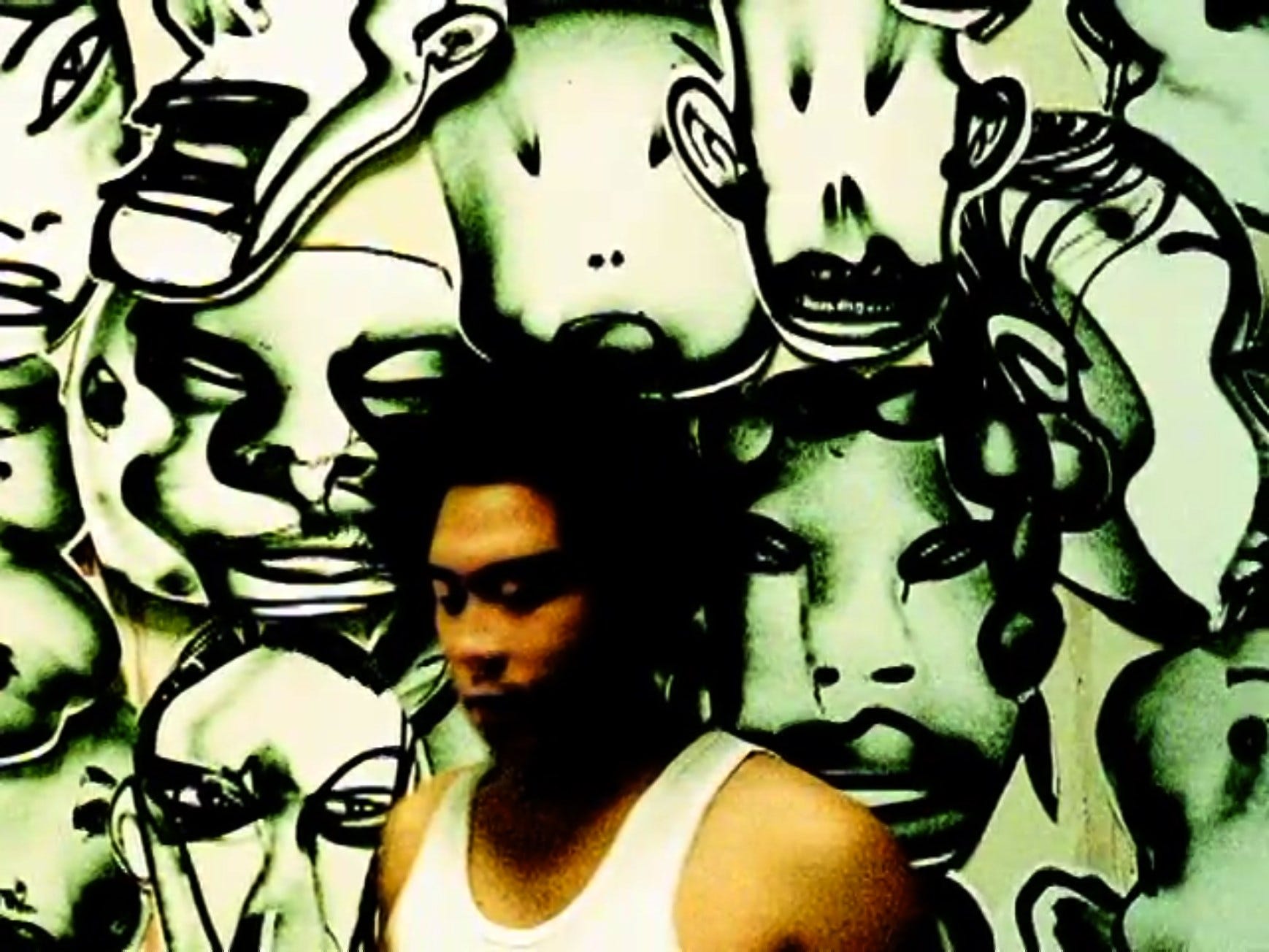
In 20+ years of watching Choe’s career, the radical transparency kept me fascinated—an honesty so unguarded it makes you uncomfortable, and then you realize the discomfort is your own.
This is my attempt at homage, an unfiltered look at, and a thank you to, David Choe.
My first piece in over half a decade.
Happy 50th.
Edit: Thank you David for reading; I appreciate your message.
Everyone is doing their best.
If you like this piece, you may enjoy:
The Immortal Legacy of Seba “Nujabes” Jun

My thanks to Seba Jun’s family and contributors for their trust and support in bringing this piece to life. A very special thanks to Pase Rock, whose invaluable commentary appears throughout.
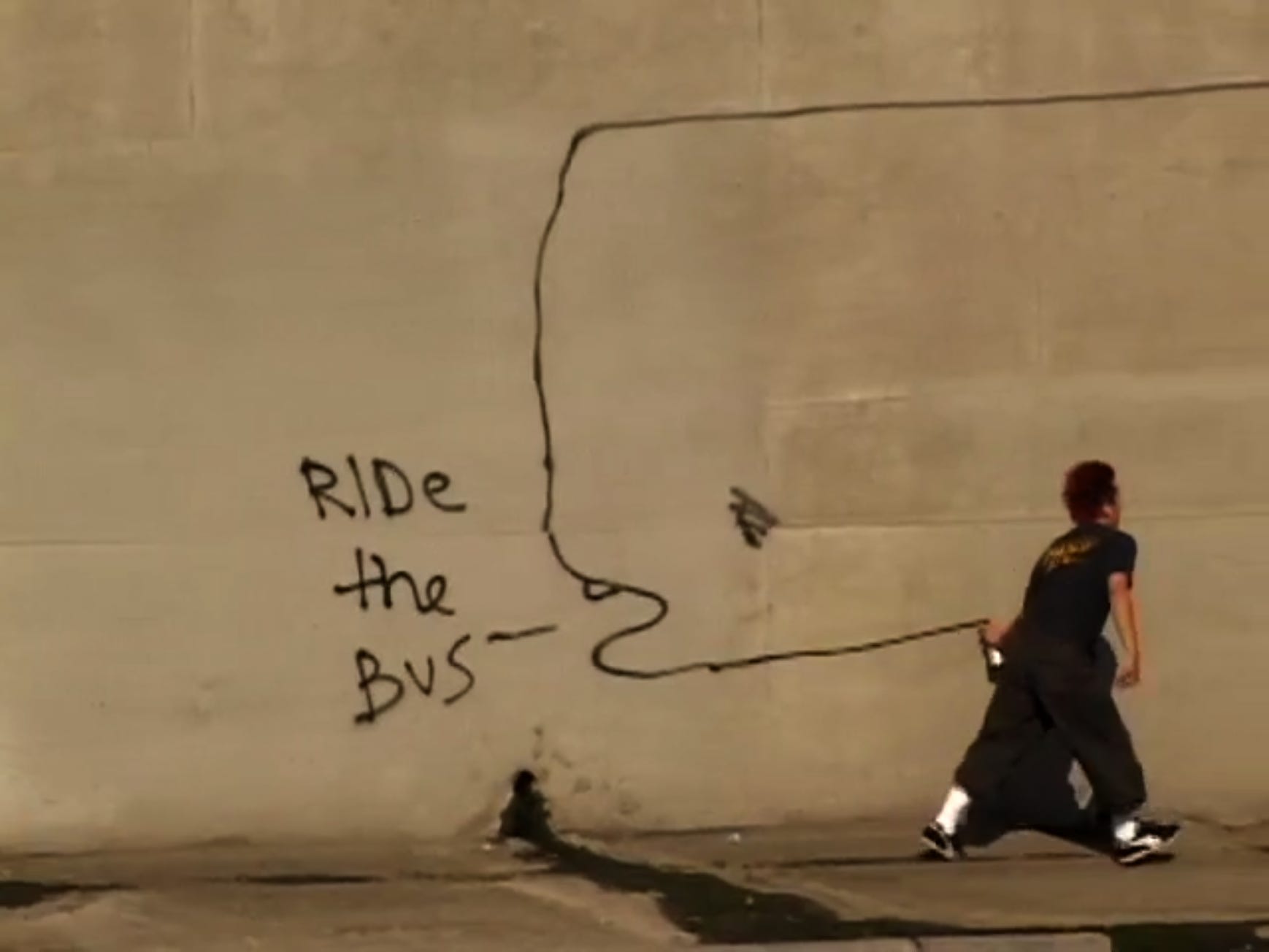
Ride the Bus
An artist worth hundreds of millions of dollars whose auction record is $32,760.
The art world has a ladder: MFA, group shows, galleries, fairs, museums, biennials, and if you’re lucky enough—auction houses. Each step is greased by the people above and paid for by the ones below.
David Choe skipped all of them, got more famous than most of the people still climbing, and the art world dismissed it as a failure, until his work landed in places the art world couldn’t ignore.
Ask Choe how it went down and you’ll get a fantastic story. The details shift; the year moves, the city changes, the girl’s name is different. The host doesn’t catch it because the delivery is so good, and the grin so wide, that you’d rather hear the better version than the true one. FX’s official biography for The Choe Show described him as “a liar, thief, gambler, and unreliable narrator.” His own TikTok bio says the same:
David Choe artist and storyteller
The most unreliable narrator.
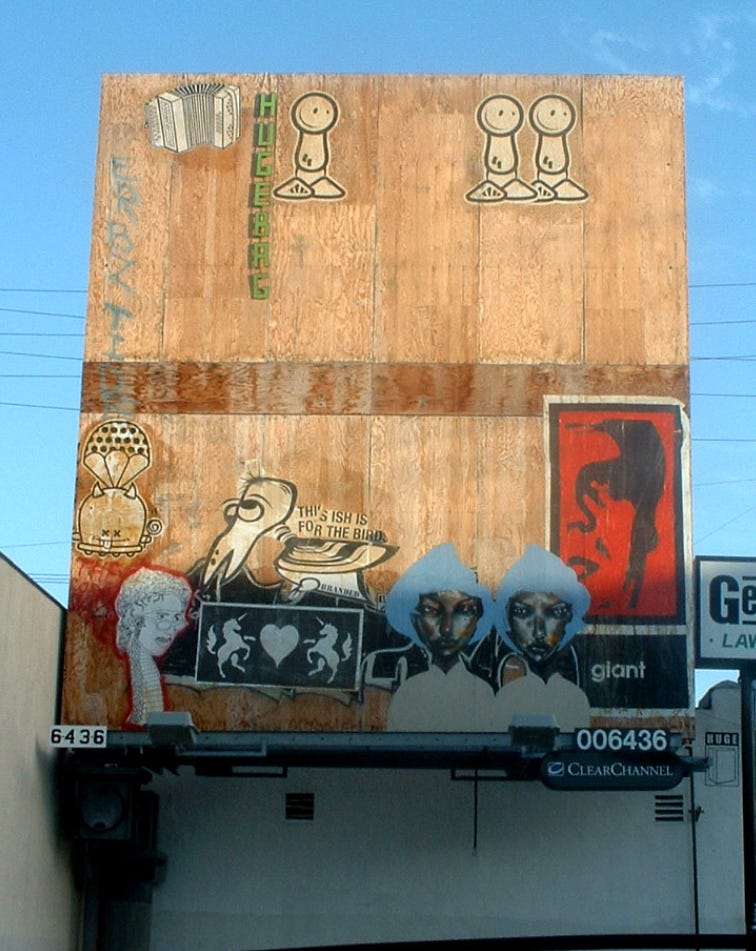
Los Angeles, 1990. A thirteen-year-old Korean kid from Koreatown sprayed John 11:35 on a bus bench with a can of Krylon flat black.
The bench was his first canvas—his family couldn’t afford an actual one. In early-90’s LA, most graffiti writers obsessed over letters: wildstyle tags, bubble scripts, throw-ups with sharp corners. Choe sprayed faces, figures, philosophical quotes, and a grinning, bucktoothed whale with no arms or legs that has stuck for 30 years.
Sa-i-gu
Before the riots, his mother Jane had already begun the brainwashing: a born-again Christian, she named her son after King David, told him at five he was the greatest artist who ever lived. His father Jimmy brought home used Xerox paper from work to use for drawing. Every morning, Choe rode the bus from Koreatown to Beverly Hills; same kid, different planet. One side of the ride, families that couldn’t afford canvases. The other side, a place that didn’t know the word struggle.
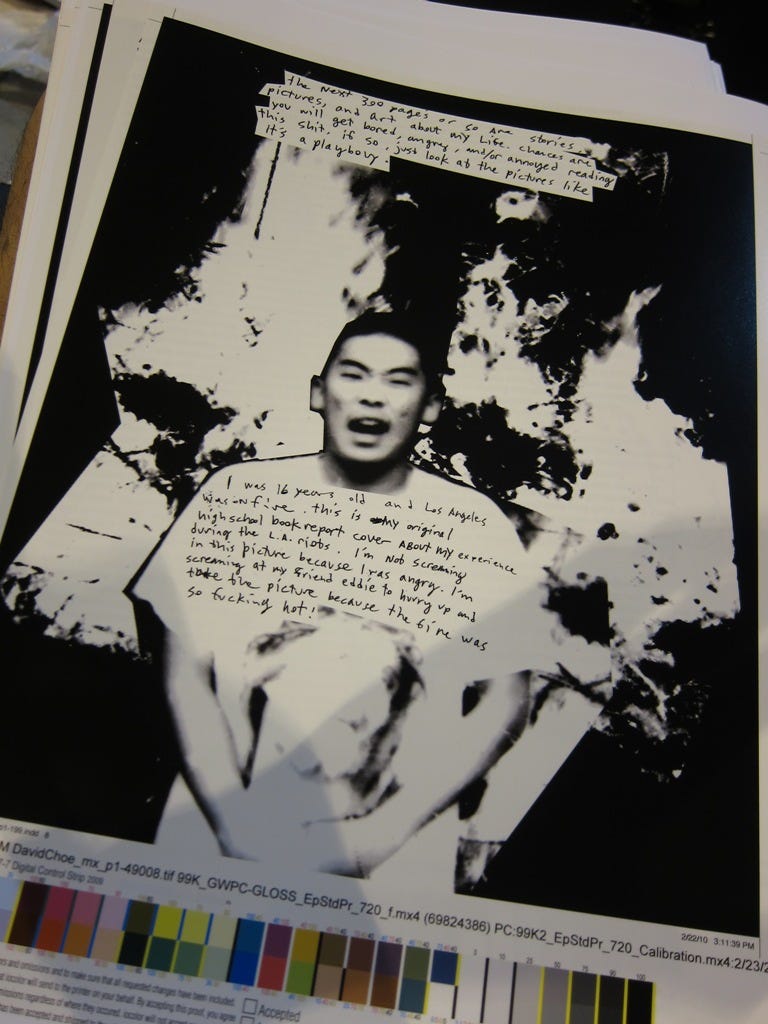
Eight days after Choe’s sixteenth birthday, on April 29, 1992, his brother pulled up to school in a stolen delivery van and they both drove through burning streets, throwing rocks and looting. Their parents’ business burned to the ground. He later wrote in Vice that he and his brother were “the only Koreans that looted during the riots,” and that his own community called him slurs for it.
His family spent the next few years on welfare.
The Barron Draws Himself Awake
A generation of artists who rejected the mainstream illustration playbook traced themselves back to one man: Barron Storey.
Barron Storey had drawn Time magazine covers of Howard Hughes and Yitzhak Rabin, painted NASA’s space shuttle in 1979, illustrated the 1980 cover of Lord of the Flies, and contributed to Neil Gaiman’s The Sandman: Endless Nights.
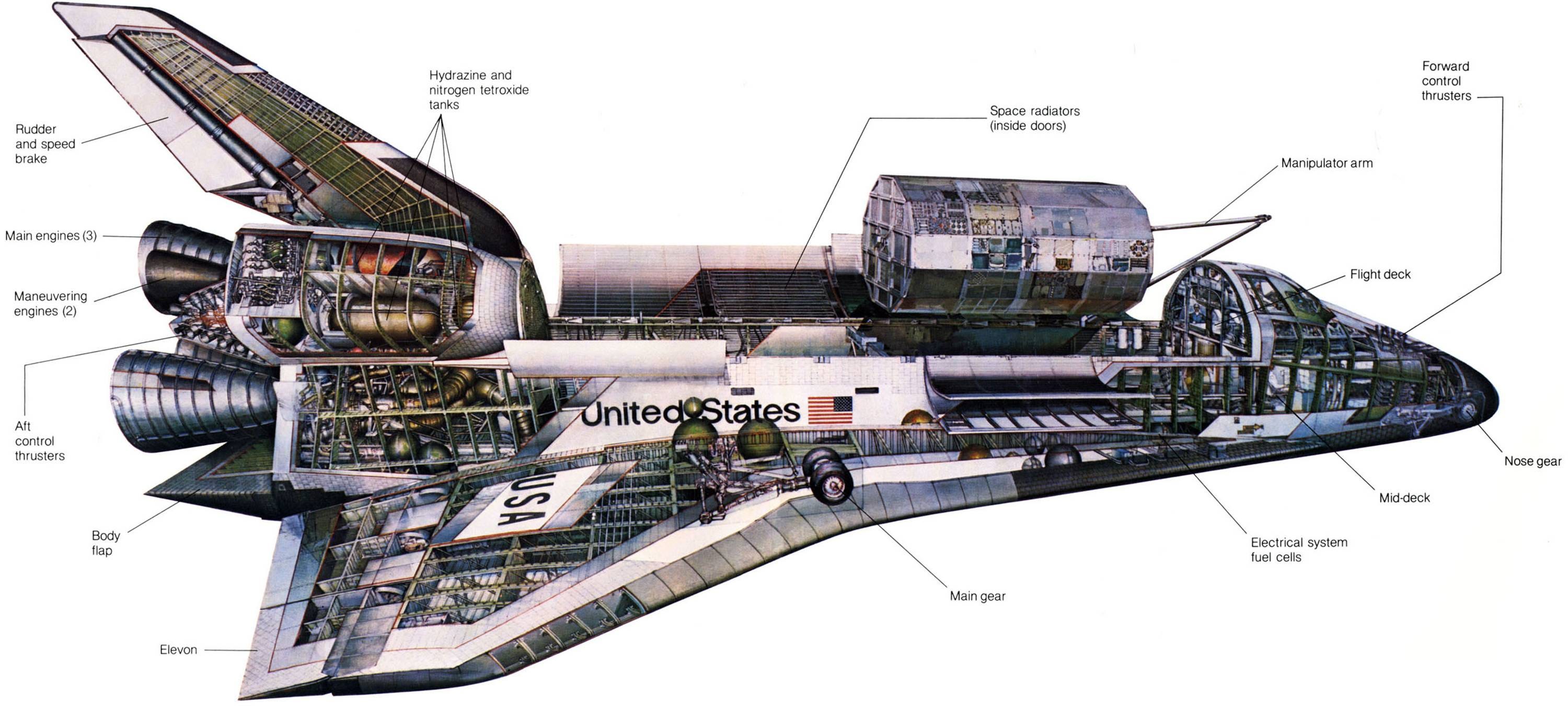
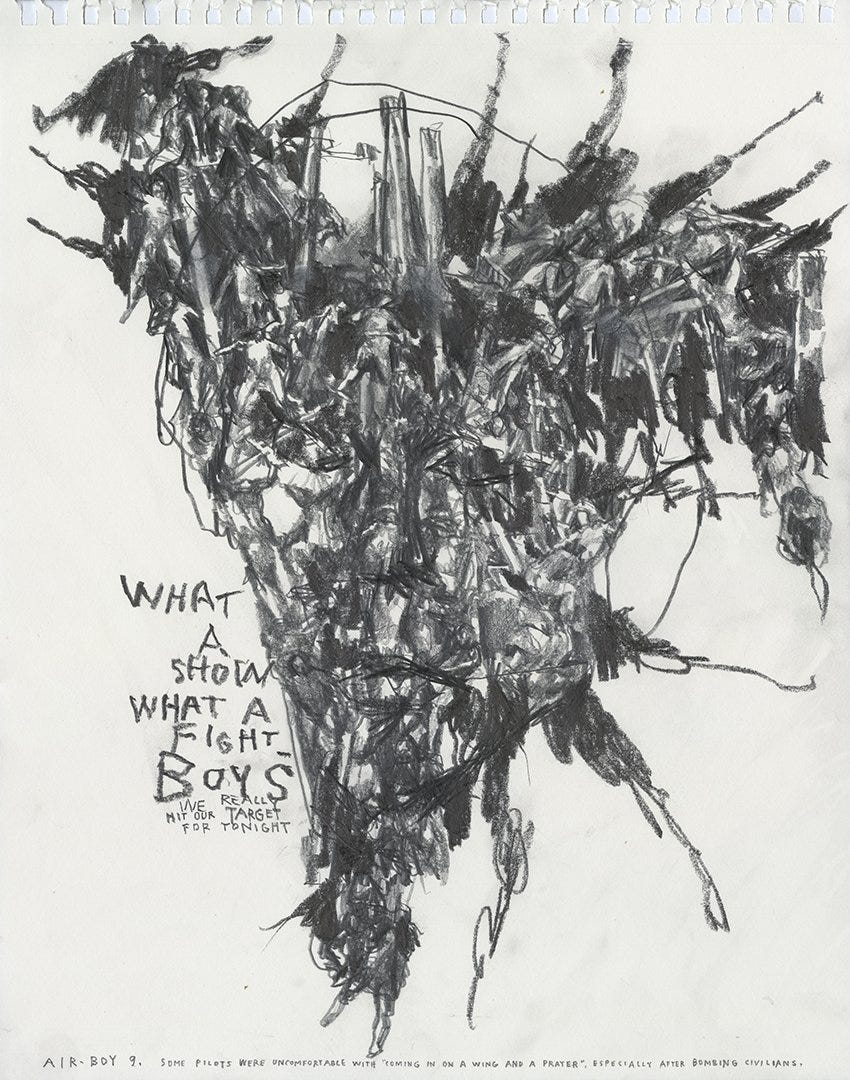
Since 1976, Storey had filled more than 145 visual journals. Pen, paint, collage, photographs, typed text, handwriting, found objects; all layered onto pages that resembled crime scenes more than sketchbooks. His technique, as he described it on the Escape from Illustration Island podcast, was to “draw myself awake” every morning, grabbing his pens the moment consciousness arrived, scribbling whatever floated through his brain. The journals explored human despair, war, homelessness, suicide; powerful, dark, free of anyone else’s opinion about what they should look like.
Choe called him the king. In Slow Jams, Choe’s 1999 graphic novel, he wrote:
Nobody draws better than Barron.
Not you, not your little sister, your architect dad, not your rebellious ex-boyfriend who draws with his own blood, not the most talented kid at your art school.
Not your favorite artist in the whole world; I’ve seen the work with my own eyes.
Nobody draws better than The Barron.
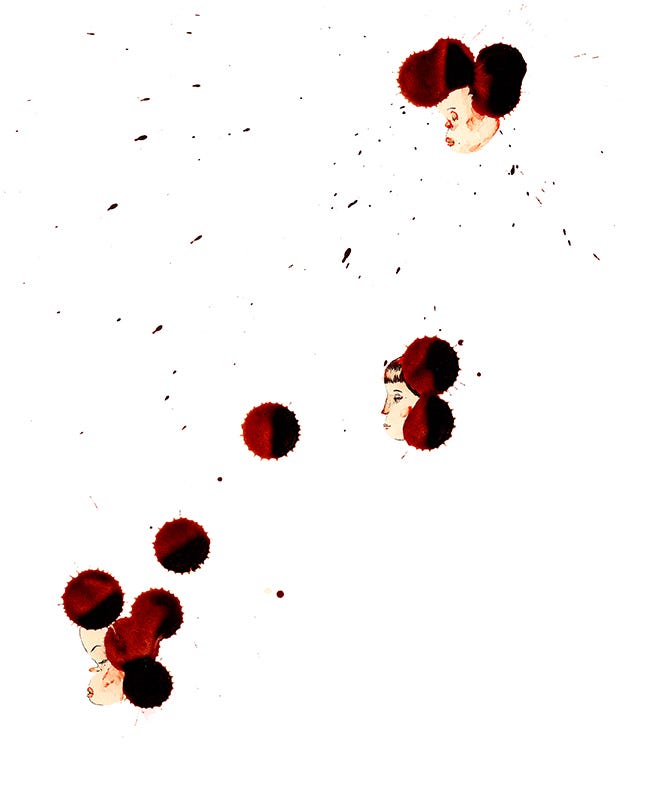
Storey layered pen, collage, and photograph until his pages looked like crime scenes. Choe layered pencil, ink, crayon, watercolor, acrylic, oil, spray paint, house paint, applied wet-on-wet, every surface already marked before the first stroke landed.
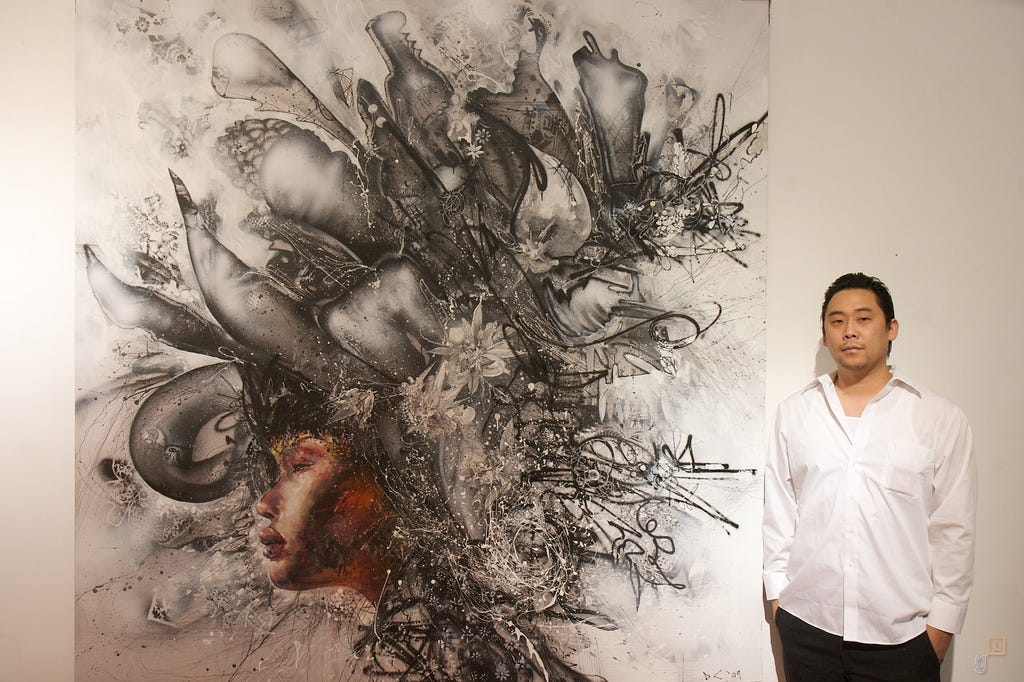
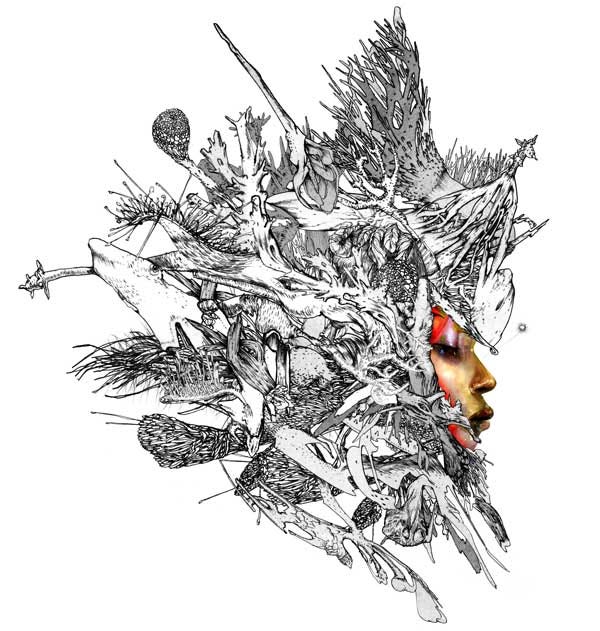
In 2004, Choe began mentoring Joseph Choe (no relation), a Korean-American artist with autism who talks through paint.
Joseph’s parents wrote that David “recognized [Joseph]’s talent and helped cultivate his artistic creativity”—the influence ran both ways.
Choe called Joseph’s work “the most brilliant drawings I had ever seen”; Joseph’s way of processing the world loosened something in how Choe approached paint. The shift is visible in the years after: the watercolors Choe exhibited at the Museo del Chopo in 2013—controlled, precise, trusting the gesture enough to let it breathe rather than layering over it—show Joseph’s influence more than any single technique.
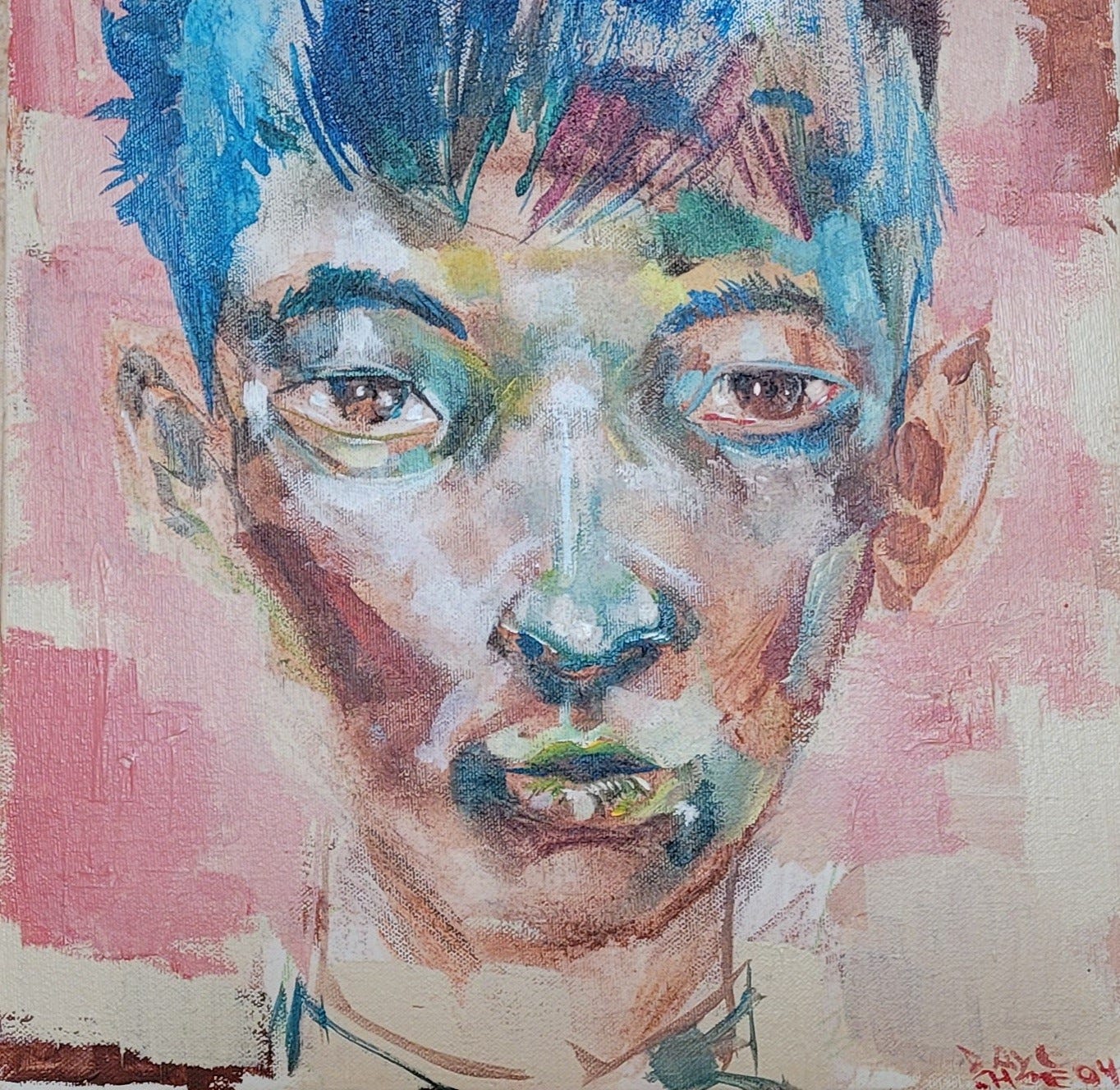
A couple of years under Storey, then he dropped out.
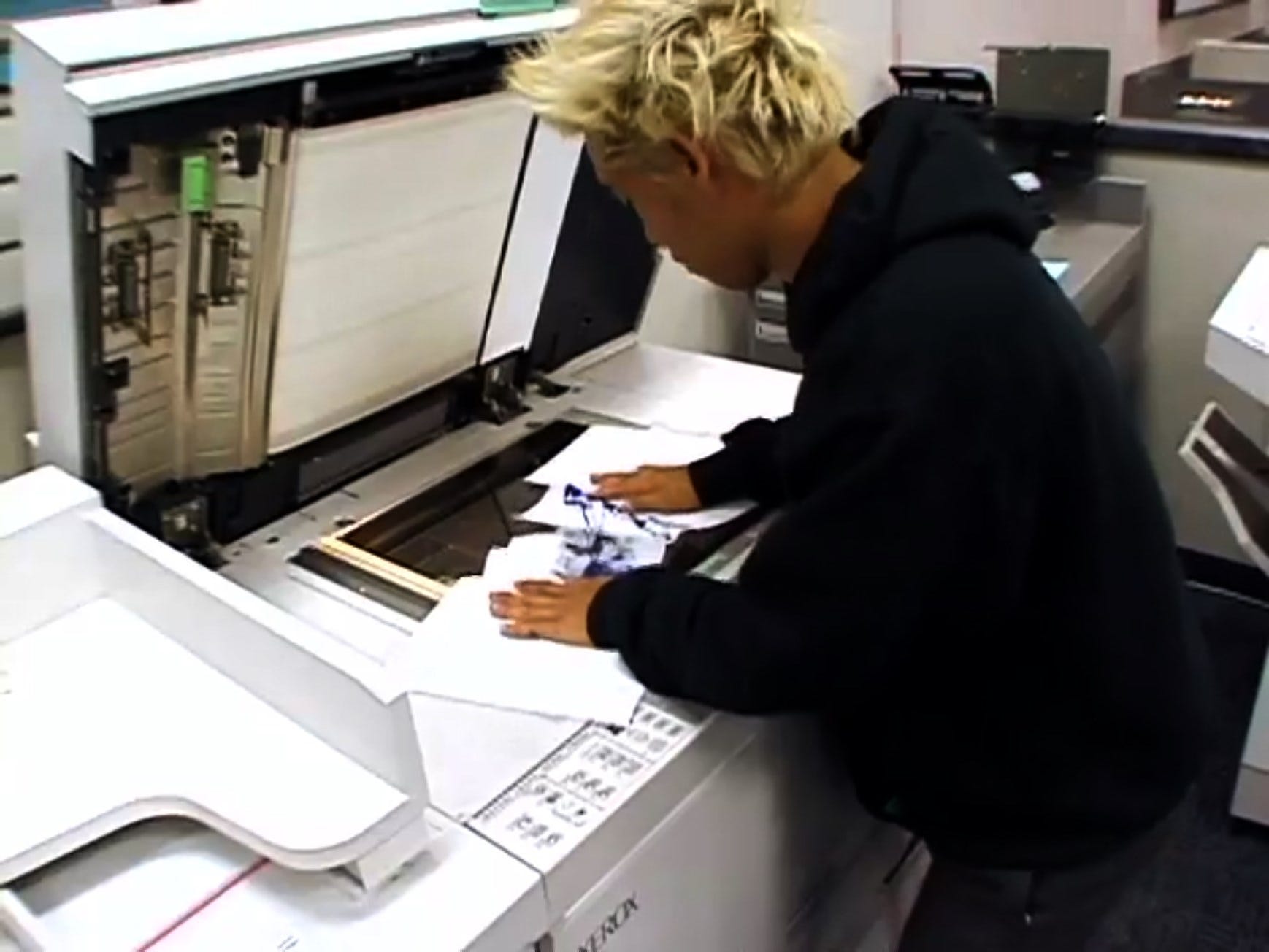
99¢ Copies and a Letter Nobody Forgot
Kinko’s on Vermont charged 99¢/copy. Choe would stand at the self-serve machine, feeding his best paintings through the scanner one at a time, because he couldn’t afford to waste a single sheet on a bad reproduction. He’d walk to the nearest newsstand afterward, flip to the masthead of Rolling Stone, Time, Newsweek, write down the art director’s name and address on a scrap of paper, walk home, and mail the copies with a handwritten note.
Rejection letters came back in the same envelopes he couldn’t afford to replace. Most of the time, nothing came back.
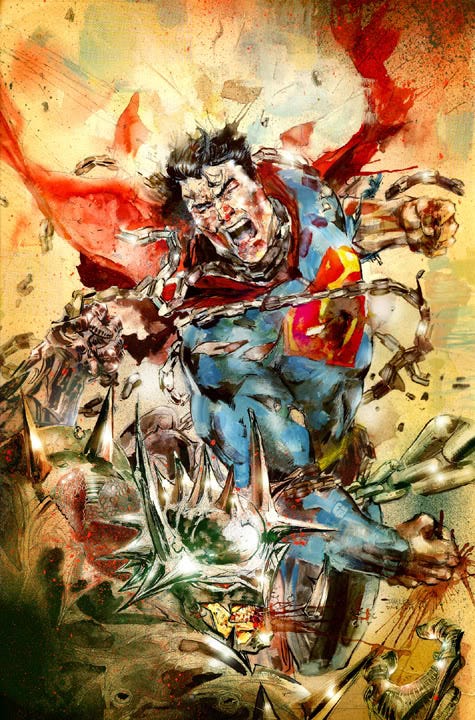
Always fascinated by comics—Jim Lee, Rob Liefeld, Todd McFarlane—he initially dreamed of drawing for the big publishers. He claims he wrote Slow Jams in a single night in 1996: 35 pages of violent sexual obsession rendered in pen-and-ink with typed text pasted over drawings like ransom notes. He photocopied 200 copies, handed them out at San Diego Comic-Con in 1998, won a Xeric Grant of $5,000 to self-publish 1,000 copies in 1999. More self-published books followed: Bruised Fruit (2002), Cursiv (Giant Robot, 2003). Every one self-financed or pulled from inside the community; never pitched to a publisher who didn’t get the joke or context.
Around 2001, he and writer Brian Wood developed NYX for Marvel’s MAX imprint: a mature-readers series about powered-down young mutants surviving in New York City. Marvel’s editor-in-chief Joe Quesada killed it before publication, calling it a proposal never formally approved. Choe wrote an open letter to Quesada—unhinged, profane, emailed to hundreds in the industry—and was blacklisted. Marvel published its own NYX in 2003 with different artists. Choe’s version never existed.
His final instruction for anyone who disagreed with him:
This is what I do for a living and that makes me the luckiest happiest guy around, I don’t need to do your bullshit, I’m not some fucking kid from the Joe Kubert art school, with a portfolio and ripped off Rob Liefield drawings trying to break into the industry, you just so happened to get a hold of me at a weak moment, and swing the word “x-men” in front of my face, and that’s the only reason I decided to do it. Just to do it. Not for money , not for fame, just for the chance to take a stab at my hero’s who I read growing up in the 7-11, like I owed it to myself or some shit.
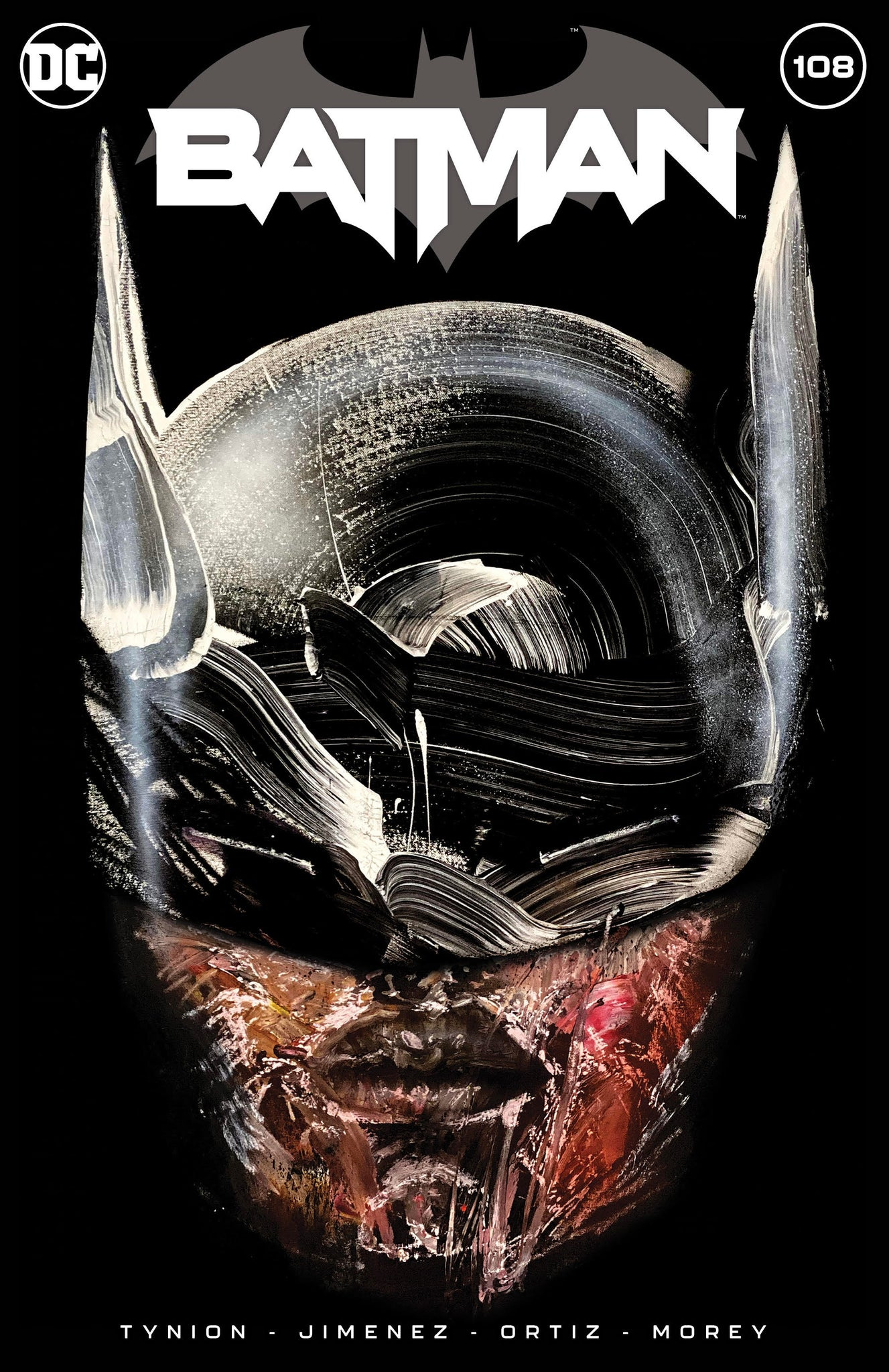
Joe Quesada’s Instagram bio, as of March 2026:
I make stuff up. Sometimes I get paid to do it.
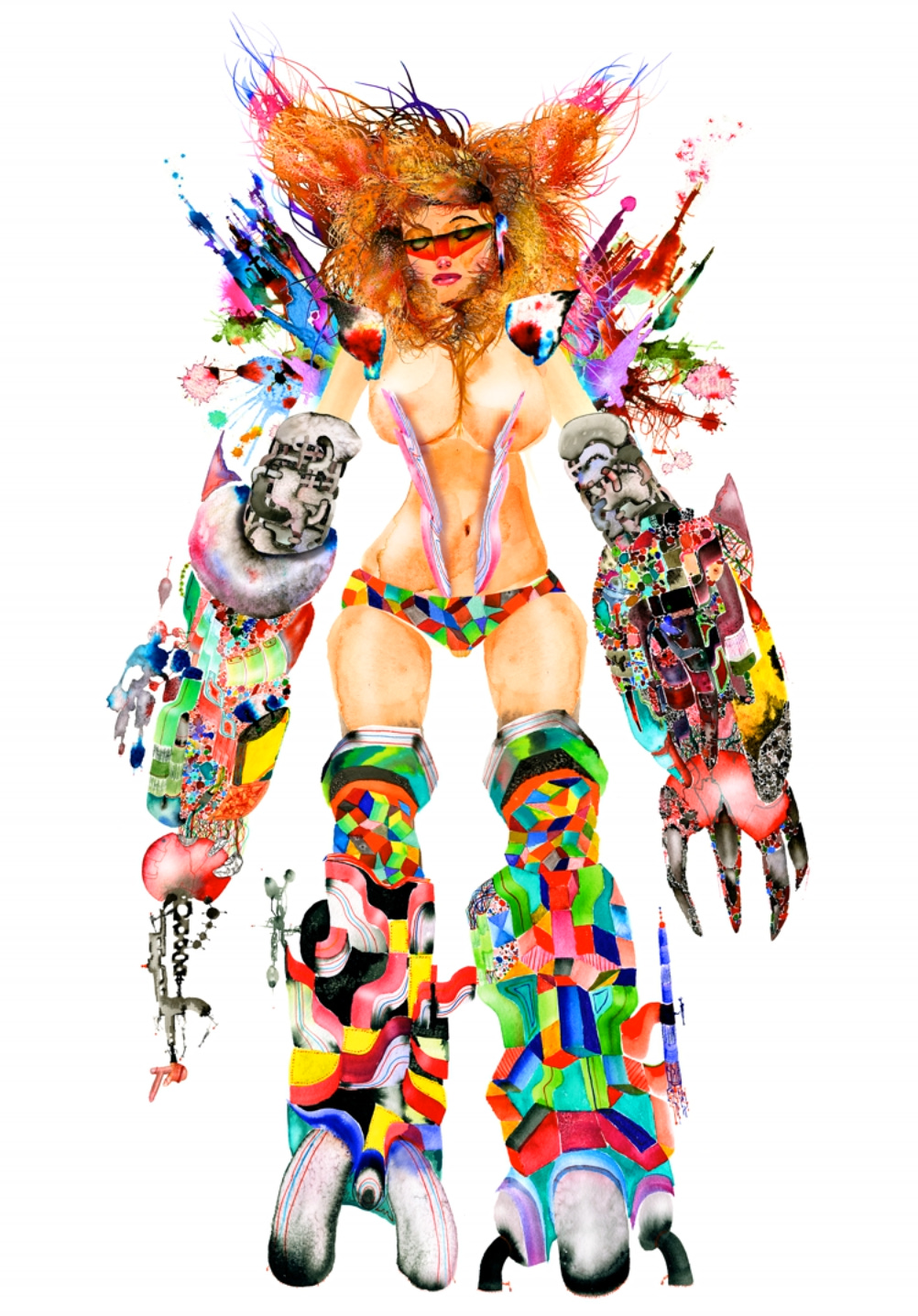
Double Rainbow Epiphanies
No blue-chip gallery would show him.
His paintings went up at Double Rainbow, an ice cream parlor on Melrose Avenue near La Brea. An ice cream shop, owned by a ‘nice, older white couple from Marin county’ was the only venue that said yes. Sales were strong enough that the store continued for two years, Choe replenishing pieces as they sold.
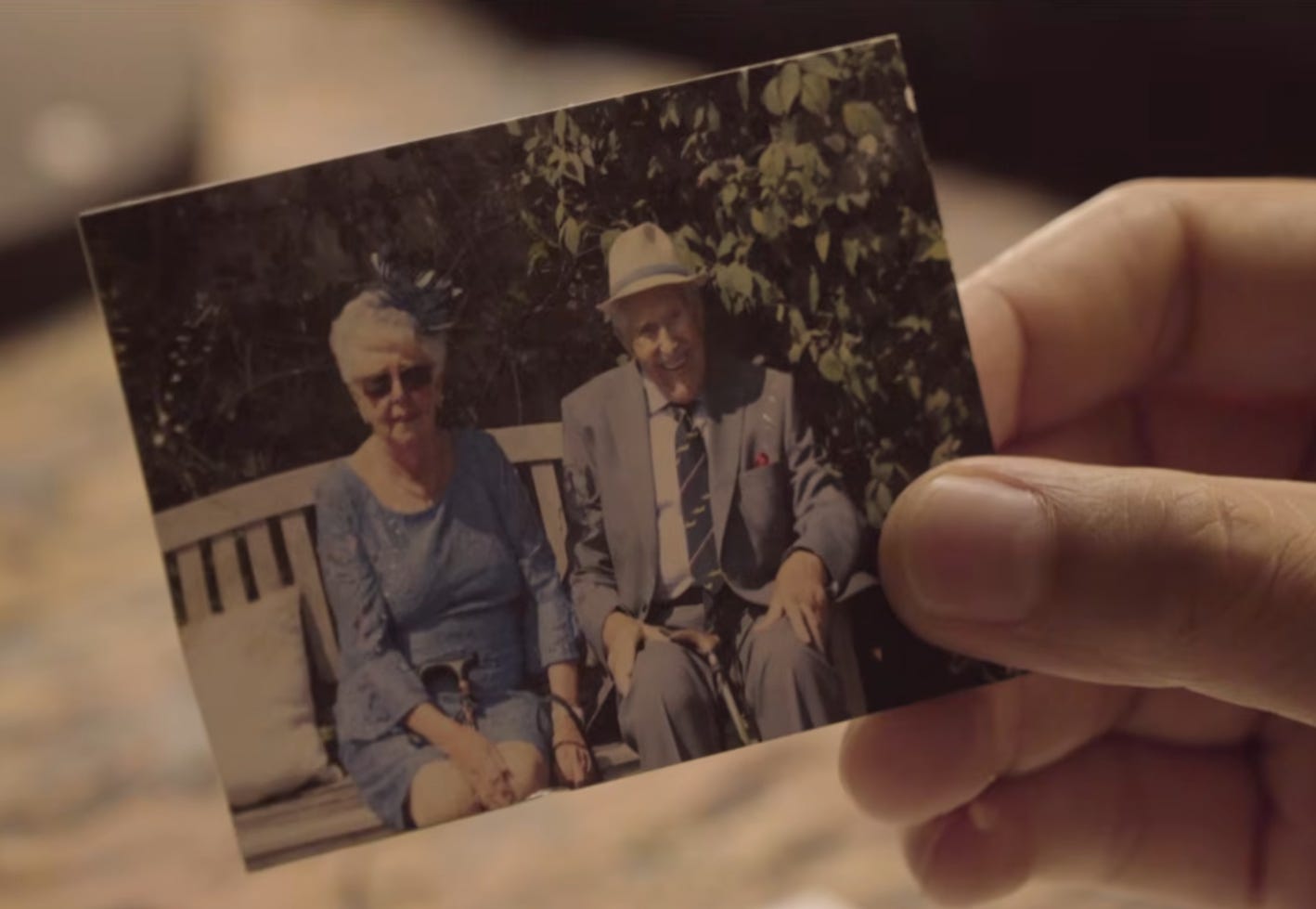
In Dirty Hands, he described the first sale like a man who couldn’t believe the slot machine paid out:
I remember I sold this painting for $500, which I mean—I was almost crying.
And you know, I trade a piece for like a skateboard.
Some girl calls me says she wants to fuck me, like just things are happening.
I’m like, what the fuck?!
His work hung between the flavor list and the hallway to the restroom. House paint and spray enamel on what might have been a cabinet door; the layering so thick you could see brush strokes from the register.
Giant Robots, Primates, and Landscapes
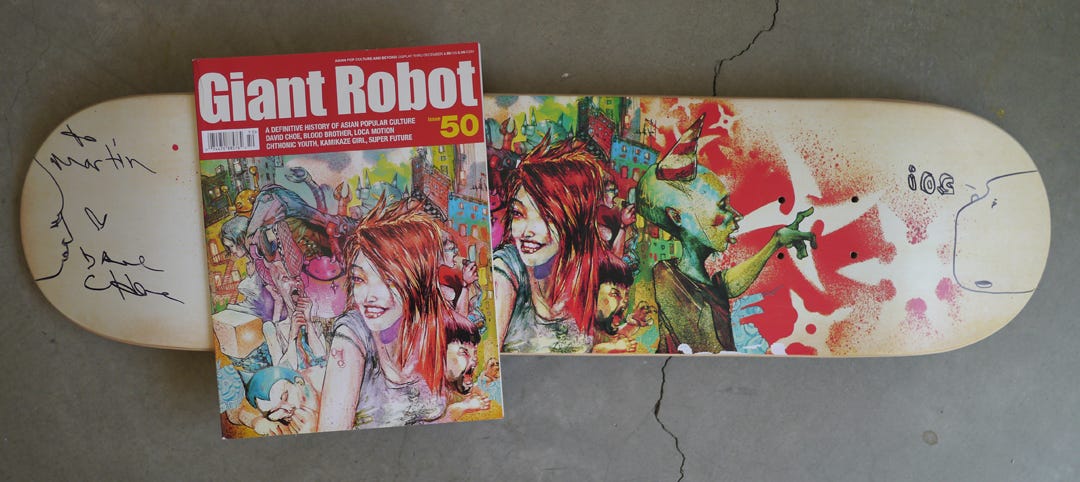
Giant Robot was the foundation: the Asian-American culture magazine founded by Eric Nakamura and Martin Wong in 1994. What The Source was to hip-hop in the late 80’s, Giant Robot was to Asian-American creatives in the 90’s—the only magazine that understood the room because it was built inside the room. Half magazine, half store, half community center. The hub for a generation of creatives who didn’t fit the mainstream art world, the mainstream media world, or the mainstream anything world.
Wong first met Choe at SDCC in 1997, a kid who walked up to their small press table and offered to contribute. The painting he sent back was perfect. Choe became Giant Robot’s go-to illustrator, “super fast and ridiculously versatile,” as Wong later wrote, and by Issue 50 he was painting the cover. By then Steve Lazarides, Banksy’s agent, was managing him.
Choe walked over and met a young man excited about his first American show, who didn’t care that nothing had sold and cared more about waking people the fuck up. The man gave Choe a cardboard cutout stencil of a rat with a bazooka.
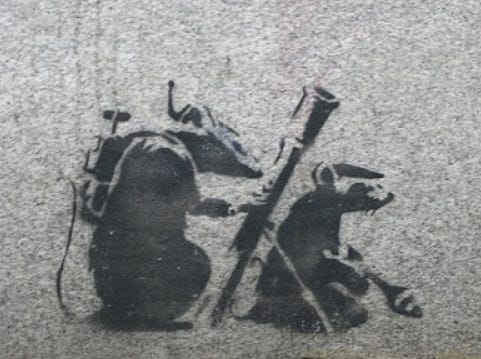
An excerpt from Why Saving Banksy Means Saving Yourself (2016)—
I used my Korean negotiation skills to talk him down to $50; although, even at $50 I felt a little cheated buying stencil art, but back then, as a starving artist myself, I was always open to supporting other starving artists so I felt good about that part. I asked who the artist was, and he said it was a fellow from across the pond in the UK who goes by the name Bank-Ski, and he was across the street. […]
He gave me a cardboard cutout stencil of a rat with a bazooka , I loved it so much I spray painted it all over koreatown until the stencil fell apart, as I looked back and realized, oh shit I’m a Banksy! the stenciled thrift store painting which I purchased for $50 still hangs in my bathroom and is estimated at $500,000 today.
Lazarides managed both of them.
Choe’s take was personal, defending Banksy’s anonymity against the scientists and journalists trying to unmask him:
I want to end this eloquently, with a personal message to all the evil expert scientists: you went to school and got all that education and were born with this giant brain; you could be helping to solve cancer and/or real crimes and this is how you choose to spend your time? Fucking with artists? Leave artists alone to create. The only people you should ever want to unmask are villains.
Matt Revelli’s Upper Playground completed the infrastructure. He founded the San Francisco-based apparel brand and gallery operation; what he built with Choe over the next decade moved street art into the market.
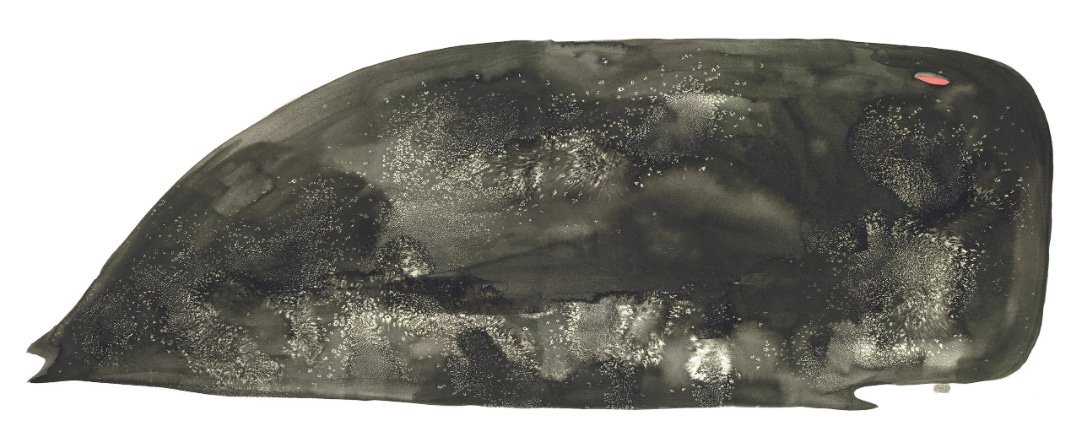
Munko
Munko had been Choe’s graffiti signature since he was a teenager, randomly appearing on pavements, concrete walls, overpasses, and freeways across LA, always accompanied by quotes or philosophical fragments. A character, limbless and grinning, evolving over the years into dozens if not hundreds of variations.
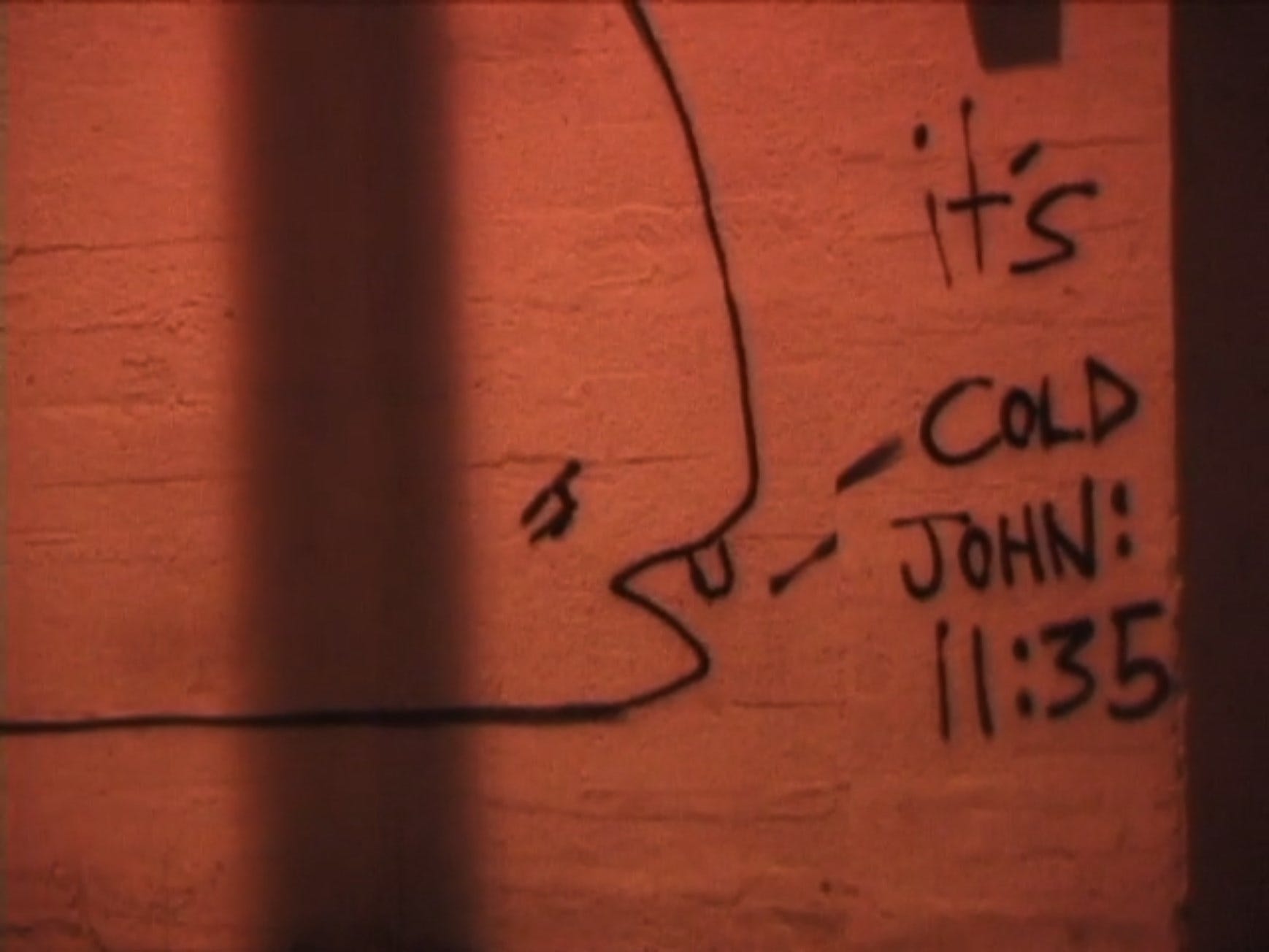
Where most graffiti writers sprayed their name, Choe sprayed a creature that couldn’t walk, couldn’t hold anything, couldn’t do anything except absorb. Upper Playground partnered with Japan’s Good Smile Company to produce Munko vinyl figures and a plush line—Munko, Munkosaur, Munkette—each of which became an instant collector staple.
The character description he wrote for the plush:
Munko has no arms or legs, but don’t take pity and cry for her. She is him and he is her, she is chubby little baby and 2 billion year old wise wizard. The black hole in her head eats all the pain and darkness in the world. He believes all her strength knowledge and luck comes from his only tooth, but in reality it’s the sole survivor of her over active sweet tooth. When you are with Munko you just be, and you will finally be at peace with your fucking self.
Cover art for Jay-Z and Linkin Park’s Collision Course in 2004, a 2x Platinum EP that debuted at No. 1 on the Billboard 200. The Obama poster in 2008 after initially refusing (“Fuck that, I’m a nihilist”), then wheatpasted across the country. Illustrations for Hustler, Ray Gun ($160/piece), Vice, Marvel, DC, Sony Pictures, Converse, and Levi’s. Artwork for the sets of Juno and The Glass House.
None of it came through a gallery.
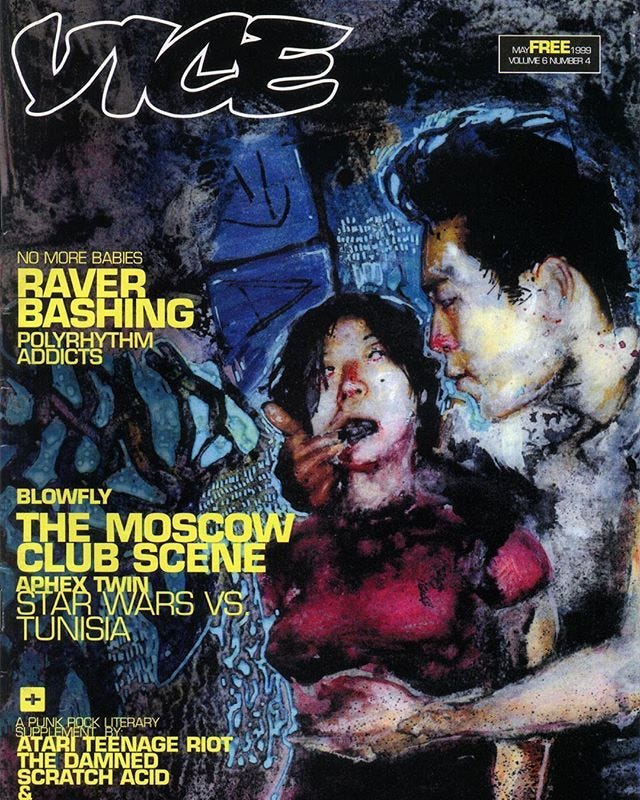
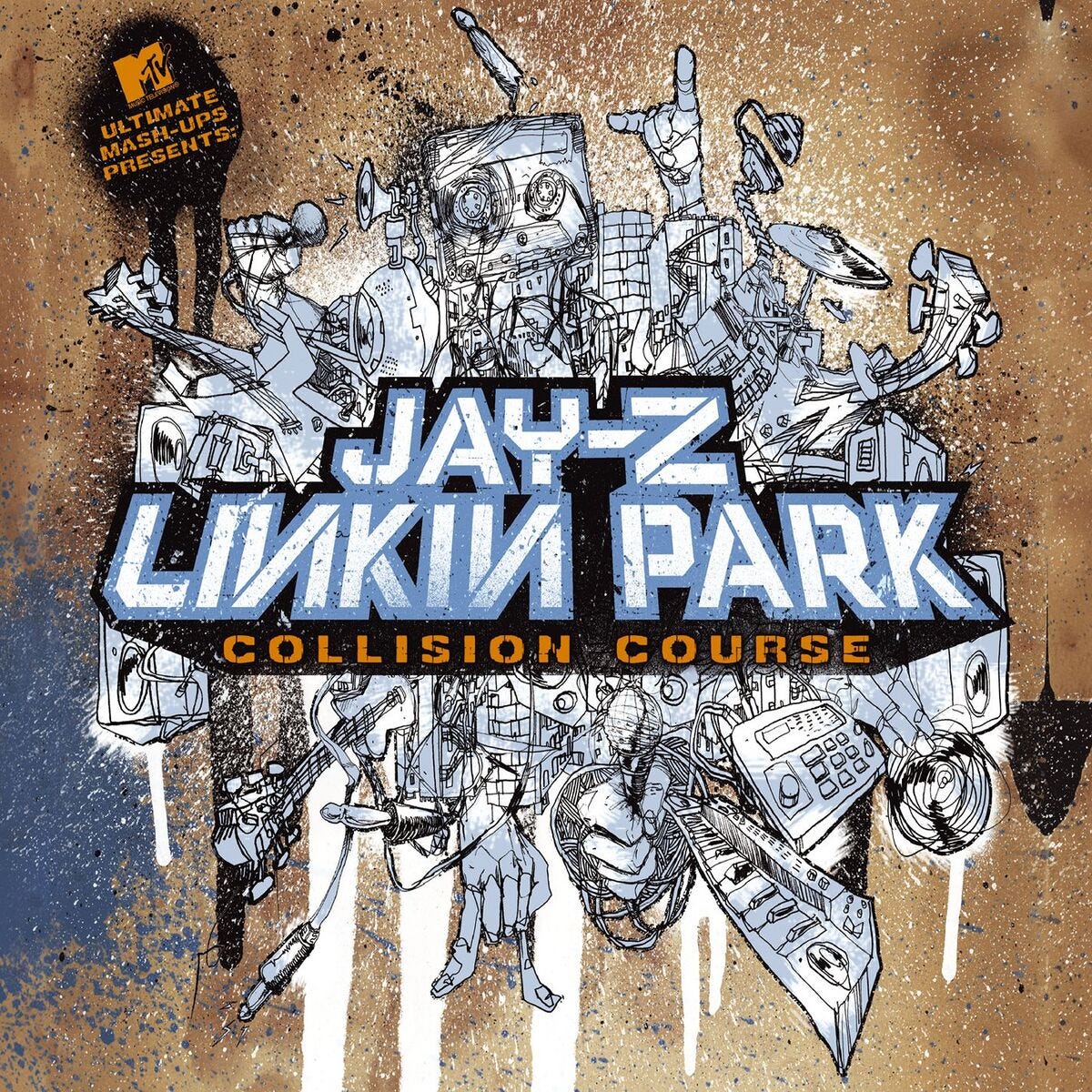
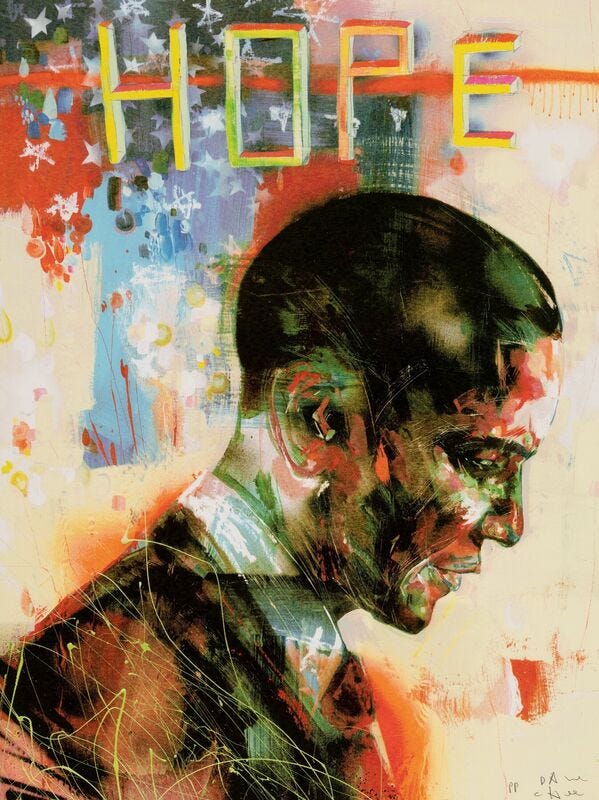
Revelli’s line about Choe:
He looks at failure and success as equal opportunities.
Giant Robot, Upper Playground, Double Rainbow, Lazarides: none of it shows up in a Christie’s catalog. Asian-American artists in LA built their own thing because the art world wouldn’t pick up the phone. At the Dirty Hands premiere in 2008, it was Nakamura who introduced the film. The Giant Robot community and the Choe community were the same community.
Choe had no MFA, zero exhibition history through official channels, and was lacking critical validation. His work came from graffiti, his methods were abrasive and occasionally criminal, and his public persona made curators nervous.
600 Drawings in Soy Sauce and Blood
In late 2003, Choe flew to Tokyo for an art show. Within 24 hours, he punched a private security officer in the face, earning himself a 90-day clip.
The cell was small and the rules left no room either. No talking during certain hours, no moving around, no lying down during the day. He was the only foreigner in his section, couldn’t communicate, and survived a system designed to break compliance through monotony.
He had a single pen and scraps of paper. Over 600 drawings came out of it. He bartered portraits of cellmates for peace, painted in whatever he could scavenge: soy sauce, blood, tea, urine.
![[soyhedz.jpg]](https://substackcdn.com/image/fetch/$s_!lbuD!,f_auto,q_auto:good,fl_progressive:steep/https%3A%2F%2Fsubstack-post-media.s3.amazonaws.com%2Fpublic%2Fimages%2F5bbe6c41-4afe-4324-8555-768b3866c6a9_400x549.jpeg "[soyhedz.jpg]")
Soy Hedz—a face painted entirely in soy sauce on scrap paper. Soy sauce bleeds at the edges, pools where the paper dips, dries into gradients the brush never planned. The face dissolves into its own surface—portrait becoming stain, a human image in a medium that won’t let it stay permanent. No layering, no revision; what landed first is what stayed. Every medium Choe built his reputation on is absent here, and the work is more raw as a result.
Stripped of spray cans, acrylics, house paint, every tool he’d built his practice around, putting his life onto paper without mediation.
Revelli relays that Choe’s prison sentence was an ultimate karmic payment for buried sins, collected in full. Released on the condition he leave Japan and never return, he exhibited the prison work in New York. Years later, the ban was lifted, and Upper Playground brought him back to paint a wall in the city that had caged him.
The Lens That Never Looked Away
Harry Kim had been filming since 2000, often living with Choe while videotaping the art-making, the fights, the confessions, the intimate wreckage. What started as a ten-minute film school project grew into a half-hour short titled Whales and Orgies, then expanded into Dirty Hands: The Art and Crimes of David Choe, which premiered and sold out twice at the Los Angeles Film Festival on June 21, 2008, won Best Documentary at the San Diego Asian Film Festival, and screened as MoMA’s closing film in the All the Wrong Art series.
Variety called it “about as indulgent as Choe is, rampaging around the globe and its subject’s mind.” Kim kept filming for years, eventually releasing David Choe: High Risk.
Kim caught the self-sabotage on camera in 2007, unperformed:
What the fuck, dude? I got a gorgeous girlfriend. I’m making great money doing art and all this shit.
And it’s like, how come I still do all this stupid shit to, like, sabotage that?
How come? And why can’t I stop that? So what’s my future goal?
Like, I guess to work on myself and just to, like, become, like, a normal person, whatever that means.
Vice extended the record into performance. Thumbs Up! followed Choe and Kim hitchhiking and freight-hopping across continents with no money and no plan.
Los Angeles → Miami
Tijuana → Alaska
Beijing → Shenzhen → Macau
Manila → Siargao
The Palo Alto Murals
Sean Parker tried to commission Choe in 2003 but couldn’t pay; Napster had been sued into the ground and Parker hadn’t landed at Facebook yet. Parker was a fan, and Choe was broke.
On the Huberman Lab podcast in December 2025, Choe told the story: Sean had been in a meeting with Warner Brothers executives and one of them, a guy named Chip, had disrespected Choe in passing. Parker shut the meeting down, telling Warner Brothers to their faces they weren’t doing business because of what Chip had done to his friend. Choe cried when he recounted it: “sometimes the little guy wins.”
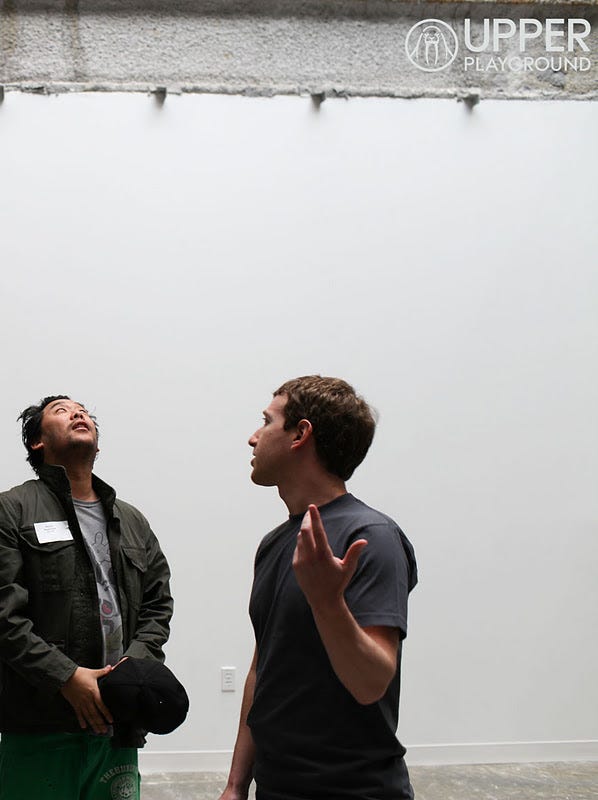
Two years later, in 2005, Parker commissioned murals for Facebook’s first Palo Alto office. Parker offered $60,000 cash or company stock. Facebook seemed pointless, a shy MySpace at best, that nobody he knew used.
He took the stock because he believed in Sean, not Facebook.
It was peak Choe on the walls: graphic, sexual, confrontational, vintage Slow Jams energy scaled to architecture. Naked figures, animals, his signature whales, all sprayed and painted onto the interior walls of a startup that would become one of the most valuable companies on earth. Choe’s friends Rob Sato and Joe To loosely recreated them for the set of The Social Network.
Zuckerberg commissioned tamer murals in 2007 for the next office, and the one after that. On May 18, 2012, Facebook went public.
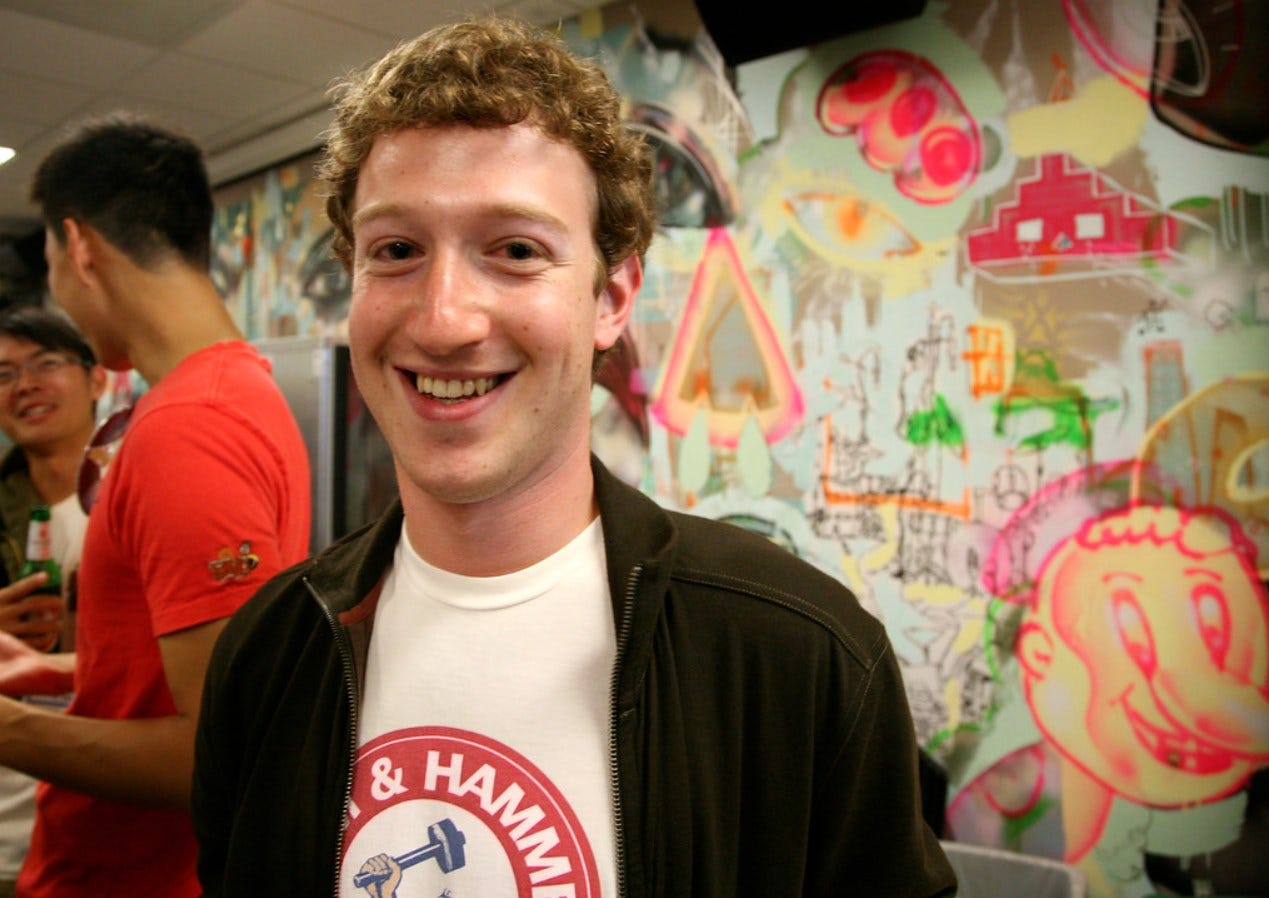


By the time Choe linked up again with ZUCK 1 in 2012 (above video), his stake was worth an estimated $200 million (in 2017).
Choe’s wealth came from painting walls for a friend who offered stock in a company he thought was stupid.
Shatterproof
David Choe, It All Adds Up, 2020—
That hole will never be filled. That hole is bottomless.
You could fill it with sex, drugs, money, achievements, cars, houses, goals.
It’ll never add up. It’ll never be enough.
The disease of more.
The gambling had been severe long before the IPO; he’d built his first million from blackjack by roughly age 30, starting with $500 and the Martingale system. The windfall removed every constraint that had kept the addiction survivable.
A weekly Vegas trip, $250,000 per hand on blackjack. Five sleepless days at a stretch, $20,000 chips falling from his pockets, an angina attack on a suite floor; he woke up 30 hours later. The casinos rolled out private everything, made sure their VIP client’s dopamine supply never crimped.
David Choe, on The Rich Roll Podcast, September 2021—
I wanted to die... I wanted to die.
I was too cowardly to actually kill myself, but I wanted to get into some kind of situation where someone would murder me or something would happen where I would die.
I had an angina attack in a casino when I was 35. And that was the best, because when I collapsed, I felt so much joy.
That was the happiest I was, because I was like, it’s going to end soon.
My pain is going to end soon.
Jason Jaworski, a close friend and writer who spent years traveling with Choe during the worst of it, published a profile of Choe in 2021 written from the inside. Choe described cycling through casino suites—Bellagio, Aria, Palazzo, MGM, Caesars—waking each morning in a different room and running to the window, hoping for escape, failing every day, too much of a coward to do it by any other means.
Huberman asked him about recovery, and Choe described his version:
David Choe, on Huberman Lab, December 2025—
Just right on the wall:
‘I am worthy. I am enough.’
And I see it every morning when I wash my face.
And it’s just like, I’m starting to brainwash myself.
Brain-mapping, he called it. Every addiction, he told Huberman, is a gambling addiction underneath: if you drink and drive, you’re gambling; if you overeat when you’re diabetic, you’re gambling.
Gambling was running from shame. The shame preceded the money, and by proxy, everything else: the trap of growing up first-generation Korean-American, where failure is the only unforgivable sin and vulnerability is weakness.
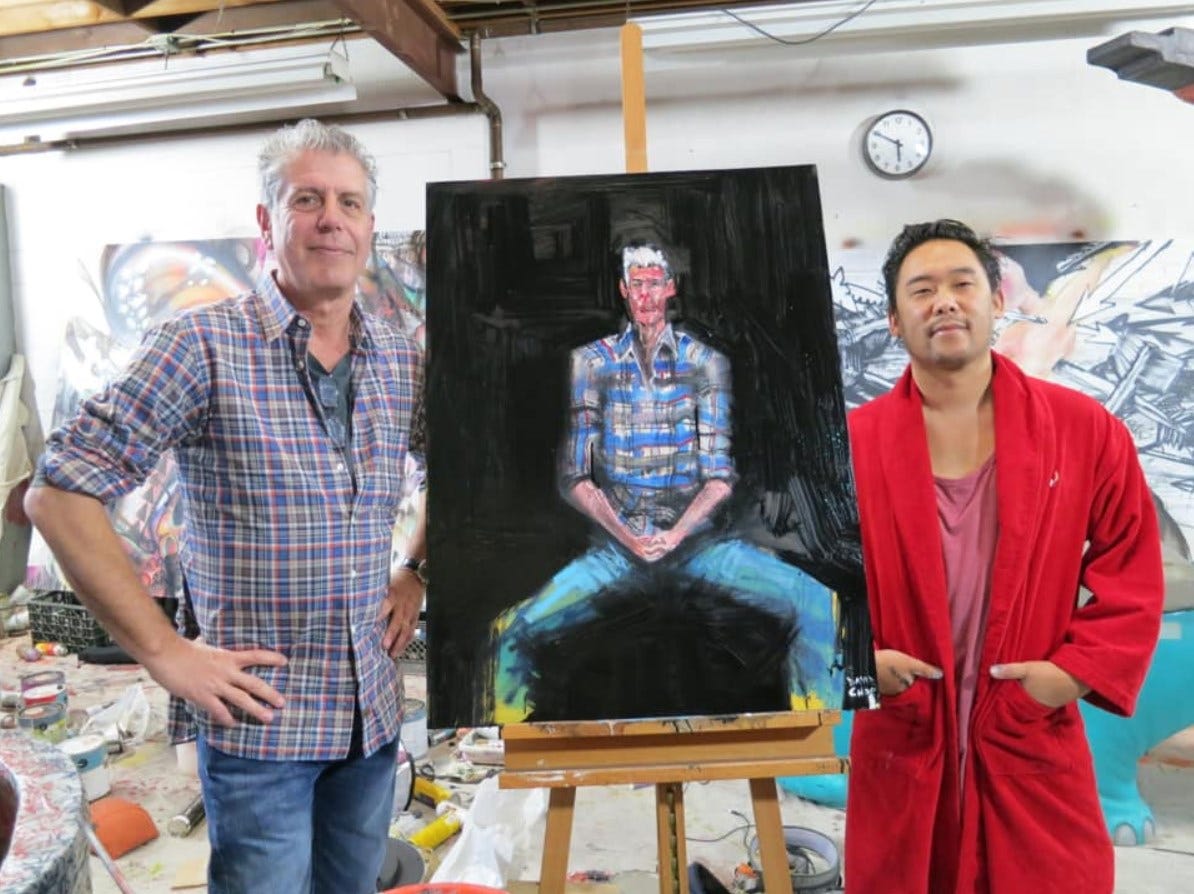
Tony
Anthony Bourdain changed Choe’s trajectory more than anyone else; more than Parker, more than Revelli, maybe more than Storey.
Their friendship started around 2010 through David Chang. Choe had been painting murals for Chang’s restaurants (Momofuku, later Majordomo) and both Davids bonded over gambling, Korean food, and being Korean-American men who had achieved a level of success they were only supposed to want. Immigrant parents who sacrificed everything; success by every metric that should have silenced the imposter syndrome, and neither one could stop feeling like the next bad decision would prove their families right about them.
Chang invited “his friend Tony” to a dinner at the Chateau Marmont, and the friend was Bourdain. They talked for hours. On following visits, Bourdain would go to Choe’s mother’s house for homecooked meals.
Bourdain had been an addict, a line cook, a man who burned through relationships and careers before Kitchen Confidential turned the wreckage into a brand.
Kitchen Confidential (2000) closes with a line Choe would’ve tattooed on himself a decade later:
It’s been an adventure. We took some casualties over the years. Things got broken. Things got lost. But I wouldn’t have missed it for the world.
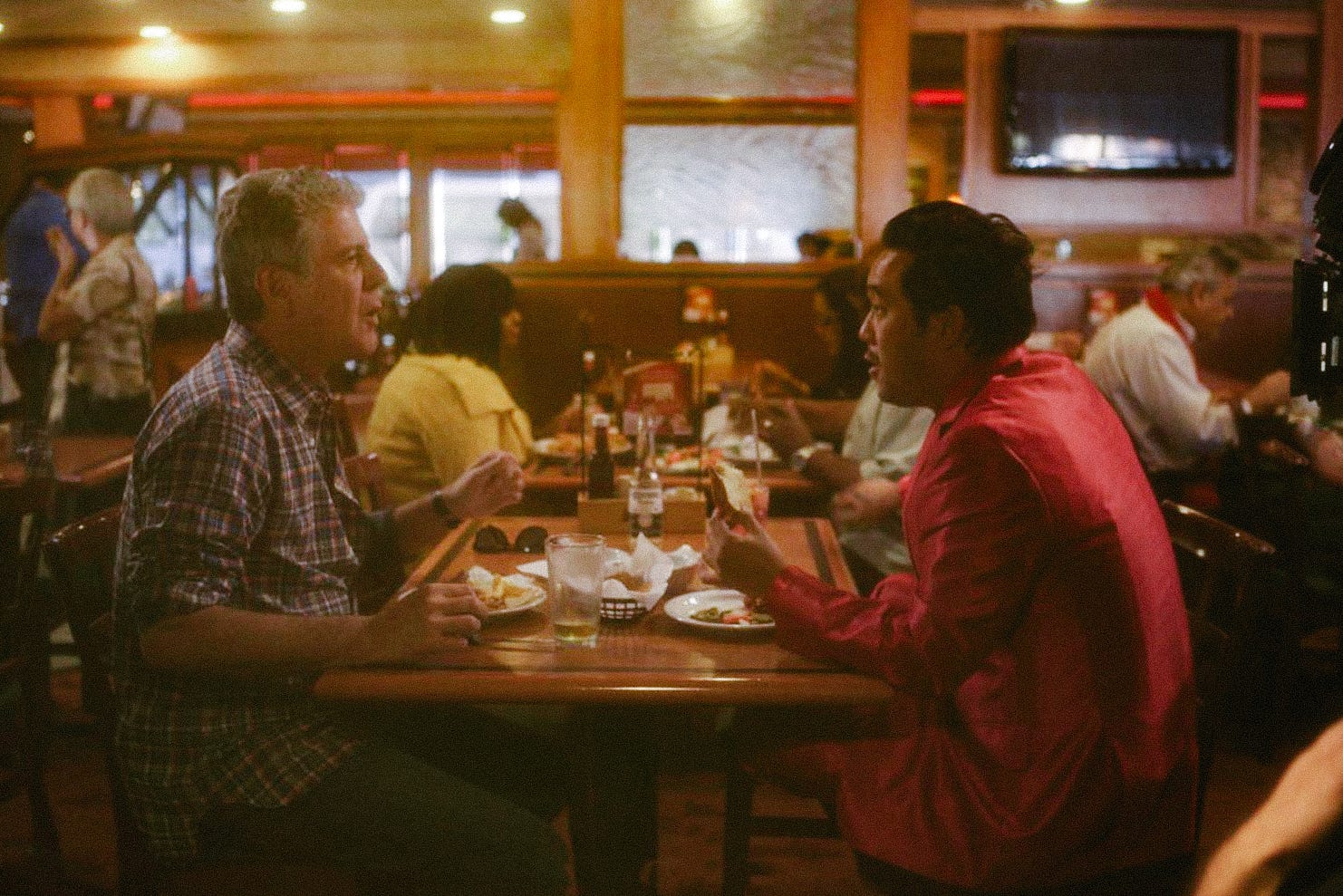

Parts Unknown Season 1, Episode 2, shot in 2013. Koreatown. They ate at Sizzler on South Vermont—not a destination restaurant but a chain steakhouse on a strip mall block, the kind of place Korean-American families went after church on Sunday. Bourdain used Choe’s term “KGB,” Koreans Gone Bad, and it became shorthand for the Korean-American creative class that refused to be model minorities.
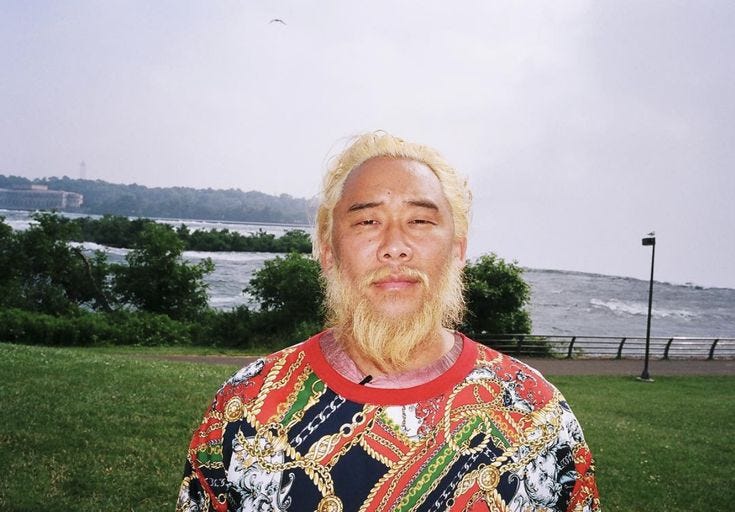
After Bourdain’s death by suicide in June 2018, Choe grew his hair for three years as a memorial. In Morgan Neville’s Roadrunner (2021), he spray-painted over a mural of Bourdain that Neville admitted he had commissioned specifically to be destroyed on camera.
DVDASA
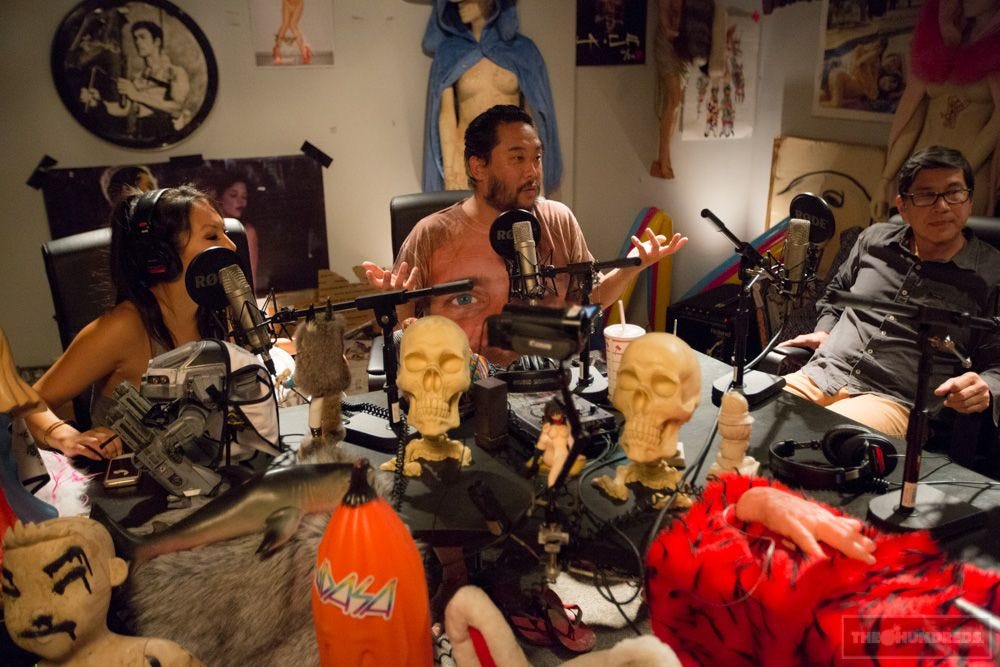
DVDASA, the podcast Choe co-hosted with Asa Akira, launched January 2013 and hit No. 1 in iTunes’ Health category. The name stood for Double Vag Double Anal Sensitive Artist—tells you everything about the frequency the show operated on.
Two people in a room talking about sex, addiction, childhood damage, and the fear of being unlovable, with no delay, no producer, and no edit button.
They recorded in the White Room, a studio space that doubled as a confessional booth and a performance stage. 140+ episodes through late 2014: sex talk, gambling stories, crude humor, and stretches of genuine therapeutic vulnerability that left no cover.
Choe disclosed his childhood sexual abuse on air; he talked about his father’s emotional distance, his mother’s weaponized faith, and his fear that he was unlovable.
Akira, an adult film actress and director who had published her own memoir, was smarter than the show required—unflappable, willing to call Choe on his own mythology in real time. When he went dark, she stayed.
One move was deliberate: nobody would ever be sure what was real. Guests cycled through. Comedians, adult film performers, musicians, random friends; episodes lasted as long as the conversation did, sometimes 45 minutes, sometimes three hours. Val Kilmer visited the White Room. Whether Choe was performing or confessing at any given moment was anyone’s guess, and he liked it that way.
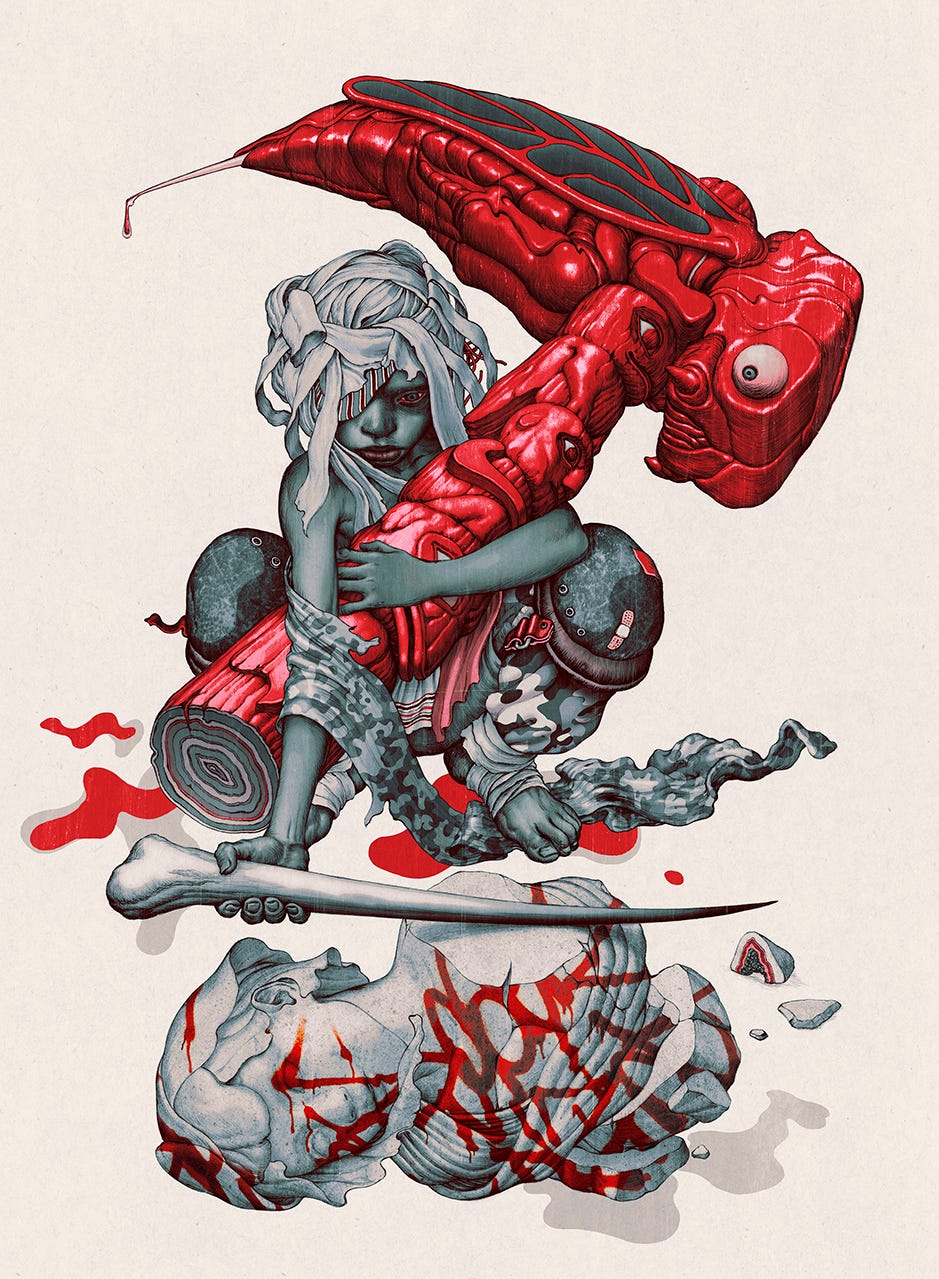
Bobby Lee’s younger brother Steve became a regular under the name “Steebee Weebee,” and the chemistry was immediate. Choe built a band around him in 2014: Mangchi, Korean for “hammer,” with Money Mark, the Beastie Boys’ longtime keyboardist, and tour artwork by James Jean, who’d shared a 30,000-square-foot warehouse with Choe in LA.
Episode 106
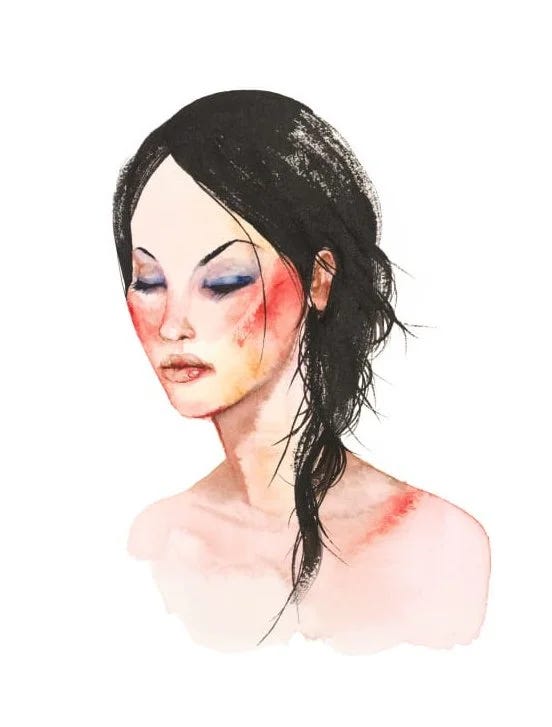
March 10, 2014. DVDASA Episode 106, titled “Erection Quest.” Choe described a massage from a masseuse he calls “Rose.” By this point the show had run 105 episodes where nobody could tell confession from performance, and an audience had formed that took the disclosures at face value—the same audience that had heard Choe describe his own childhood sexual abuse with visible pain. 105 episodes had stripped the format of any safety net.
DVDASA ended with a 25-hour marathon on November 1 to 2, 2014.
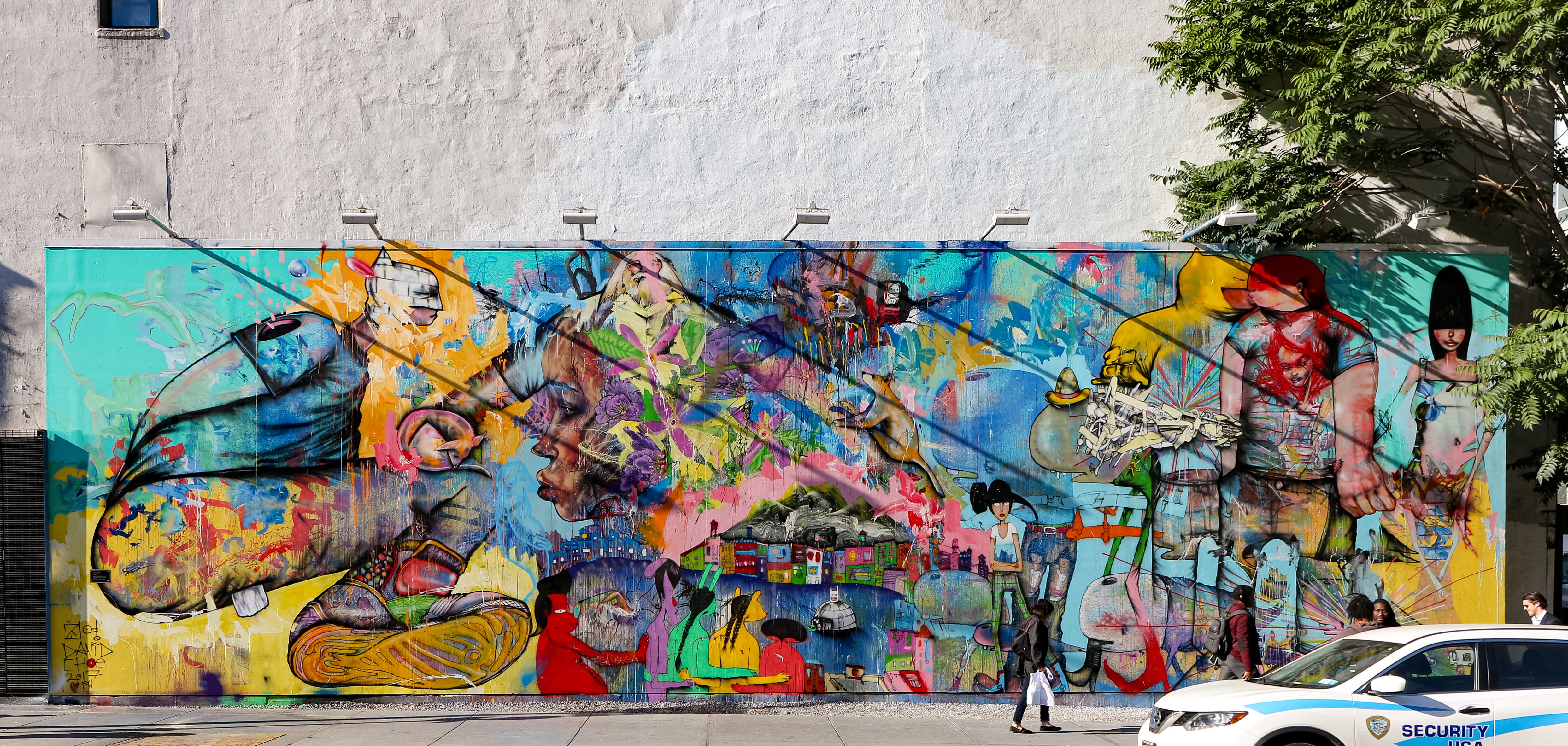
Episode 106 resurfaced in 2017 when his Bowery Wall mural drew protests and was eventually defaced.


It resurfaced again in April 2023 when clips went viral following Netflix’s Beef. The creative team issued a joint statement calling the story “undeniably hurtful and extremely disturbing.”
The audience split. Some defended him: it was a story, he said so, and the format was always unreliable. Others couldn’t square it: the same voice that had disclosed childhood sexual abuse with audible weight had used the same microphone to describe what he described. Listeners who had invested in DVDASA as something real, who had treated Choe’s confessions as a contract of mutual vulnerability, couldn’t forgive Episode 106.
No victim has come forward, and no charges have been filed.
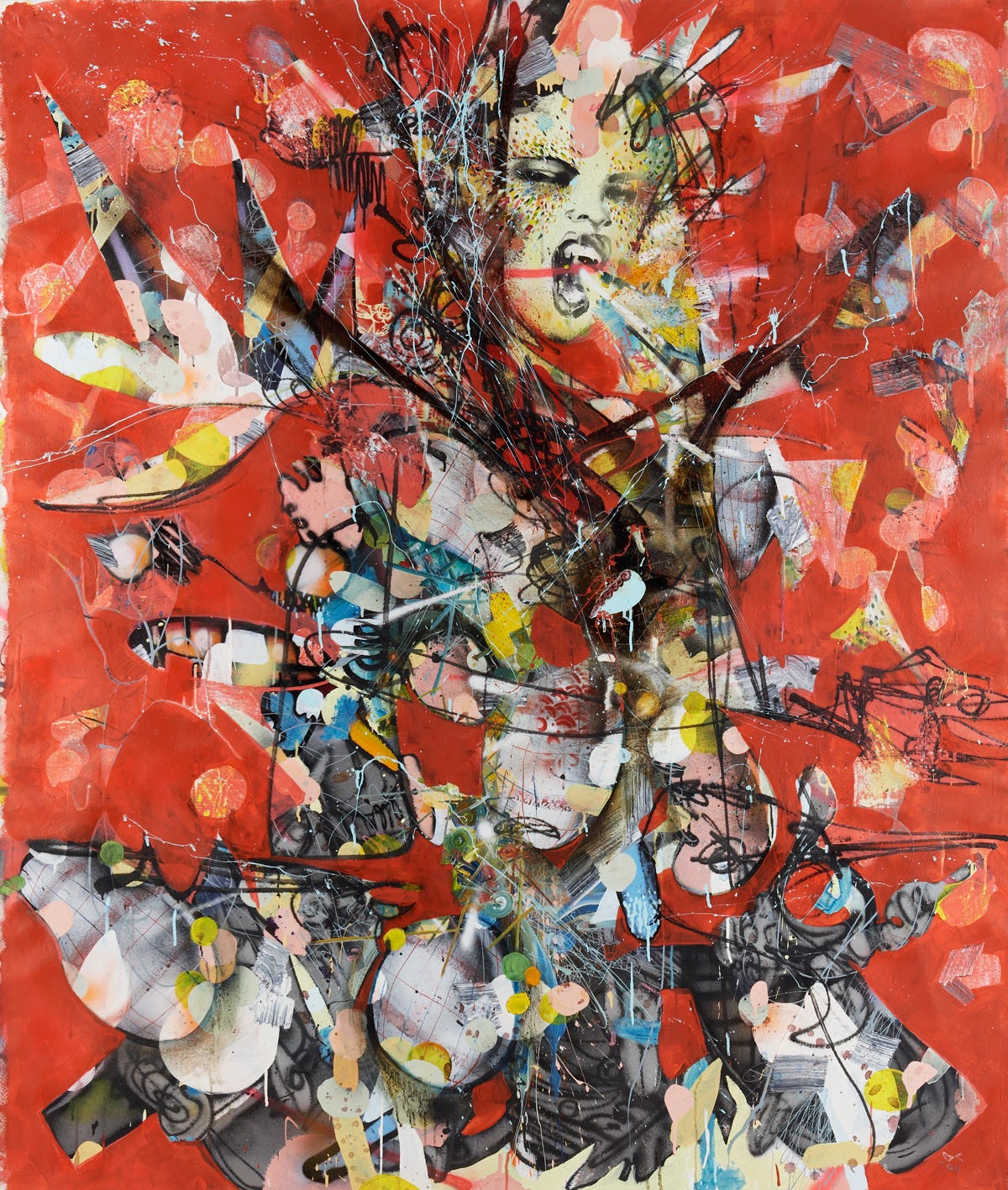
The School of Dirty Styles
From Sedition, mapping the dirty style back to its material origins:
My dad would bring home used Xeroxes from work so I could Crayola all over the backs, then I moved on to painting on benches and other shit on the street because I couldn’t afford canvases... So even before you start, there’s some history, there’s some chills, spills, and marks, then you keep creating more history on top of that, spilling, spraying, dripping, creaming, collaging, making a mess. All this ugly dirty shit, with hopefully the end product being something tolerable and beautiful... born from that filth.
A Choe face up close: features that look barely controlled, lines drifting past anatomical accuracy into something looser and more unsettling, eyes that hold you with a fixedness implying months of studio time when the whole thing went down in minutes. The surfaces have topography; you can see brush strokes from across a room. The grin migrates from painting to painting, Munko’s grin on human features, absorbing everything.
In a piece called “The Perfect Day,” written during a mural trip to Cambodia with the Igloo Hong Foundation, he described the philosophy underneath the paint:
I will admit, I try to stay purposefully ignorant about the history, politics, and current events of most places I visit. Ever since I started hitchhiking all over the planet in my teens, I would rather get an oral history from the people I met travelling instead of reading about it on my phone or in a book... It’s been a lifelong journey and fight to stay present, to live in the moment without holding onto old grievances, revenge, or getting stuck replaying histories I cannot change... It’s about freeing your vision to allow you to see the beauty in the imperfections around you, and every once in awhile those imperfections culminate into a perfect day.
Exhibitions tell the rest of the story—an ice cream shop on Melrose to:
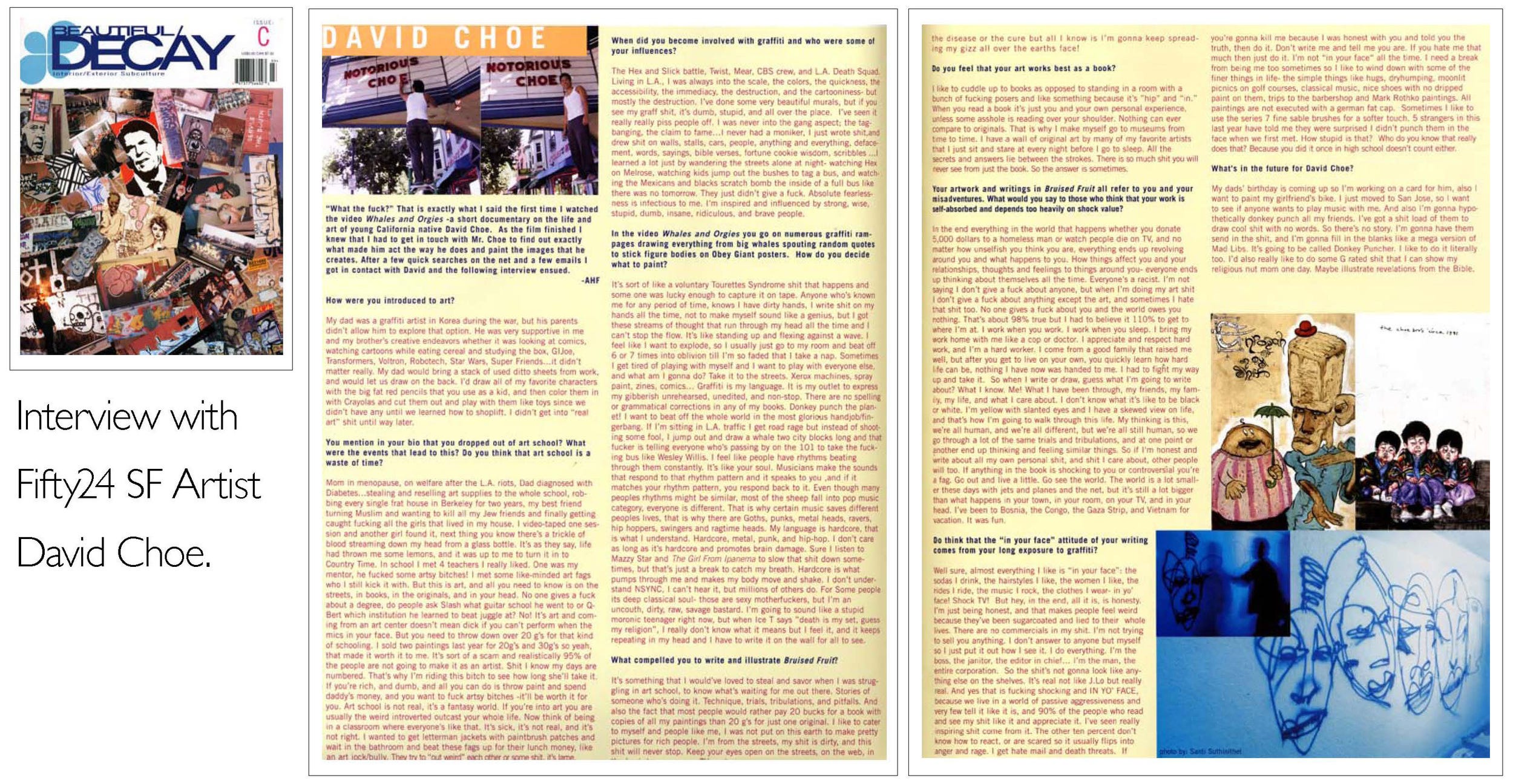
David Choe at Fifty24SF (2003, 2004)
Anno Domini in San Jose (2005)
First museum solo at the Santa Rosa Museum of Contemporary Art (2005)
“Gardeners of Eden” at Jonathan LeVine in Chelsea (2007)
“Murderous Heart” at Lazarides in London and Newcastle (2008)
“Nothing to Declare” in Beverly Hills (2010)
Character Assassination by David Choe at Fifty24SF (2010)
David Choe, on The Rich Roll Podcast, September 2021—
I was like, it has to be in LA. It has to be on the most expensive—right in Rodeo Drive.
I want every celebrity there. I had to show everyone, like, I was enough.
And I was not—I wasn’t even enough.
I was better than you.
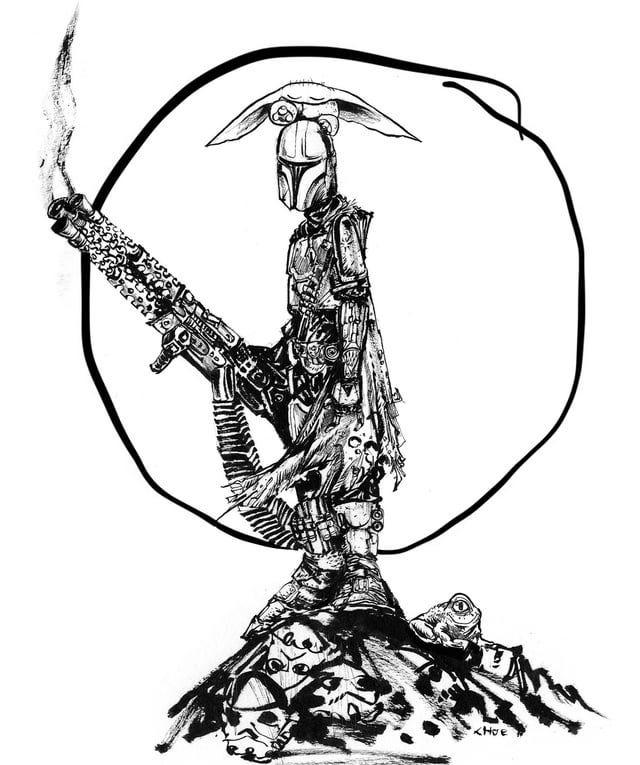
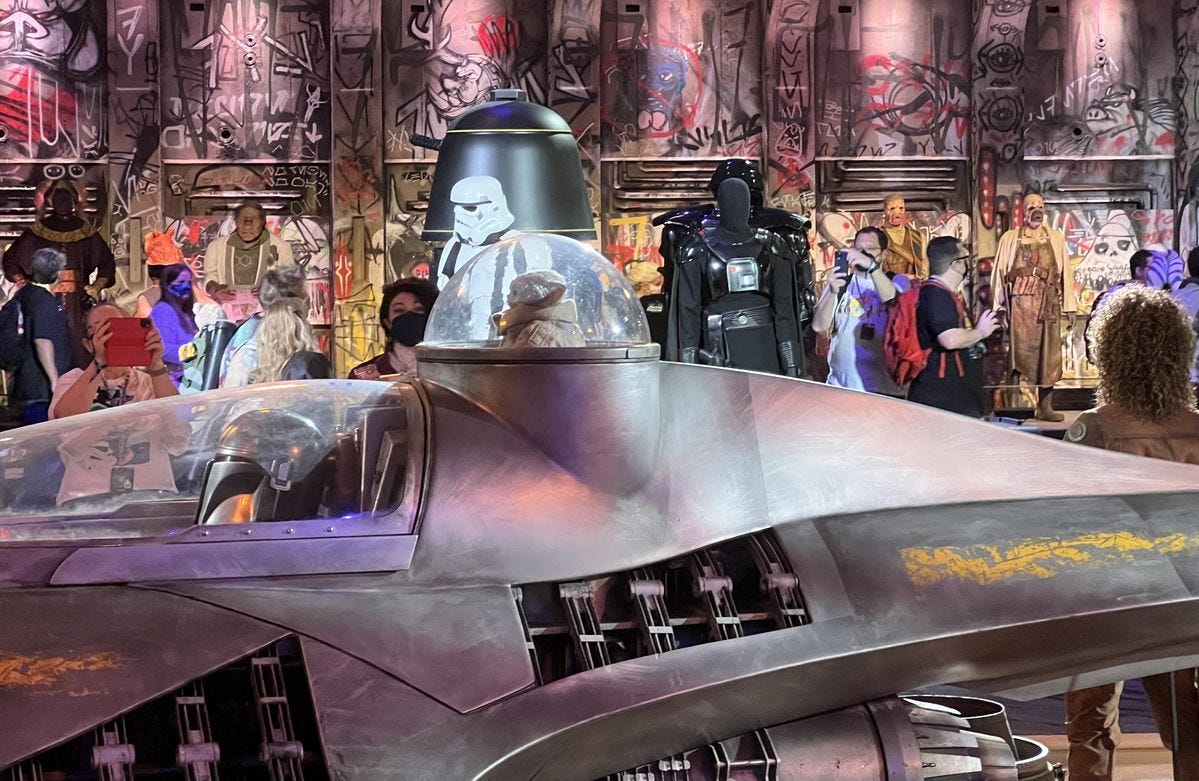
Alien graffiti on The Mandalorian’s Tatooine sets—tags calibrated to species heights, Jawa-level scrawl kept low to the ground—came from Choe pitching Jon Favreau directly, then taking a cameo in the Gamorrean fight club scene instead of payment. Juxtapoz dedicated an entire issue to him, guest-edited by Choe himself. His Obama portrait hung in the White House. Each placement bypassed the traditional ladder entirely.
Kantor Gallery noted the tension between reckless scrawling and refined composition
Variety conceded a moment of bliss watching him execute an ornate face with a spray can in each hand
KQED wrote that his hands are dirty literally and metaphorically, and to wash them would erase the creativity that is his nature
Slant Magazine called him “an unsettling hybrid of what is terrific and terrible about the American dream”
The strongest aesthetic case against Choe: strip the mythology away and you’ve got a technically gifted painter who never learned when to stop. He runs on the same transgressive energy that powered Robert Williams and the Juxtapoz generation.
The layering is relentless; at its weakest, the sheer mass does the work that composition should.
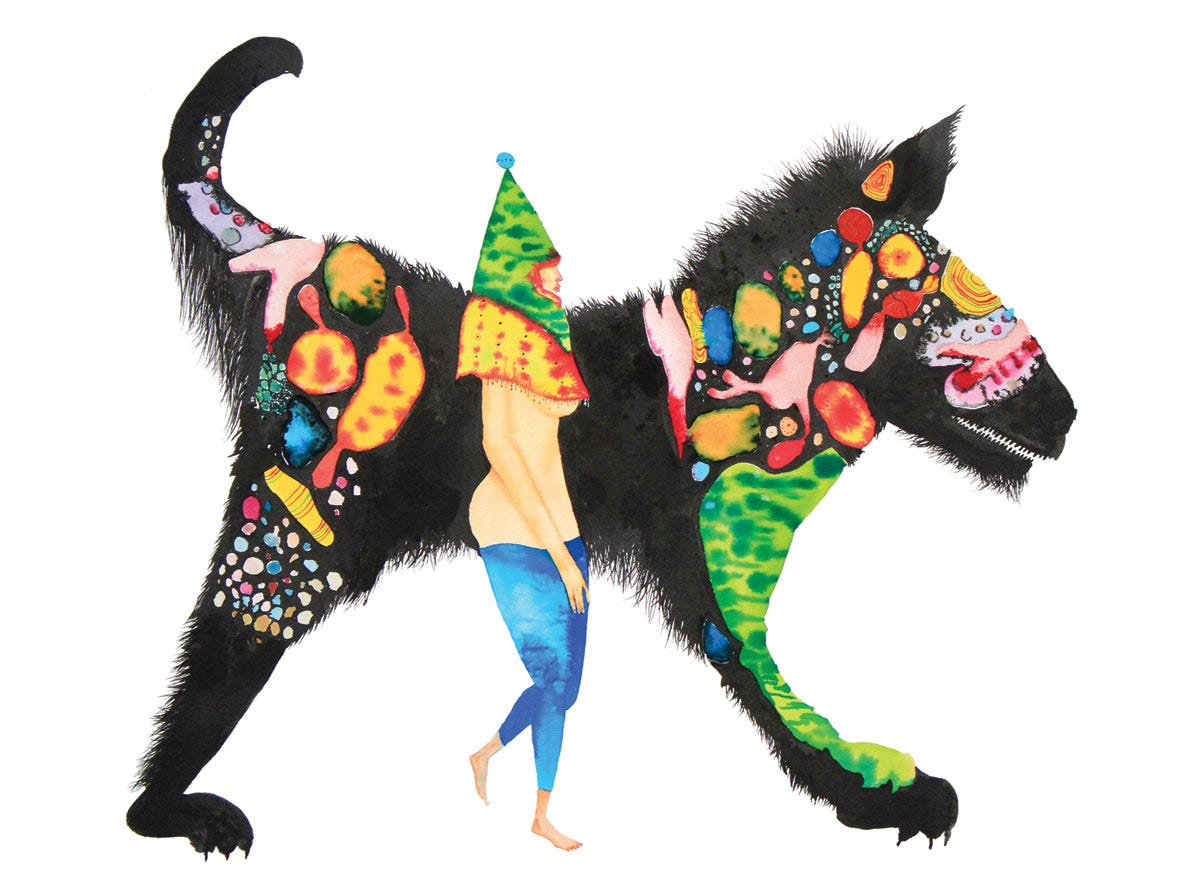
“Snowman Monkey BBQ” at the Museo del Chopo in Mexico City, 2013: all watercolors. Controlled, precise, quiet. He told Rogan why:
David Choe, on The Joe Rogan Experience #563, 2014—
At some point, I just stopped selling my paintings.
I was like, I just either give them for free to my friends or you can look at it for free on Instagram or you can buy my books that are cheap or you can go out and look at the murals I did.
I’m not on this planet to make really expensive art for rich people.
Koreatown, not Seoul
Choe turned being a bad Korean into a brand—a contradiction Wendy Sung examined in Global Asian American Popular Cultures.
The riots broke the model minority bargain: work hard, stay quiet, don’t make trouble, and America lets you in. His parents held up their end, and America burned down their business anyway. Choe watched it happen at sixteen and drew the only conclusion a teenager could draw: the bargain was never real, and the people who kept honoring it were getting played.
Before the riots, his parents had sent him to South Korea as a young child, where he has disclosed being sexually abused.
David Choe, It All Adds Up lecture, 2020—
I was shipped away to Korea when I was four years old because my parents were too poor to raise three kids.
And that fucked me up for the rest of my life.
That wound was so deep.
They sent him the way immigrant families do, to reconnect with the culture, to learn the language. What happened broke something that took decades to name. It taught him early that his family’s respectability hung by a thread, and could collapse at any moment.
Jimmy Choe told a therapist [tr.]:
Everyone has a hard time growing up.
You don’t talk about it. You zip it up. You fold it up.
You put it in a drawer in your chest, and you lock it away.
On Rich Roll’s podcast, he described what that silence looked like at the dinner table:
David Choe, on The Rich Roll Podcast, September 2021—
I was six or seven, and the waiter’s like, what do you want? I never had an adult asking me what I want. There was a lobster tank. I’m like, that, I’ll have that. And I could just feel my dad glaring down at me.
’Do you know how much a fresh lobster costs?’ My brothers jumped in—stupid, David.
So the lobster comes, I can’t even enjoy it. He’s like, no, we’re gonna sit here till you finish eating that. And so I’m like crying eating this lobster tail.
Cut to 20 years later, I’m gambling millions of dollars in Las Vegas, having lobsters sent up to the room. I don’t even eat the lobsters. There’s rotting lobsters in every penthouse in Vegas. It’s just like a fuck you to my dad.
And I didn’t even put that together till I was in therapy.
David Choe, It All Adds Up lecture, 2020—
Everyone that’s here is a trauma survivor escaping a horrible situation.
So they hit the ground running when they get here. They carry all that burden from their generations of their families in here and they put that onto you.
We didn’t fucking come here for a second class life. We came here for a better life.
That’s workaholism. That’s trauma surviving workaholism.
The “Koreans Gone Bad” label gave people room to be loud, broken, public, and Korean at the same time.
Cathy Park Hong, in Minor Feelings (2020):
Minor feelings are also the emotions we are accused of having when we decide to be difficult—in other words, when we decide to be honest.
Roy Choi built Kogi BBQ. Bobby Lee turned his dysfunction into a comedy career. Choe turned his into paintings, then a podcast, then a windfall, then television, then trading cards.
By 2016, he was in therapy. Years of treatment followed.
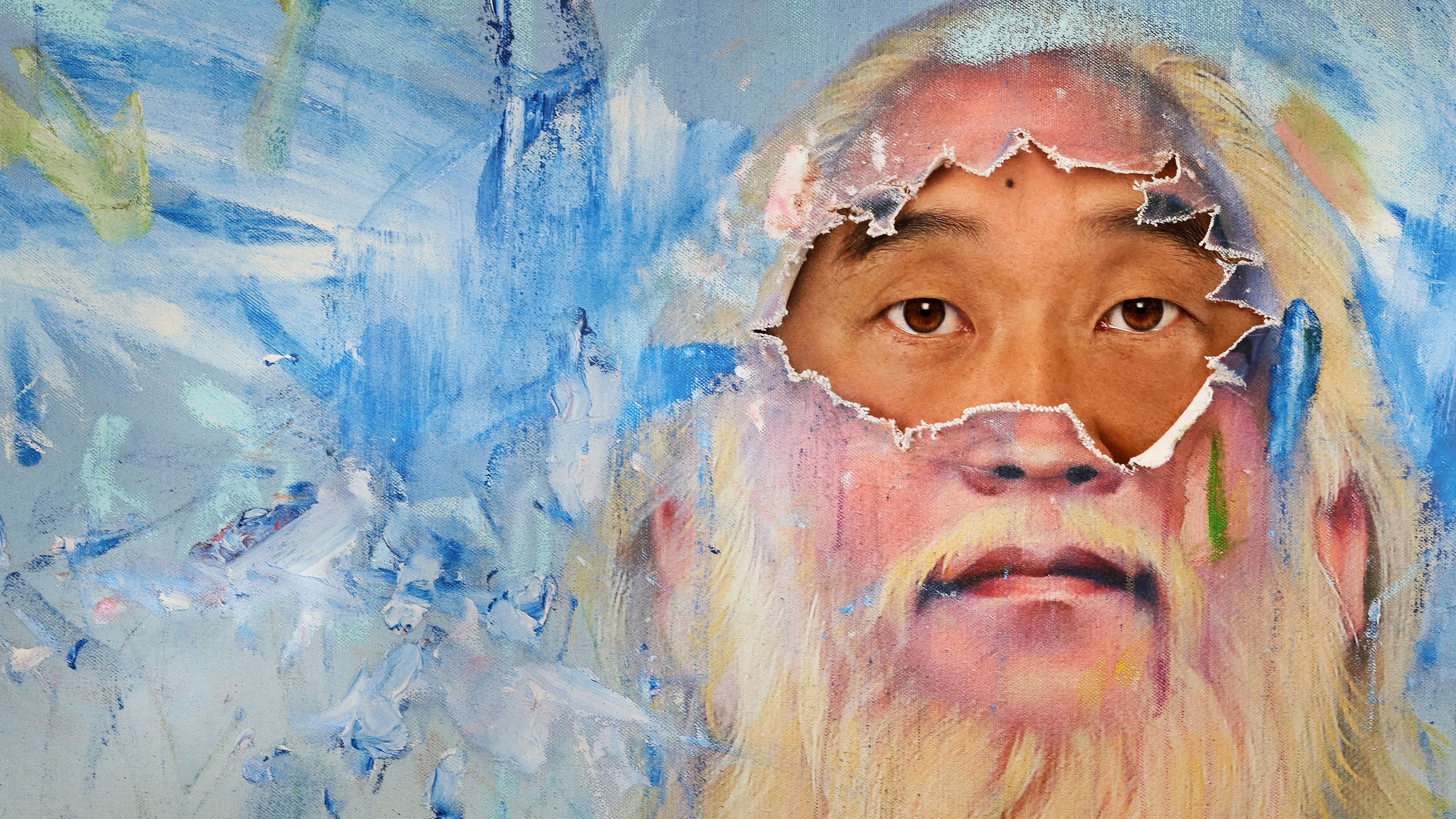
The Choe Show
Its first version had nothing to do with television.
In the summer of 2017, with years of therapy, Choe rented the old Farmers Insurance building off Wilshire in Koreatown and built something nobody had a name for. He called it “The Choe Show.”
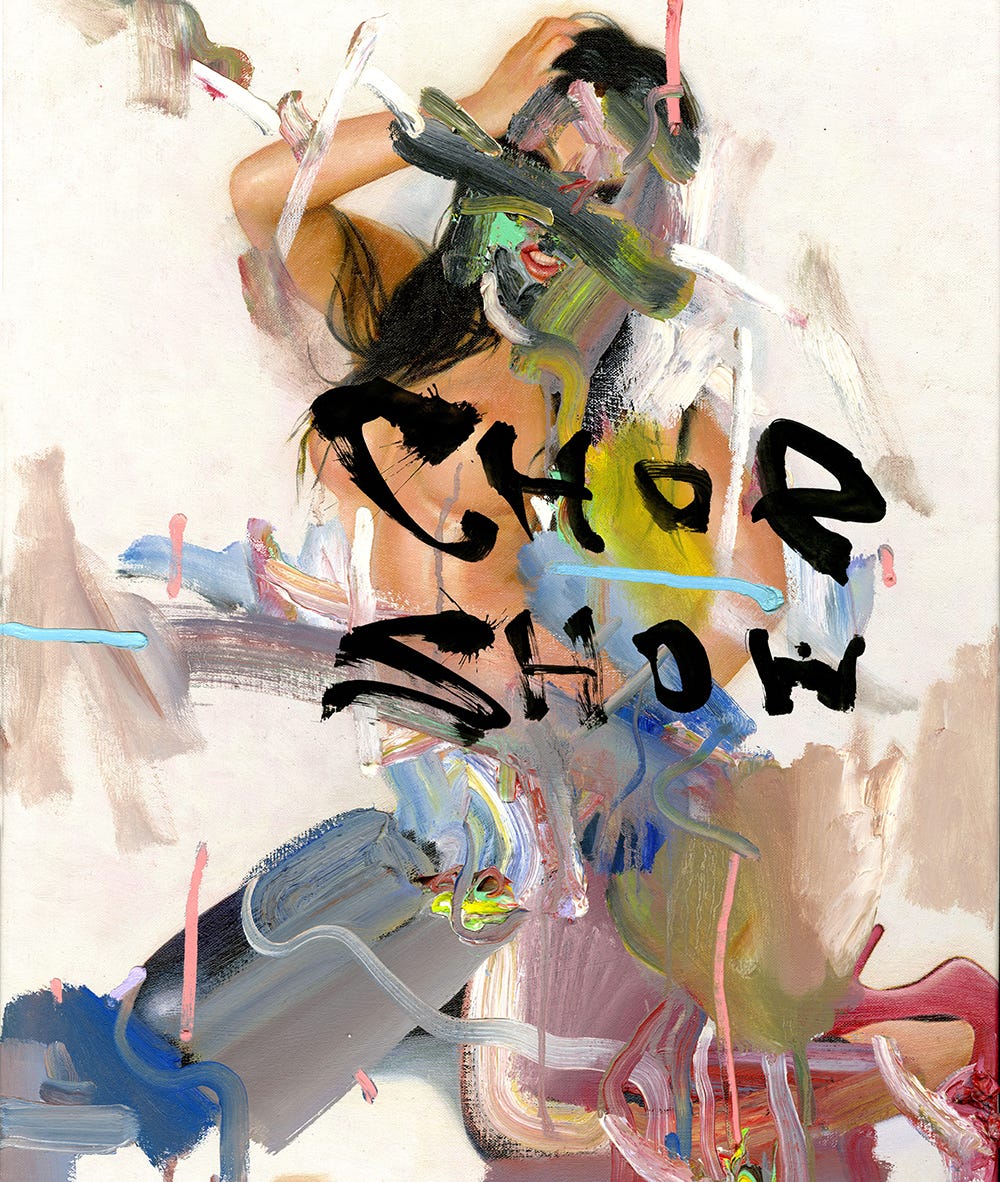
Applicants filled out an extensive online questionnaire, got phone-screened by members of Choe’s family, signed NDAs, and were told to abstain from food, drugs, alcohol, porn, and masturbation for twelve hours before arriving. They showed up in groups of strangers, put on jumpsuits, and were led through a series of rooms: one where a guide used intimate details from their applications to push them toward buried pain, one where actors recreated scenes from Choe’s life, one where participants beat a padded actor with a whiffle ball bat while screaming the name of whoever was hurting them—the sound filled the room.
Choe’s paintings hung in a pitch-black room, visible only by flashlight. He appeared first as a hologram, then in person. The cameras recorded everything.
LA Weekly reported that participants emerged in tears, connecting with strangers they’d met hours before, describing the experience as something between group therapy and a religious ceremony. It ran July 12 through August 5, free, invite-only, in a building with no sign out front.
The Choe Show (FX, 2021) scaled the format for broadcast. Hiro Murai executive produced alongside Revelli and Christopher Chen—Murai was coming off Atlanta, and the pairing made sense. All five episodes dropped June 25, 2021. Choe filmed in his childhood Koreatown home, sat with guests while painting their portraits—a medium he openly hated, which is why he chose it—and conducted conversations that followed wherever vulnerability led.
Will Arnett discussed childhood shame.
Steve-O explained how childhood abandonment led to a career as, in his own words, “an attention whore.”
Asa Akira returned, revealing dimensions the DVDASA format had kept buried.
The Hollywood Reporter called it “a chaotic, emotionally exposed mess—by design.”
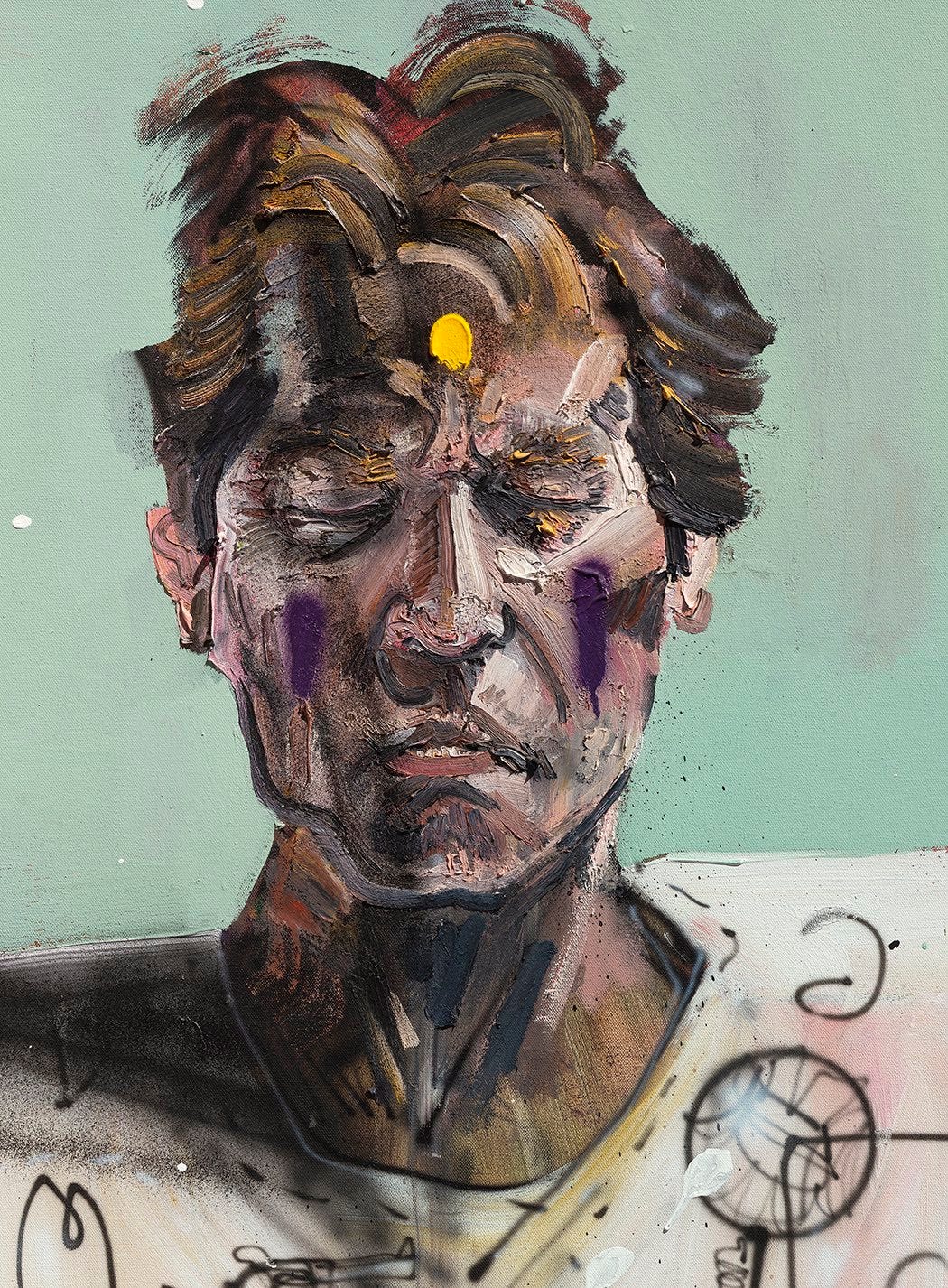
Val Kilmer’s segment was the format pushed to breaking. Kilmer, who by then could barely speak after throat cancer treatment, communicated through a notepad. Choe painted him in silence.
FX cancelled it after five episodes.
Not For Sale
Lee Sung Jin had been kicking around a road rage premise for years, based on an actual incident, when he realized the story needed Asian-American characters. Netflix won a bidding war for the series in March 2021.
Isaac Cho—Danny’s cousin fresh out of prison—was the role nobody could cast. Hundreds of actors submitted tapes. Lee told Today that everyone was “leaning really hard into the kind of Koreatown mafioso energy,” and none of it felt right. He was watching The Choe Show when it clicked. Choe was talking about being abandoned by his family, and Lee thought: “The way he’s talking about it just feels so Isaac.” He texted Steven Yeun and Ali Wong: “Hey, do you think David would ever act?” Choe submitted what Lee called “the most creative self-tape I’ve ever seen in my life,” complete with bloopers and creative editing. “I just knew he was perfect. That guy doesn’t know how to be false.”
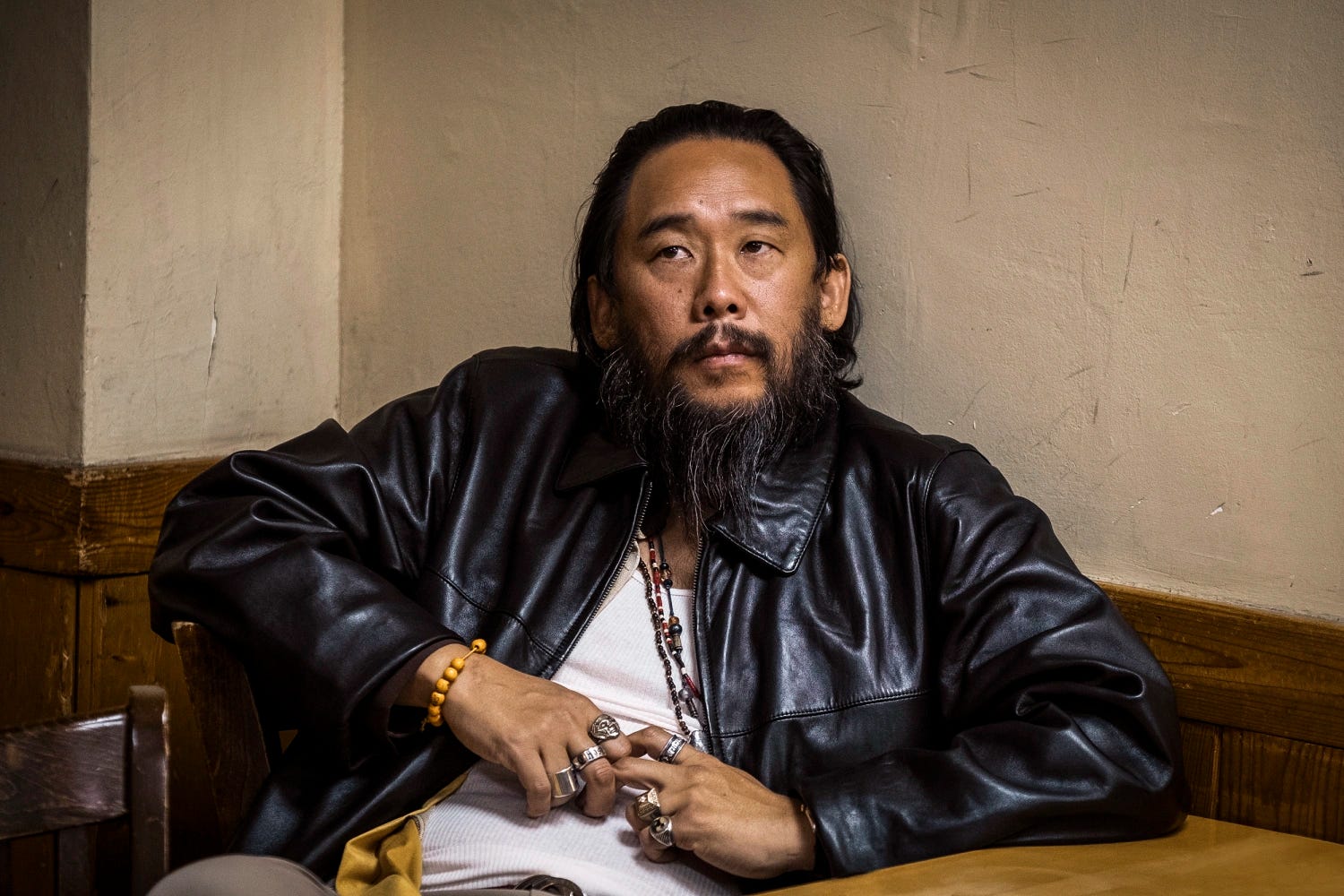
Lee received something Choe hadn’t given the public in over a decade: his paintings.
Hundreds of canvases, all unseen, stockpiled during his years of withdrawal. Lee’s original plan had been public domain paintings for the title cards; he’d already selected Pieter Aertsen’s sixteenth-century A Meat Stall with the Holy Family Giving Alms for the first episode. When Choe offered his catalog, Lee switched. He kept the Aertsen for Episode One and picked nine Choe paintings for episodes two through ten, each one interrupting the cold open with Choe’s twisted, paint-heavy figures, then vanishing before the viewer could process them. Lee worked with Sarofsky on custom title text, using late-90’s Ray Gun magazine as visual reference. They tweaked the font, Balboa, to look increasingly manic as the series progressed.


Three seconds of Choe before each episode began. Lee’s favorite was the finale’s, Figures of Light: a figure peering down at chaos below, mirroring the high-angle shot that returns to Danny and Amy’s wrecked cars. IndieWire observed that the title cards yanked a tripwire that made the characters fall. Every week, Choe’s paintings smuggled themselves into the cold open of one of the most-watched shows of 2023.
Beef earned a 98% Rotten Tomatoes score, eight Emmys, three Golden Globes. Ali Wong became the first woman of Asian descent to win an Emmy in a lead actress race. The show became the first created by and starring Asian Americans to win Best Limited Series at the Golden Globes.
70 million viewing hours in its second week alone.
Choe stopped selling paintings, stopped exhibiting, told Rogan he wasn’t on this planet to make expensive art for rich people.
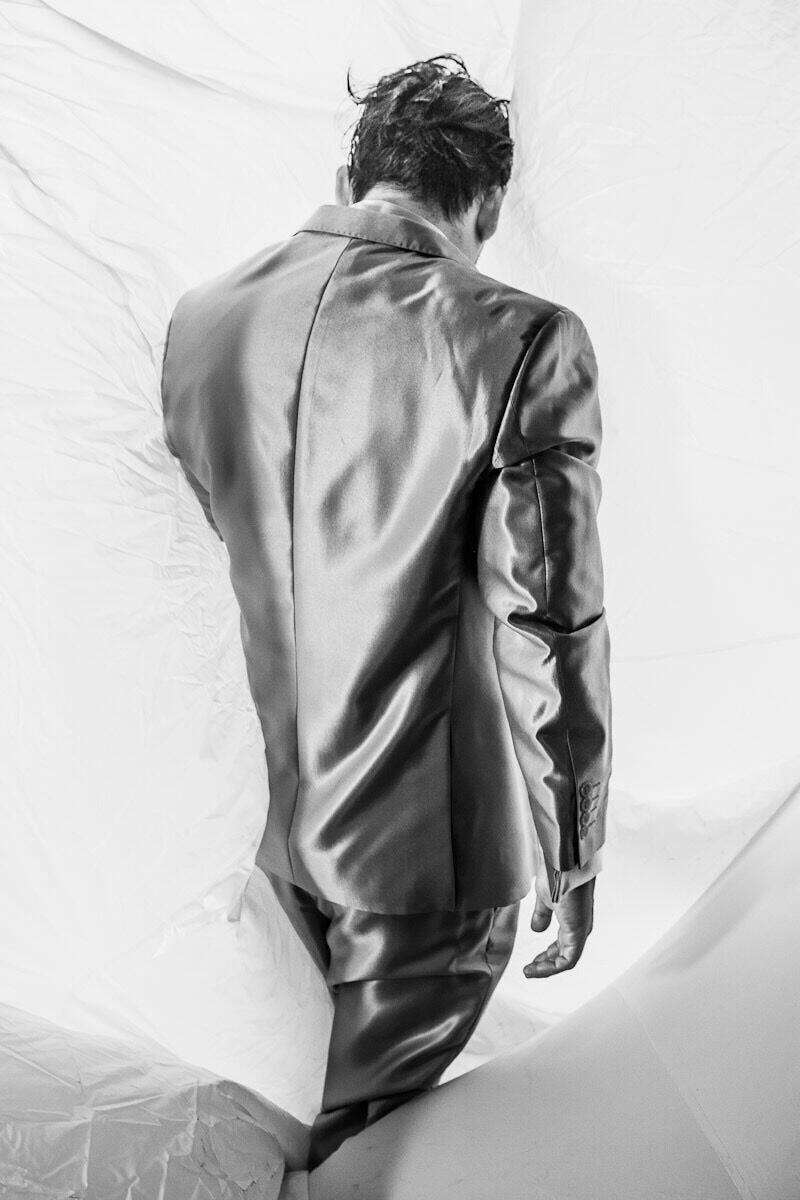
From Shame to Grace
The Huberman Lab interview in December 2025, a four-hour unedited look into the mind of David Choe. Tales of his mother’s blind faith, then a switch to stories about 99-cent color copies mailed to art directors whose addresses he’d copied from mastheads at newsstands.
David Choe, on Huberman Lab, December 2025—
Everything the world had shown me, besides from my mother, is that you’re not enough. And that was also confusing because she sent me away and abandoned me. So it was like, you’re telling me I’m the best, but then you threw me out like trash.
Work addiction was the one nobody flagged because the output looked like success. He told Rich Roll you can hide in plain sight and people pat you on the back. He’d had a heart attack at 35 and gone back to the casino the next day.
David Choe, It All Adds Up lecture, 2020—
My love must be performance-based. Only when I achieve, perform, and I do something good. That’s when people accept me.
His best work always came from constraint. On Rogan #1518, he said every horrible thing that ever happened to him—physical abuse, sexual abuse, prison, career destruction—had always led to bigger and better.
His girlfriend at the time of Dirty Hands:
My girlfriend says it all the time.
She’s like, you just want to be tortured.
You just want to be fucked up.
And it’s like, yeah, I mean, sometimes you miss it.
Sometimes you miss the loneliness. Sometimes you miss the pain.


He’d tested that hypothesis in Tanzania. On the same episode, Choe told the story of living with the Hadza, a hunter-gatherer tribe, for four months. He’d arrived with a tent and branded food while they slept in caves and foraged.
At the end of the first week, he moved into the cave and gave up everything. “That first week is withdrawal. I’m like, fuck, where’s my phone?” he told Rogan. “And then, all of it goes away. I’m not thinking about any of my addictions, I feel peace, I’m not miserable, my depression goes away.”
Morning to night: hunt, eat, celebrate, sleep. No screens, no money, and no audience. He spent days making art with the Hadza kids.
The tribe came back covered in blood from a hunt, looked at the art, and threw it off the cave.
David Choe, on The Joe Rogan Experience #1965, April 2023—
It just hit me so hard in that moment. They’re so present.
It’s just—we did it. We love it. And bye-bye, it’s a piece of paper in the wind now.
And I threw it off the cliff and I was like, more of this.
Donations flooded the Meleka Foundation, funding wells and schools. Choe co-shot a documentary, We Are Hadza.
David Choe, on The Rich Roll Podcast, September 2021—
It is an impossibility to be a great artist and to be well.
And the pain of walking around being like, I’m not entitled to actually take care of myself because that will threaten the very thing that makes me who I am.
A former teacher of Choe’s, interviewed by Jaworski, saw the bind from outside the mythology:
I truly feel he’s more comfortable when he’s fighting, when things are broken.
Most artists first start off obsessed with work as an escape, as a survival tool—the work distracts them from the pain of reality.
But take that away—that means and need to survive—what happens to the work, to the person?
Like a dog chasing a car that eventually stops, they get pummeled or run over by their own longing for achievement.
Choe still believes in Santa Claus, announcing it publicly, and unironically, for the first time at almost (now) 50. As a child, when someone told him Santa wasn’t real, he decided Santa was real but just didn’t bring him presents because he was bad.
On the verge of tears, from the Huberman Lab episode, December 2025—
I can’t sit still because that means I have to sit with myself and I can’t do that.
I can’t do that.
I couldn’t do that—I couldn’t do that.
I can now.
CHOEYMON
Choeymon arrived on February 2, 2026: 888 packs, ten cards each, Pokemon-inspired art rendered in Choe’s hand across textured foil, cracked ice, and holo finishes. Munkomon, Choemon, Pikachu through Choe’s line, Mega Charizard reimagined in dirty-style brushwork.
Every pack carried a chance at an original 1/1 hand-painted card, a Choe painting the size of a playing card, tucked inside a $45,445 eight-pack set sold through Rowang Gallery on Artsy.
From shame to grace. CHOEYMON.com is here. I came out of my cave of isolation.
All proceeds back to the Meleka Foundation, the same Hadza community he’d been funding since Tanzania. A fifteen-year-old can hold a Choe original in his hand for fifty bucks.
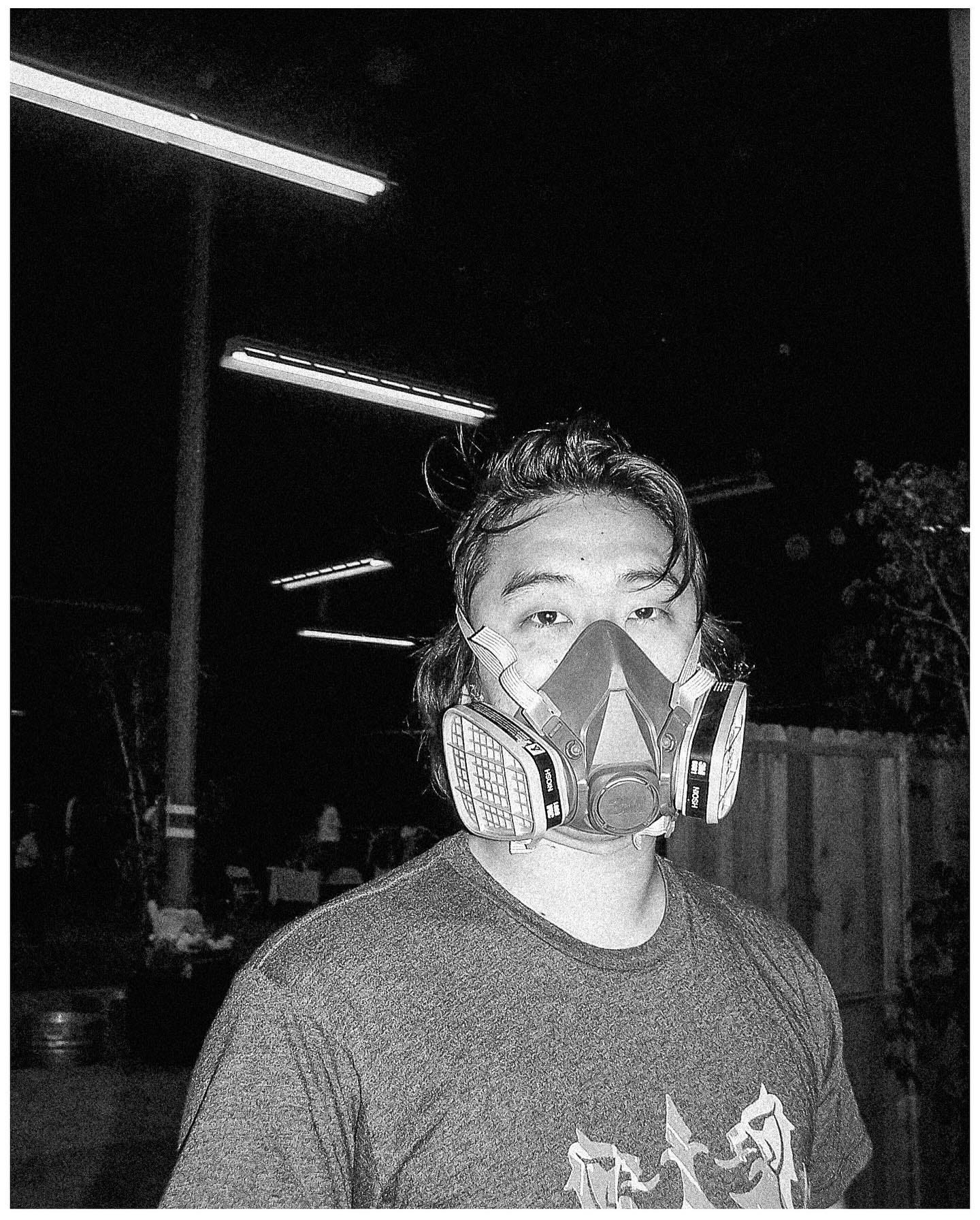
Why Saving David Choe Means Saving Yourself
On March 13, 2026, Reuters published a year-long investigation identifying Banksy as Robin Gunningham, a Bristol native who’d later adopted the name David Jones.
“There is no Robin Gunningham,” Lazarides told Reuters. “The name you’ve got I killed years ago.”
A decade earlier, Choe had written that unmasking Banksy would serve no one, that the only people worth unmasking were villains.
Choe on March 9, 2016—
Who is Banksy?
Banksy is Batman he is not Robin.
Choe’s response to the unmasking, posted as an Instagram Story on March 18th, accompanied by a still of Spider-Man being carried:
There was an
Understanding
When Spider-Man was
unmasked
You saw my face
Now shut the fu<k up
About it
if you want me to keep
protecting you
Than you protect me
You didn’t see sh!t

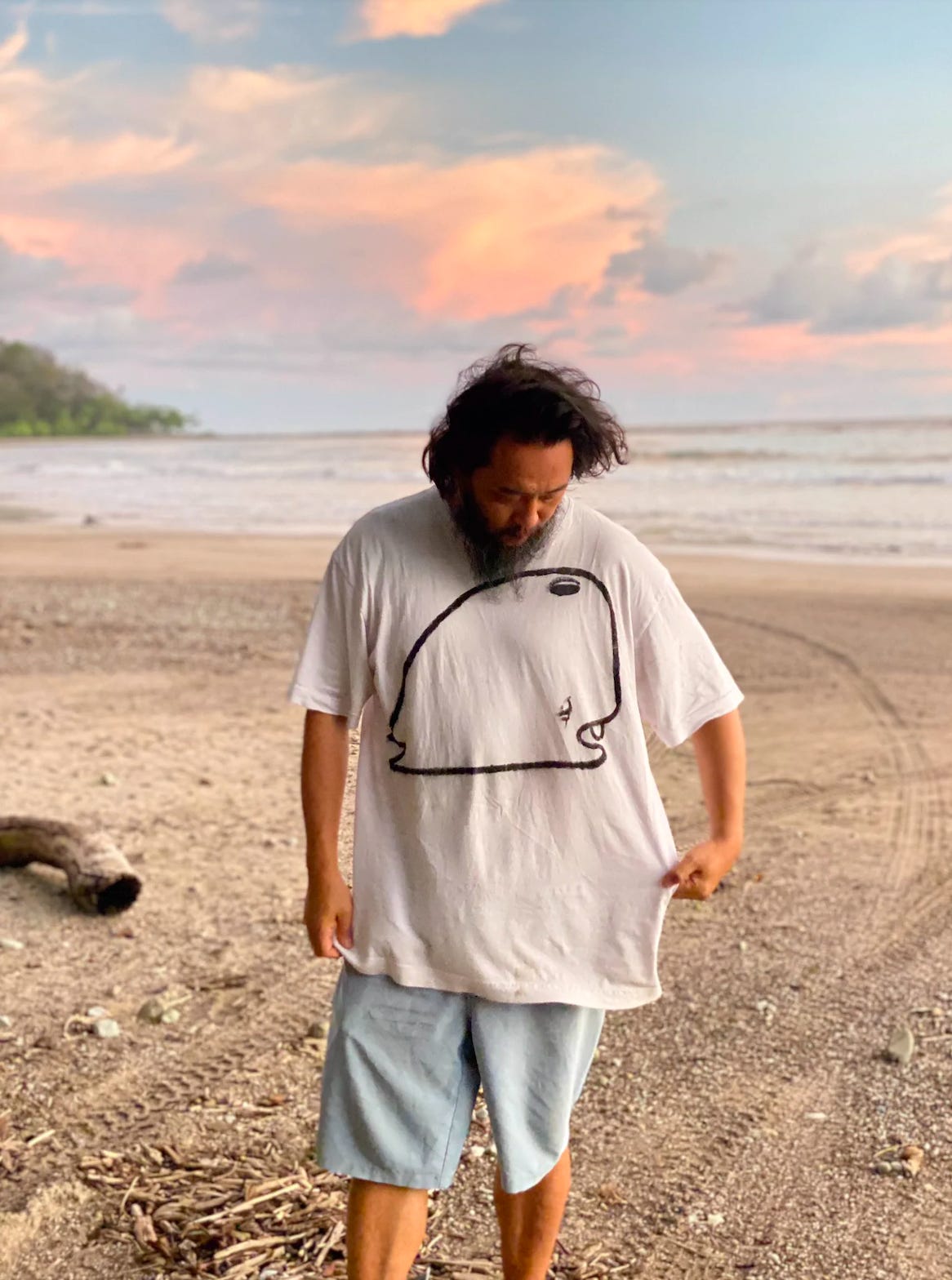
Somewhere on Western Avenue there’s a whale on a cracked off-white slab of concrete between a transmission shop and a taquería. Four feet tall, no arms, no legs, one tooth, and a hole in its head. The spray paint is so old the color has left it. It’s been repainted twice.
Soy sauce, blood, Krylon, stock options, and trading cards.
Different paint on different walls, in cities that kept changing, over decades that didn’t slow down. Underneath all of it, the same kid trying to get past the part of himself that kept score to the part that could finally sit still.
Choe finally did.
All uncredited images c/o David Choe