
The Hoodie That Ate Hip-Hop
How a Harajuku backstreet, a Virginia Beach studio, and a century of Black-American craft labor reshaped luxury fashion.

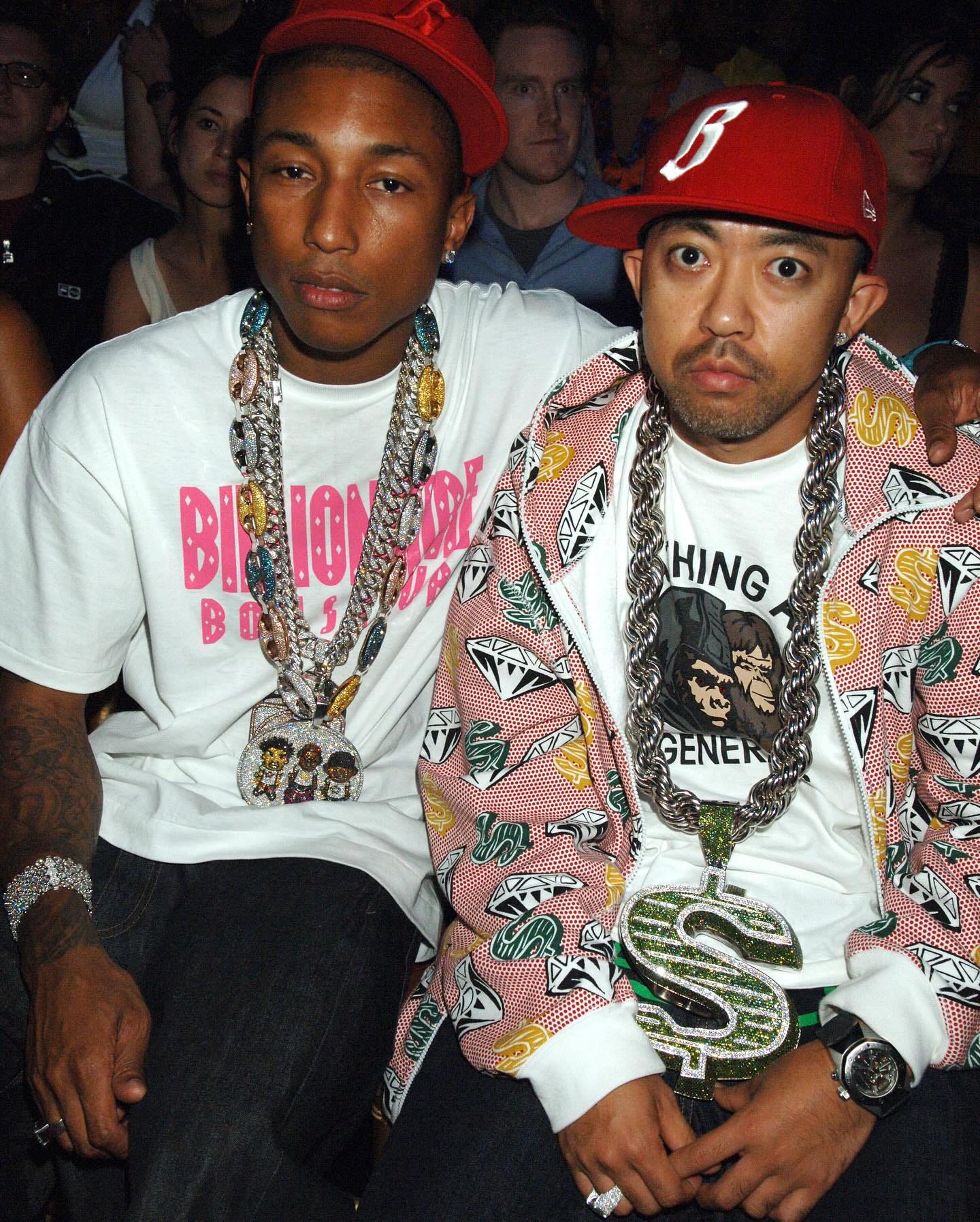
Tokyo knew what to do with American leftovers—denim, camo, cartoons, rap-video fits. In Harajuku, kids picked it up, studied it, and hung it under glass with a price tag attached.
DISCLAIMER:
This article constitutes opinion, cultural commentary, and criticism.
French and Japanese translations are unofficial and non-authoritative.
Heavily inspired by Ametora; can’t recommend it enough.
NIGO & P
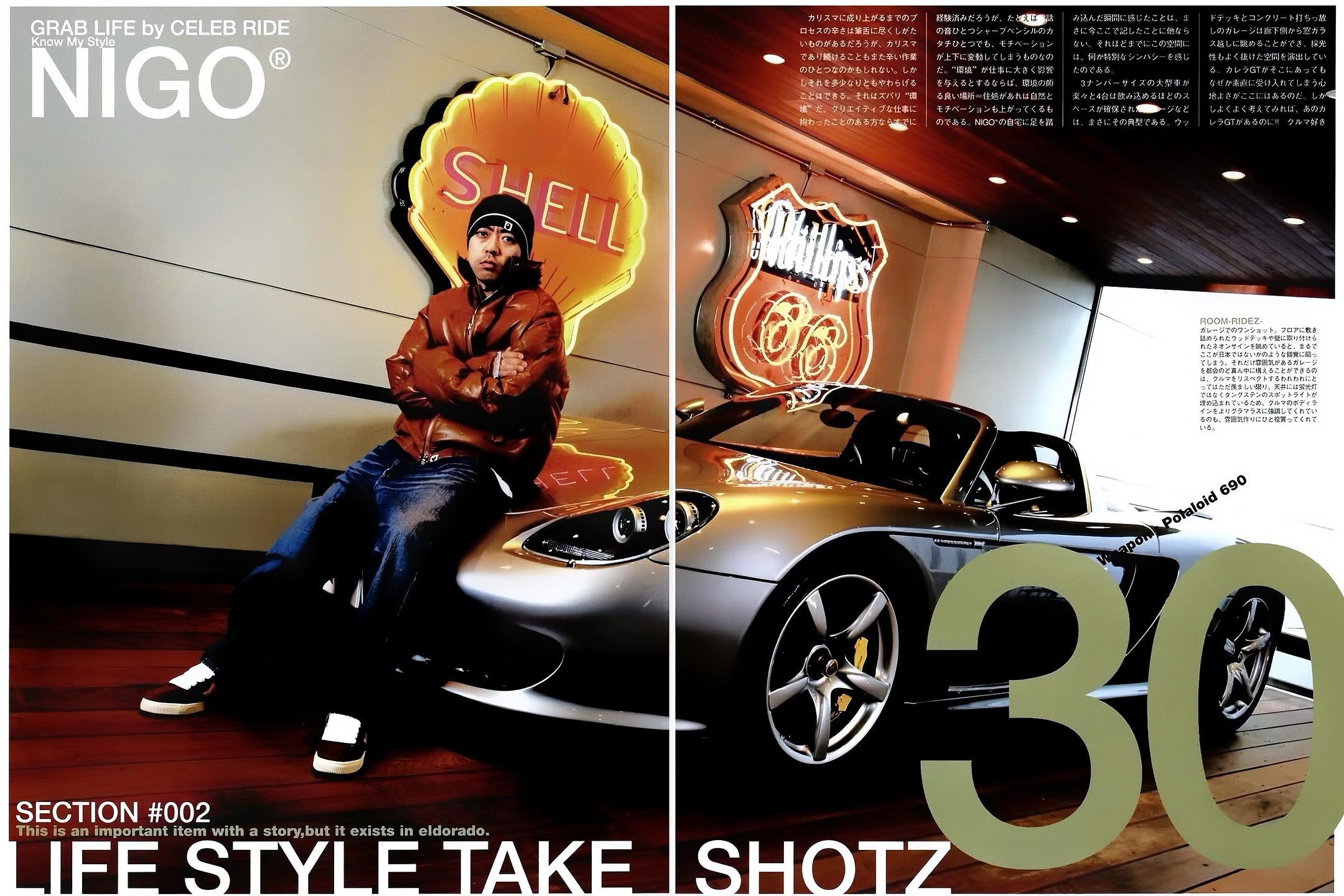
In the early 2000s, before the two launched BILLIONAIRE BOYS CLUB, Pharrell Williams walked into NIGO’s personal archive in Tokyo.
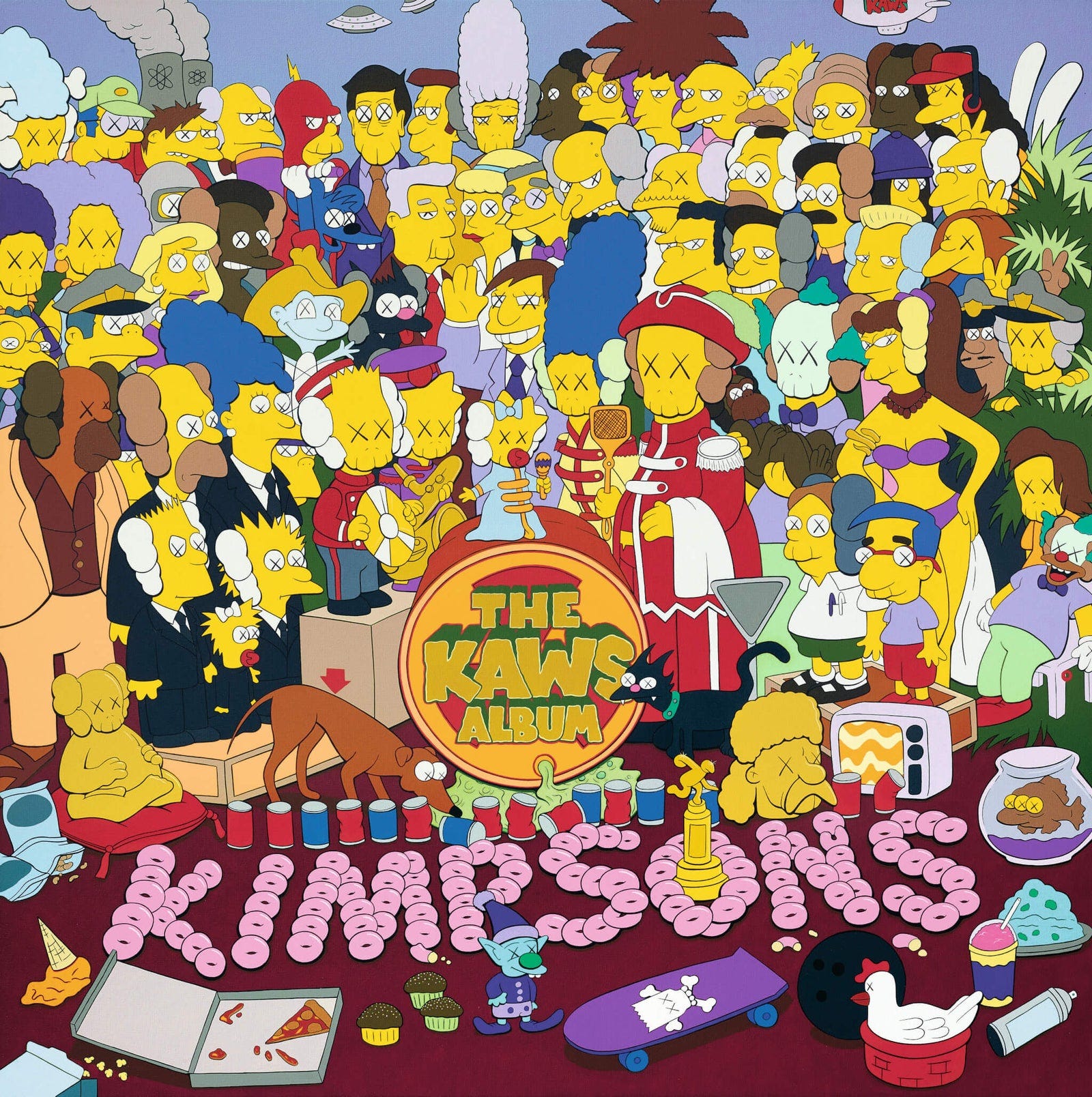
NIGO had already helped launch KAWS’s breakout “Kimpsons” series at Shibuya Parco in 2001, packaging American childhood back to itself before most of America noticed it was happening.
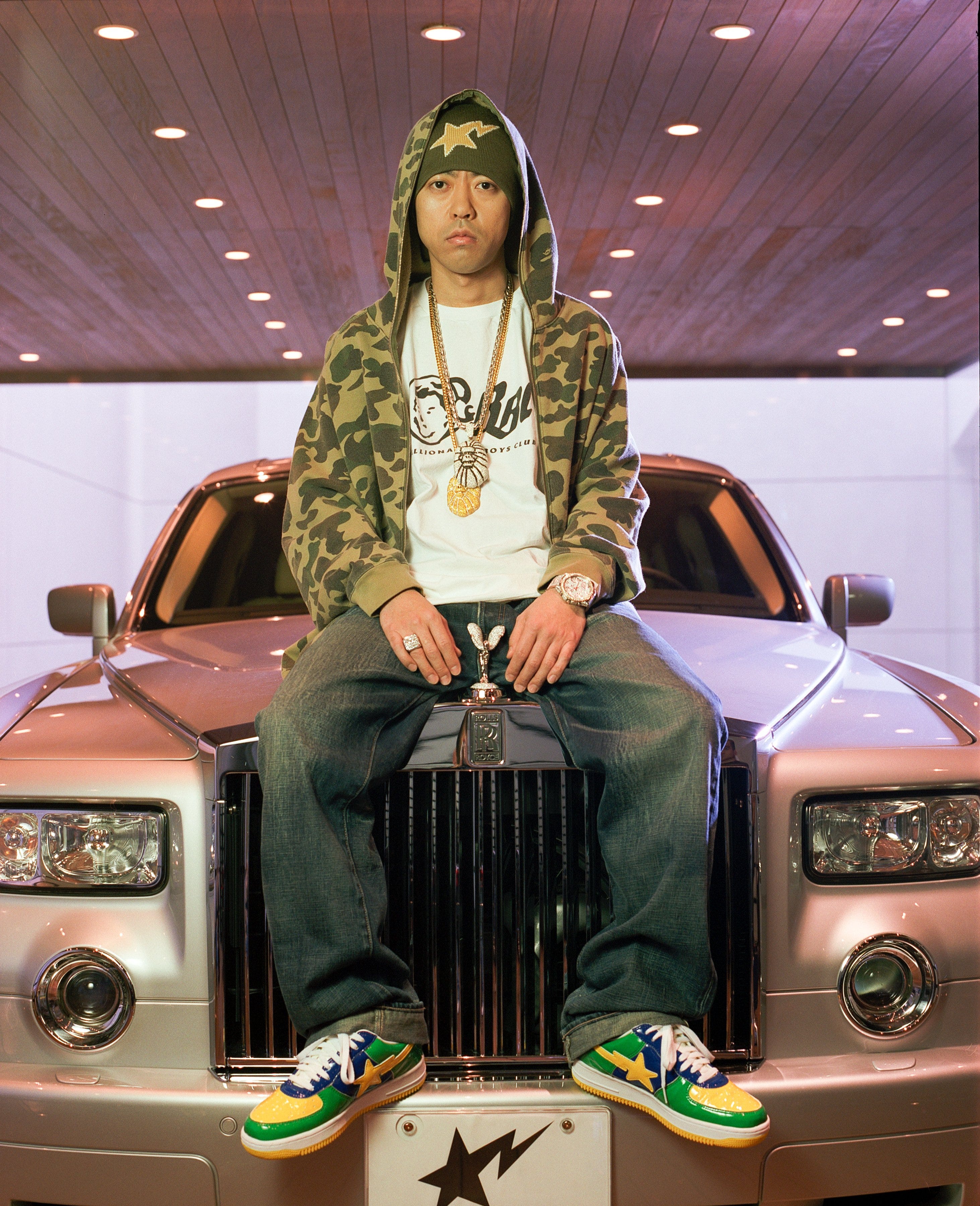
Jacob the Jeweler had introduced them. For months, Pharrell and NIGO had been orbiting each other through a jeweler’s catalog: NIGO would thumb through photos of Pharrell’s commissions and ask Jacob to remake each one in different gold colors.
Pharrell, GQ, 2019—
Up until meeting [NIGO], my greatest references—the guys that garnered the most respect—were the guys with the big Bentleys. My big brother Jay. Big brother Puff. […]
He just bowed all the time.
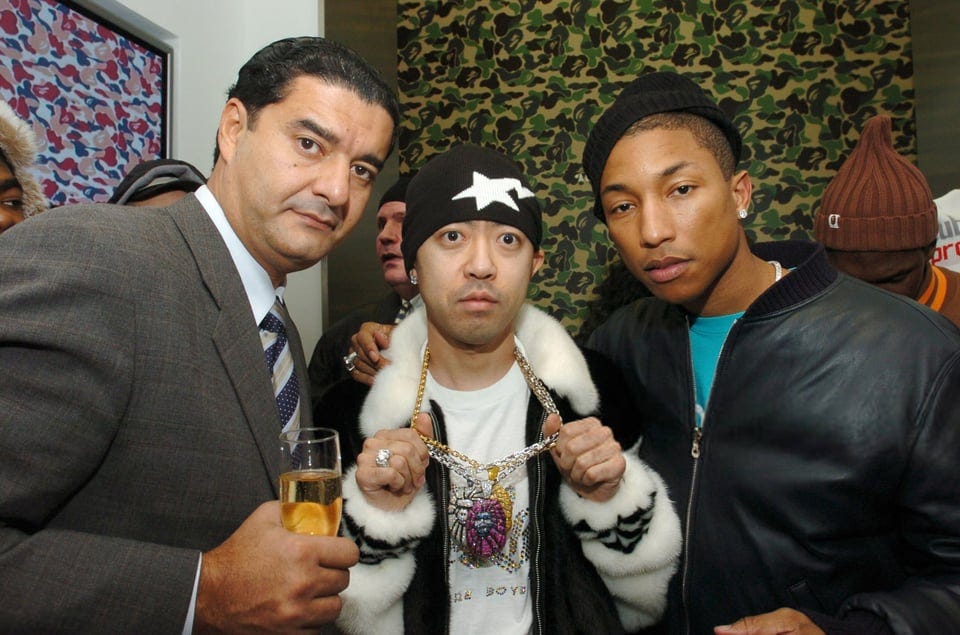
NIGO described BAPE’s secret sauce to WWD JAPAN in November 2002—
デザイナーになろうと思ったことはない。僕が得意なのはディレクション。振り屋。ヒップホップの影響が大きいから、サンプリング手法と同じで、壊さず、そこに新しいものをつけて出す。
I never set out to become a designer. What I’m good at is direction—being a furiya (振り屋), a sender, a router. Hip-hop is the big influence, so my method is the same as sampling: you don’t destroy the source, you graft something new onto it and put it back out.
NIGO took this technique, and applied it to varsity jackets, sneakers, cartoons, and American sportswear, all while controlling it from the top down, starting with the factory. The boxes started arriving in Virginia Beach two years later.
Japan invented little of the raw material—denim, workwear, military surplus gear, and hip-hop all crossed the Pacific as American imports.
The mills in Okayama wove selvedge on old Toyoda shuttle looms—domestic frames once used for sailcloth, per Ametora. Men’s Club in Tokyo did similar for Ivy League clothing, documenting every detail of a dying American style with architectural precision before building an industry around preserving it.
The Osaka 5—Studio D’Artisan, Denime, Evisu, Full Count, and Warehouse—mastered American denim on thrown away equipment. Earlier still was Lapine, the Osaka deadstock-Levi’s import shop. Projectile looms weave faster and wider, and American mills switched to them in the 70s for the efficiency. The old narrow shuttle looms left slubs, an uneven selvedge edge, unique texture that vintage denim carried. Japanese mills like Kurabo repurposed their own shuttle frames and revived the selvedge the U.S. industry had stopped bothering to make.
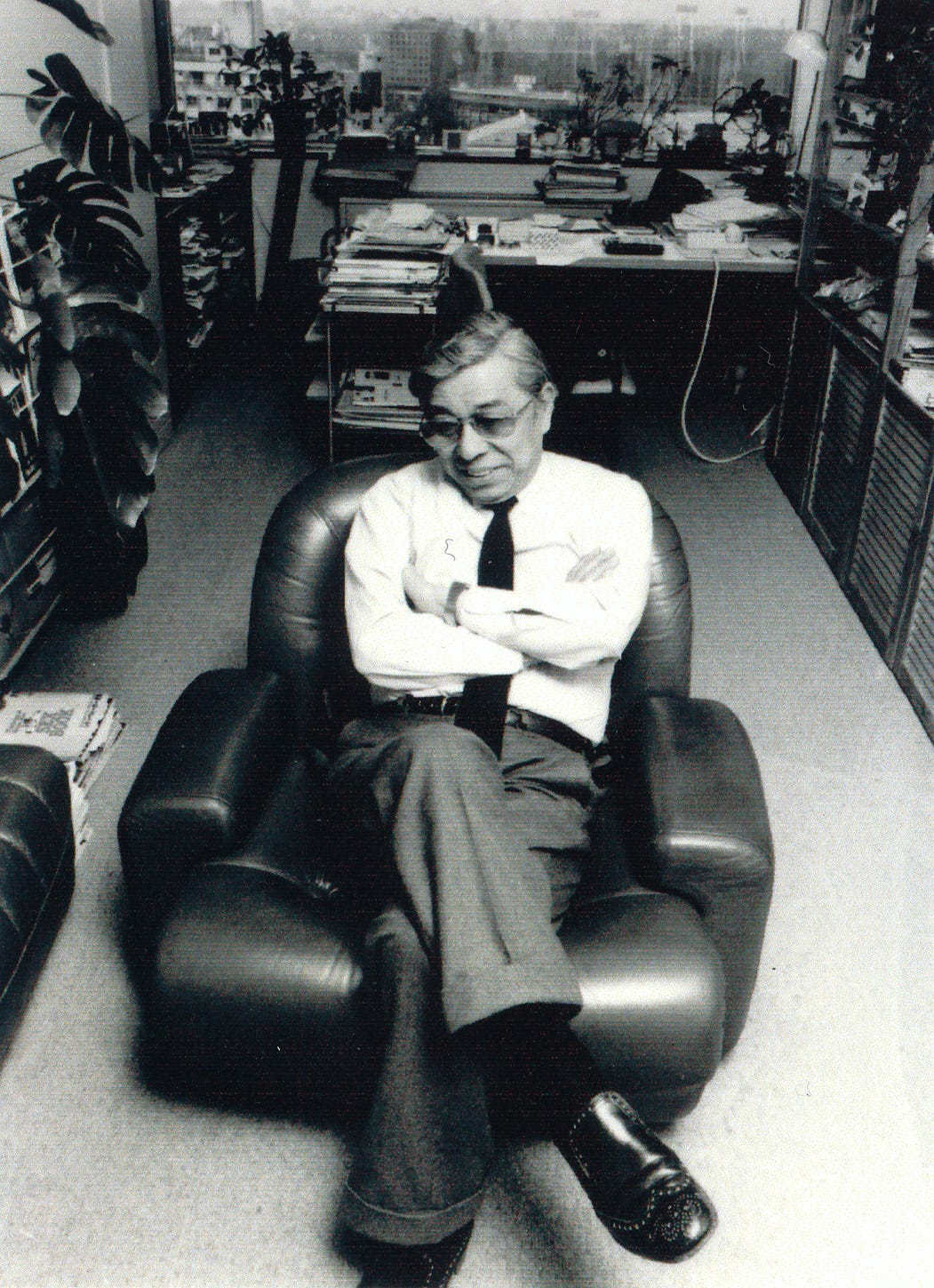
Kensuke Ishizu spent the war years in Tianjin and came back to a scorched Japan, where American GIs walked down the rebuilt boulevards of Ginza and Yokohama. The American style was obvious: broad shoulders, natural waists, cotton that breathed, a posture that carried the body easily. Ishizu studied all of it.
He founded VAN Jacket in Osaka in 1951, moved it to Tokyo three years later, and grew it to a peak of ¥45.2 billion (per W. David Marx’s Ametora) by treating American style as something worth studying. VAN published its own magazine, Men’s Club, beginning in 1954; it taught collar construction, loafer welt types, sack-suit cut, penny placement, button spacing, and intricacies other sources rarely did.
A Japanese teenager in 1960 who wanted to look American could open Men’s Club and study the rules; an American teenager had only his father’s closet to copy.


Eventually, this produced the Miyuki Tribe. Weeks before the 1964 Tokyo Olympics, Japanese teenagers in VAN’s Ivy uniform loitered on Miyuki Street in Ginza every weekend. Tokyo police swept the street and hauled off about 200 of them, processing 85 at Tsukiji. Take Ivy ran in Japanese that year and didn’t reach English until 2010. The team aimed at all eight Ivy League campuses and made it to six, skipping Cornell and U. Penn.
Ametora (アメトラ: “American traditional”) is the label, but the romantic translation undersells the business Ishizu was running. His expansion through Daiei and other Japanese supermarket chains had hollowed the brand out; cheapened it in a way. VAN filed bankruptcy in April 1978.
Hiroshi Fujiwara, who would later mentor NIGO, was 14 when VAN collapsed, with NIGO then 7 and Jun Takahashi, who built Undercover, 8. The generation that founded Ura-Harajuku had watched the most successful Japanese menswear brand in history die of abundance, and they built their own brands starting in 1993.
By the late 1980s, a generation of Tokyo teens had grown up wearing American brands as the norm: Brooks Brothers, Levi’s 501s, and moccasins remixed into a Shibuya style called shibukaji.
Sociologist Kōji Namba, quoted in Ametora, 2015—
All the fashion items in shibukaji were American, but “America” was not something that existed above them. It was something on their level.
Ishizu’s VAN crowd in the 60s had thoroughly studied and understood American style. Ura-Harajuku’s future builders came out of this scene.
Kojima, at the bottom of Okayama Prefecture, had turned out 90% of Japan’s school uniforms since 1937; by the 1970s it made almost all the country’s jeans. When 3,000yds of American denim landed at Maruo Clothing’s Kojima factory in February 1965, the women sewing it couldn’t get a stitch into the starched cloth.
W. David Marx’s Ametora documents that exact scene literally, and names the machine brands—Mitsubishi and Juki.
Nobody’s Home
With Tokyo rebuilt, the Shinkansen (bullet train) line opened. The Miyuki Tribe arrests were a largely overlooked wrinkle in that presentation. When the Olympic cauldron was lit on October 10, the style had drifted from Ginza to Shibuya, then over the hill to Harajuku. A generation of young designers began colonizing those backstreets in the mid-90s.
Where Paris’s Chambre Syndicale de la Couture had, since 1868, kept control, Ura-Harajuku—literally “behind Harajuku”—folded all aspects into a half-mile radius and handed them to 20-somethings.
Hiroshi Fujiwara was a charter member of the International Stüssy Tribe [IST] alongside Goldie, Mick Jones of The Clash, and Luca Benini of Slam Jam—Shawn Stüssy’s hand-picked circle of DJs, designers, and shop owners who moved product for each other across Tokyo, London, Milan, and New York. The inaugural IST meeting was held in Tokyo. Sarah Andelman opened Colette at 213 Rue Saint-Honoré in 1997, the Paris shop where European eyes first saw BAPE, Supreme, and Stüssy alongside Hermès and Prada.
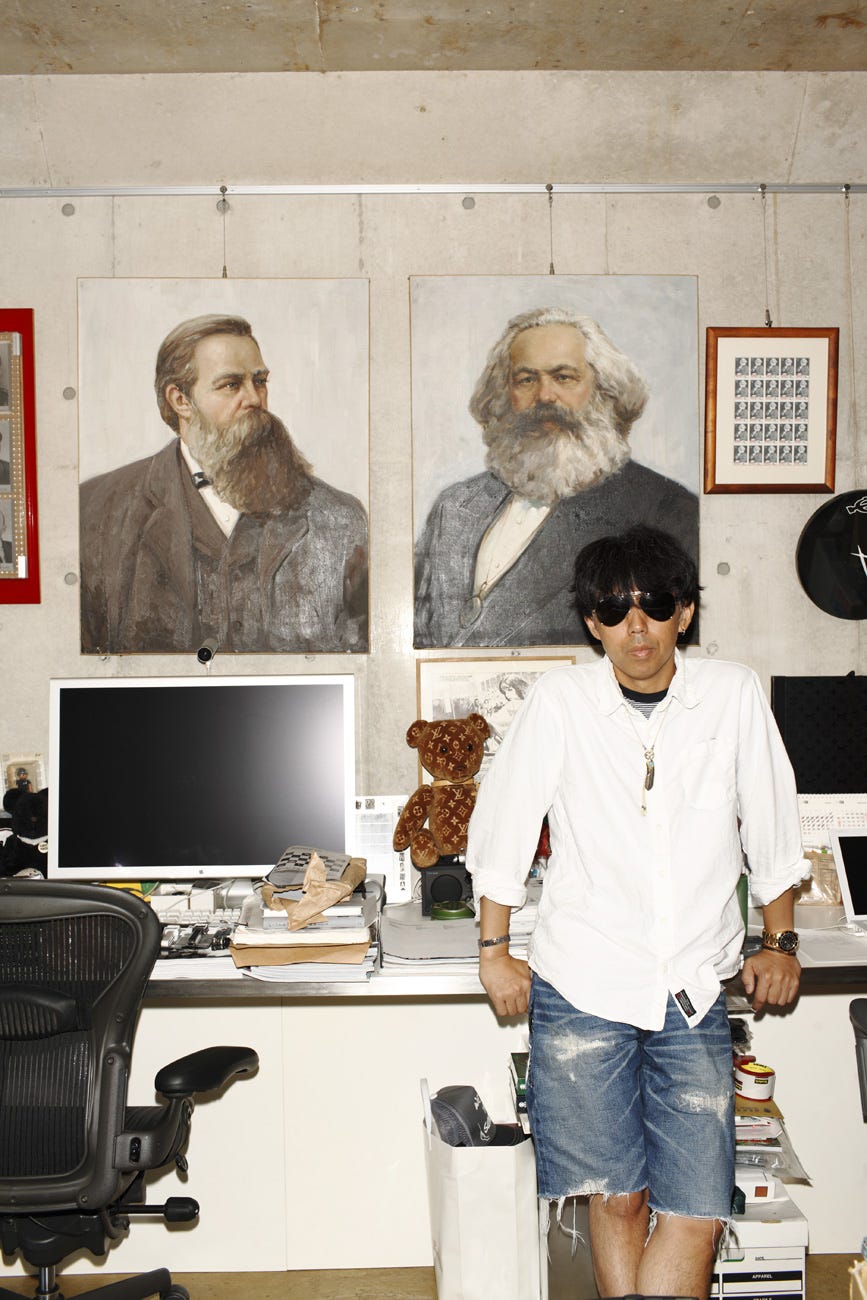
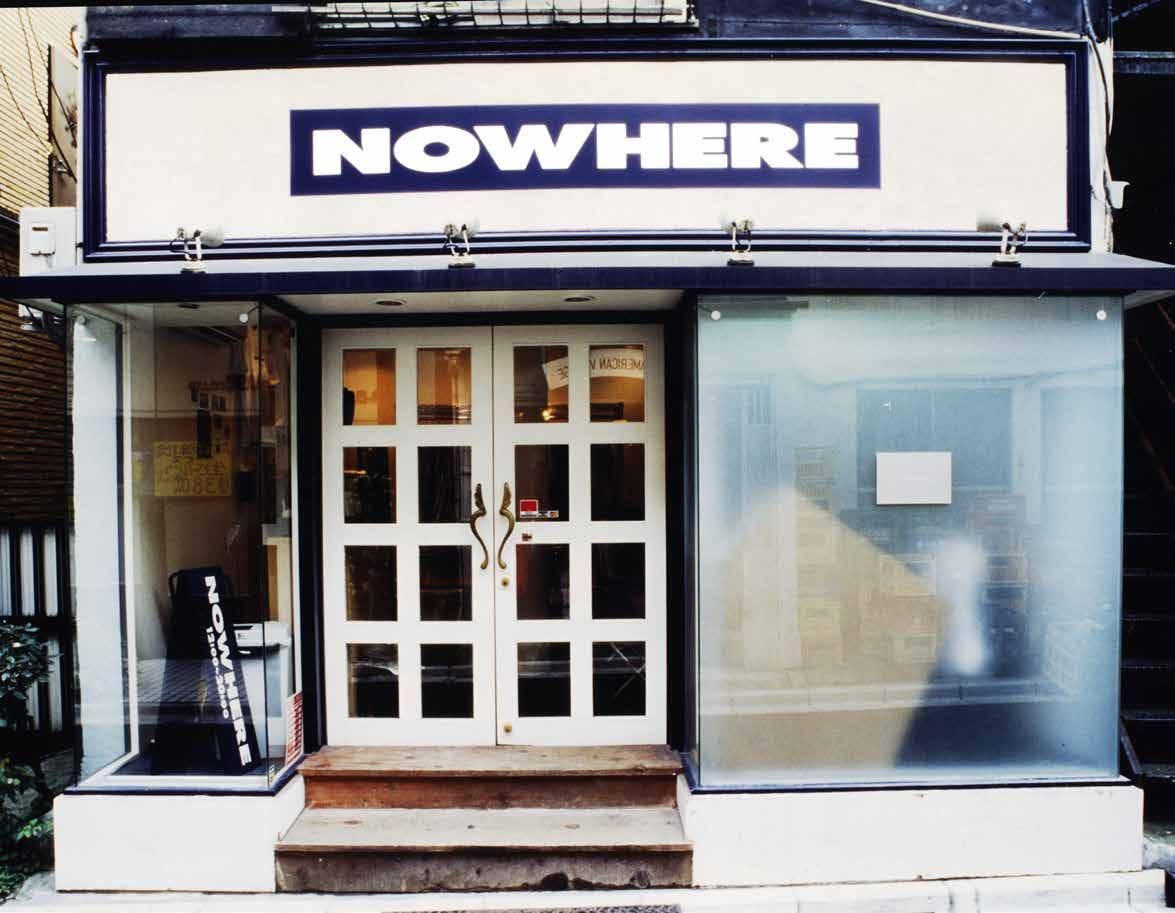
James Jebbia opened Supreme on Lafayette Street in 1994, and Fujiwara’s influence on Tokyo’s broader scene shaped how the brand was received in Japan. Jebbia had been working the downtown New York scene for years before Supreme, and when he opened, the model was already in his hands: one storefront, limited runs, no wholesale, and a clientele built on plugs. NIGO and Takahashi had opened Nowhere on a Cat Street backstreet in April 1993 on the same terms.
VF Corporation paid $2.1 billion for Supreme in 2020. Rei Kawakubo and Adrian Joffe opened the first Dover Street Market in Mayfair in 2004, selling Supreme and Nike on racks beside Prada and Balenciaga.
Fujiwara for Numéro Tokyo in July 2018—
90年代の裏原のブランドが始めるまで、ファッション業界でブランド同士が一緒にものづくりをすることは世界にも類がなかったんですよ。その一度で二度おいしい感覚をハイブランドも気がついたのかも。
Until the ura-Harajuku brands of the nineties started doing it, there was nothing like it anywhere in the world—labels making things together. The luxury houses eventually caught on to the two-bites-of-the-cherry logic of it, I suppose.
Neighborhood × WTAPS and BAPE × Undercover preceded Louis Vuitton × Supreme by 20 years.
Hypebeast and Highsnobiety, both launched in 2005, turned drop calendars into a real-time news category, before social media existed in the capacity it does today. A Tokyo release on a Saturday morning was on an American reader’s feed by Saturday night. It meant anyone with an RSS reader had the same information the inner circle did, which changed the nature of the scarcity without dissolving it. The 50-shirt drop NIGO had sold in a single Harajuku storefront became a global lottery managed through a virtual app.
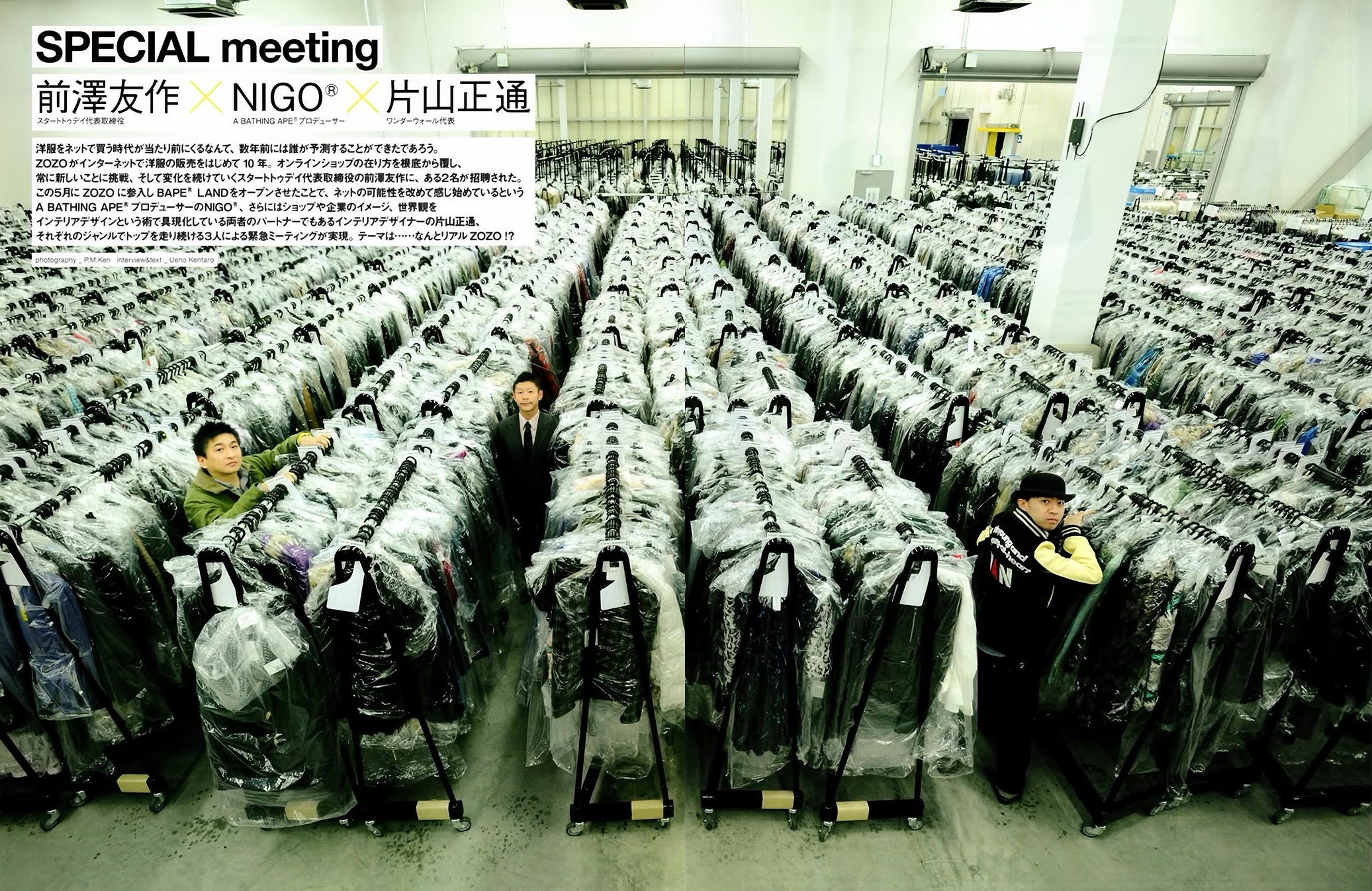
Fujiwara even hid his own name from GOODENOUGH. He explained to biographer Masayuki Kawakatsu why he kept his involvement anonymous.
Fujiwara in 丘の上のパンク (Shogakukan, 2009; English via Marx’s Ametora, 2015)—
僕がやってると言うと、服本来を見てもらえずに、買ってくれる人たちは買ってくれるし、嫌っている人たちには無視されそうだから、それをなくしたくて、名前を出さなかったんです。
If I told people that I was doing the brand, no one would actually look at the clothing. People who were going to buy it would just buy it, and people who hate me would ignore it.
Fujiwara for HILLS LIFE, October 2018—
その”裏原宿のカリスマ”みたいに言われるけれど、当時の感覚としては、”結局、相手にされていない”って感覚でしたよ。もちろん、雑誌で僕の記事を読んでくれていたような若い人たちは僕を支持してくれていたけれど、いわゆる”業界”の人からは、相手にされていなかったし、理解もされていなかったと思う。それは、実は今もそう思っているんですけどね。
People call me an “icon of ura-Harajuku,” but the feeling at the time was, frankly, that nobody was paying us any attention. The young readers who followed my magazine columns supported us, sure—but the so-called “industry” didn’t take us seriously and didn’t understand us. To be honest, I still feel that way now.
Fujiwara founded Fragment Design (2003), a studio that doesn’t sell its own product but applies a double lightning-bolt stamp to everyone else’s.

Nike paid for the 3% edit, as did Louis Vuitton, Moncler, Rolex, UNIQLO, Starbucks, and a long list of others. Strangely, Fujiwara did not enter through fashion. He entered through records, and London came first: Punk first, then London, then McLaren, then Afrika Islam at The Roxy.
Fujiwara recalls his first encounter with Sex Pistols to seventh grade in Mie and told Tokyo Art Beat in December 2024. He brought records back in his luggage, and Tiny Panx opened for the Beastie Boys on the 1987 Japanese tour and cut among the earliest Japanese-language hip-hop records. Major Force, the label he co-founded in 1988, released Major Force West compilations through London distribution; Masayuki Kudo and Toshio Nakanishi (Tycoon Tosh) ran the West operation out of the Mo’ Wax building after Kudo relocated from Tokyo in 1992, stitching James Lavelle’s record label to the Tokyo source.
From the July 1987 issue of Takarajima, he and Kan Takagi (his Tiny Panx partner) ran a monthly column called “Last Orgy” that catalogued the music, films, and clothing arriving from London and New York for a Japanese readership.
Fujiwara spotted Eric Haze’s graphics at Keith Haring’s NY Pop Shop in the mid-1980s and commissioned GOODENOUGH T-shirts via Michael Kopelman of Stüssy UK.
Simiarly to Fragment’s approach, Off-White designed its own goods, but Abloh’s collaboration calendar (Nike, Ikea, Rimowa, Evian, McDonald’s, Mercedes) treated the in-house line as one editorial stamp among many rather than the center of the operation. Abloh was elite at building rooms around the subject:
Two protégés emerged from Fujiwara’s circle: Jun Takahashi and Tomoaki Nagao.
Tomoaki Nagao arrived at Tokyo’s Bunka Fashion College intending to become a fashion writer. Nagao told Mebuku, the Maebashi local paper, that on July 21, 1984—the first day of seventh-grade summer vacation—he had walked into Atsumi Records in town and bought the Checkers’ debut album Zettai Checkers together with a copy of Olive, Magazine House’s girls’ fashion title, that featured the band. Nagao bore an uncanny resemblance to Fujiwara, and the nickname Hiroshi-ni-gō—Hiroshi #2—stuck.
Nagao became Fujiwara’s assistant, then later, became known as NIGO.
NIGO and Takahashi extended the franchise into “Last Orgy 2”—Fujiwara joined them in “Last Orgy 3” in Asayan, a three-author monthly that doubled as a promotional channel for BAPE, UNDERCOVER, and GOODENOUGH at the moment all three brands were fighting for identical readers.
NIGO, Sabukaru, April 2026—
I think the two of us were looking beyond Japan. We had many friends abroad, and generally, it’s difficult to get Japanese people to acknowledge you unless you’ve already been recognized overseas. None of it was calculated; it feels more like we were editing things based on intuition.
Cold Bath Water
The Nikkei lost nearly 60% of its value between 1989 and 1992. Commercial rents in Tokyo dropped by roughly 1/3 over the next few years. The conglomerate escalator that a generation of design-school graduates had expected to ride up to Mitsubishi or Sony, froze. Archivists, who four years earlier would have been tailoring salaryman suits, found cheap alley frontage on backstreets priced out of reach during the Bubble years.
NIGO and Takahashi co-founded Nowhere in 1993. They opened it on a budget of just 400,000 yen (roughly $4,000)—an amount that, years prior, wouldn’t have gotten a month’s rent in Ginza—and split the cramped space with literal wire netting: Undercover on one side, NIGO’s venture on the other.
A Bathing Ape took its name from a Japanese idiom—an ape sunk in a warm bath, too comfortable to move (in some translations, ‘lukewarm water’): postwar Japan’s stock jab at complacent youth who had everything, moved through soft comfort, and understood nothing about the struggle.
The first BAPE shirts were Ralph Lauren blanks, an Ape Head hand-screened onto them in the back of the Cat Street joint. He kept most of those early prints in deadstock condition; now a rare collectors’ item, worth ¥100,000 to ¥200,000 each. Two decades later, Virgil Abloh would do it with deadstock Ralph Lauren Rugby flannels, a $40 blank sold at $550.
When asked whether Nowhere had launched Ura-Harajuku, NIGO’s framing was that the two of them just happened to be the earliest.
The backstreets filled fast with more labels:
Neighborhood opened in 1994 under Shinsuke Takizawa
Bounty Hunter opened in 1995 under Hikaru Iwanaga
WTAPS opened in 1996 under Tetsu Nishiyama
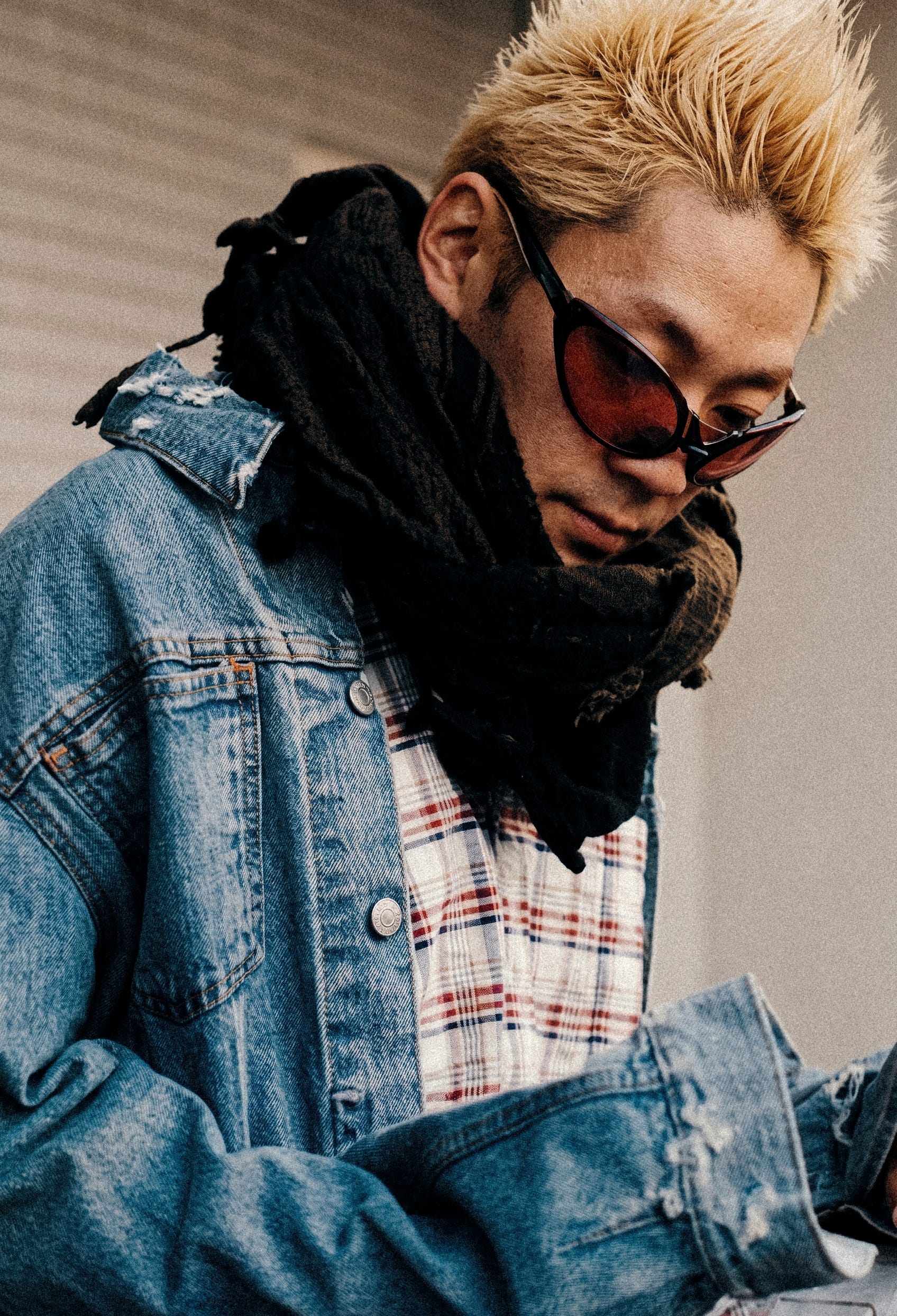
Acting as muscle tissue was SK8THING—Shinichiro Nakamura—the mythically lowkey and reclusive design legend who taught himself graphic design on a Mac in Fujiwara’s studio. A large share of the streetwear logos hip-hop wore from 1993 to 2015 are courtesy of SK8THING.
Reportedly, he and NIGO sat through a five-hour Planet of the Apes marathon in 1993; SK8THING had sketched the Ape Head logo. Kazuki Kuraishi worked next to him on BAPE graphics before moving between Neighborhood, Fragment, and adidas Originals by Originals—the designer who eventually carried the Ura-Harajuku method into Kanye’s adidas era.

Neighborhood sold BAPE, BAPE sold WTAPS, all close enough so a customer could walk the entire Ura-Harajuku scene in 20 minutes and leave with product from 5 brands none of which directly competed.
It was 2004, and American streetwear was trying to reverse-engineer the model and failing, because it required knowing both Takizawa and Nishiyama personally, and knowing meant having been around long enough that nobody needed to explain what WTAPS was or why Neighborhood was carrying it.
BAPE pulled from hip-hop, sportswear, and American pop culture all at once: Nike on your feet, Charlton Heston in the monster movie playing on cable, hunting camo at the Army-Navy surplus store.
Iwanaga introduced KAWS to Medicom Toy founder Tatsuhiko Akashi in the late 1990s, and by 2000 KAWS had licensed his Companion figure into vinyl with Medicom. The Japanese toy industry treated KAWS as a fine artist while the American gallery circuit was still treating him as a graffiti kid. NIGO, running BAPE at peak velocity, bought KAWS paintings and commissioned collaborations.
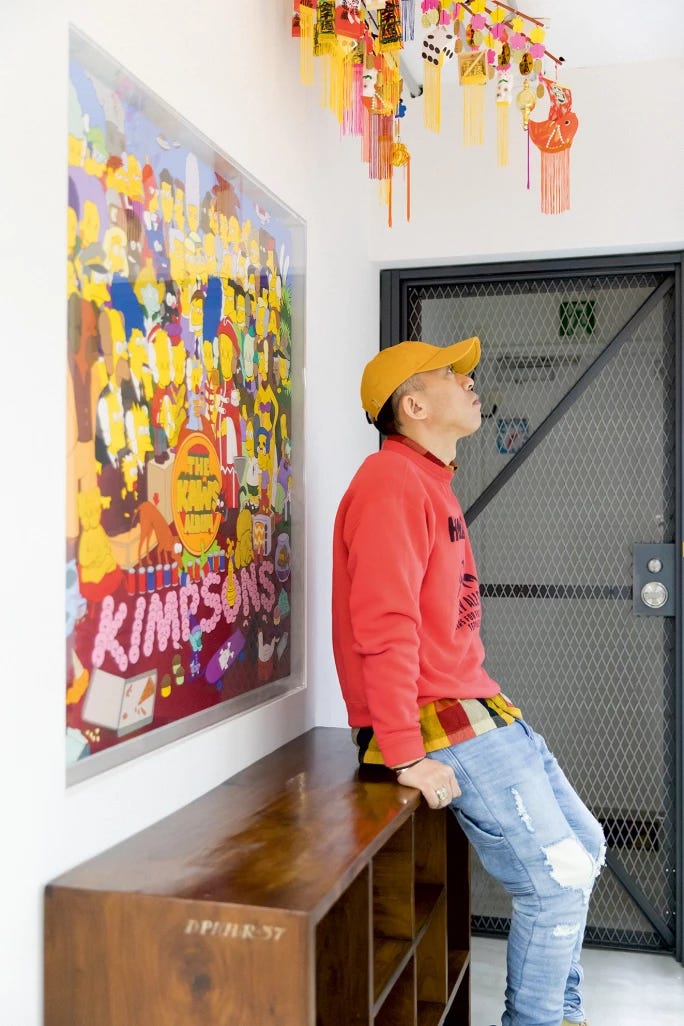
Sotheby’s Hong Kong sold KAWS’s 2005 painting The Kaws Album—a Sgt. Pepper’s cover reworked with KAWS figures in place of the Beatles—for $14.8 million against a presale estimate of $1 million.
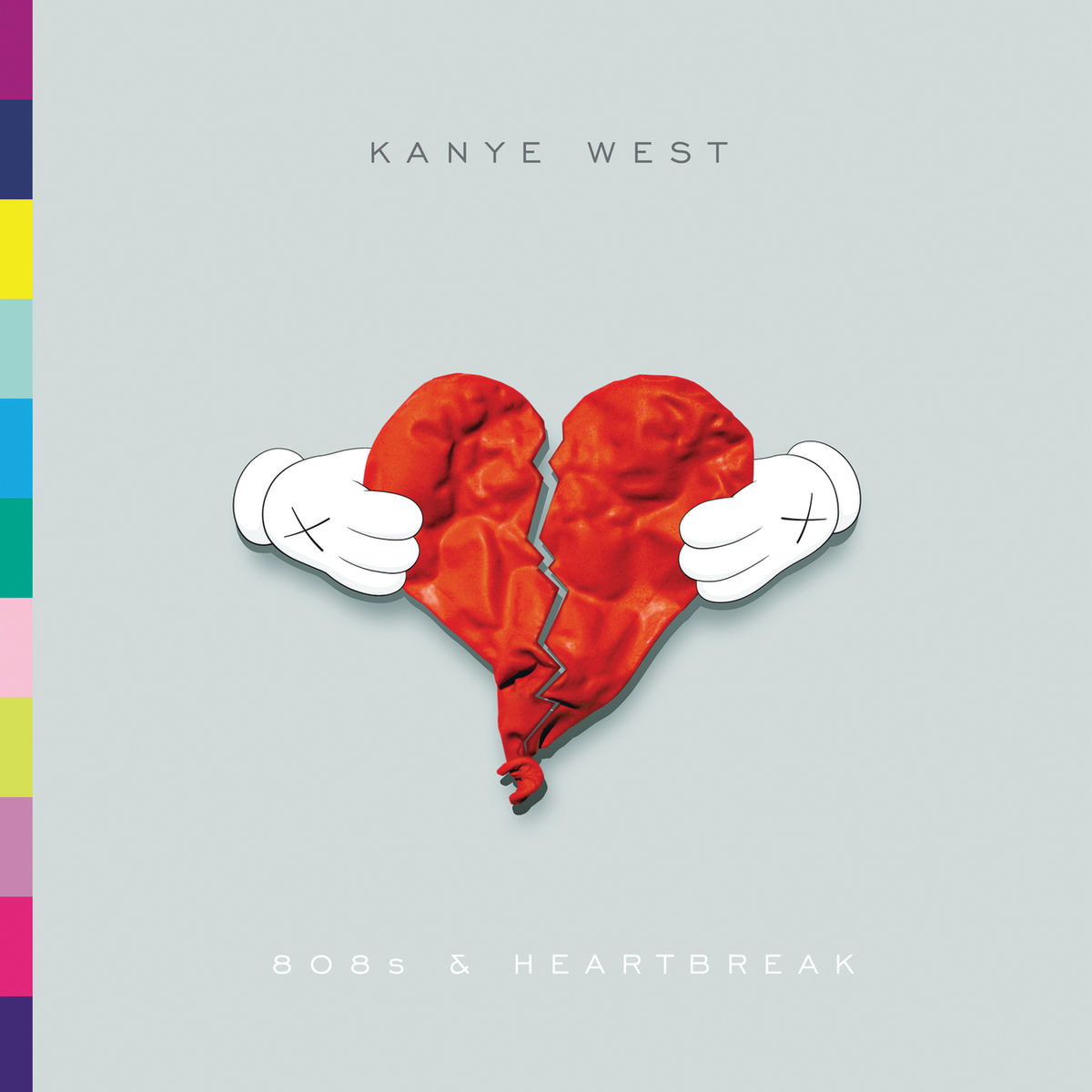
Shoichi Aoki founded FRUiTS magazine in Tokyo in 1997 after walking Harajuku’s Jingu Bridge on Sundays for five years and photographing the teenagers who gathered there. The bridge, closed to cars on weekends, functioned as a runway for obsessives assembling outfits from the backstreet boutiques. A Tokyo teenager in a hand-sewn Gothic Lolita dress mixed with Margiela tabi boots. A boy in a BAPE hoodie, Neighborhood cargos, and a hunting hat made from his grandfather’s pheasant feathers. The magazine ran 233 monthly issues until Aoki folded it in 2017, citing that the Jingu Bridge scene had naturally disappeared.
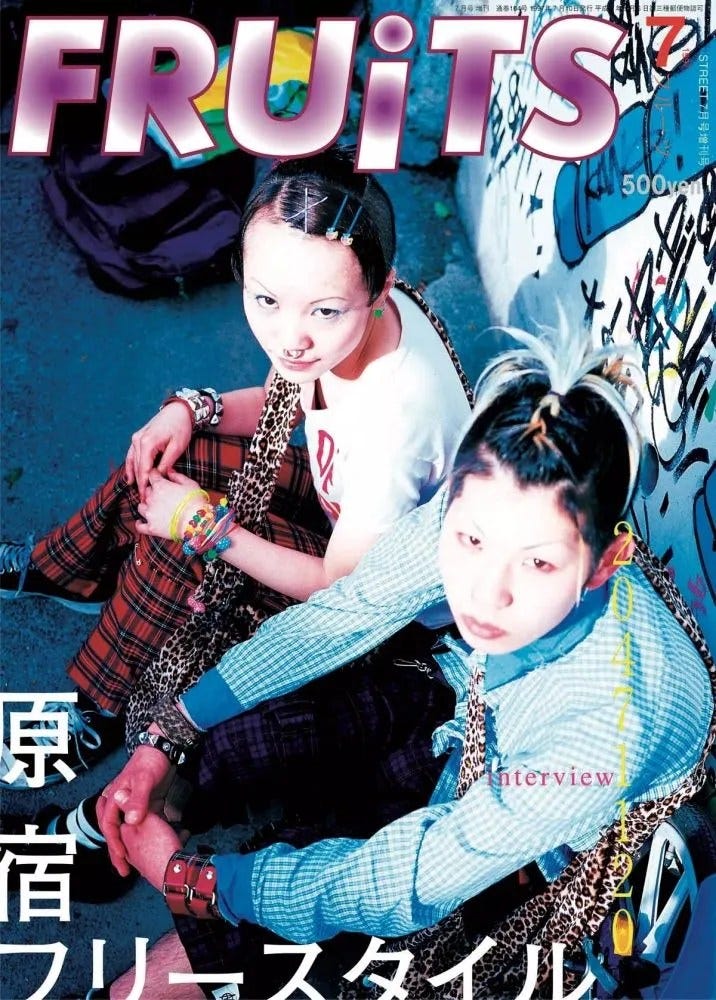
FRUiTS was to Harajuku what Men’s Club had been to the Miyuki Tribe. The subjects were not models, wealthy, nor credentialed. Merely teenagers, who had assembled outfits from brands whose workshops they could walk to in 20 minutes. A Paris editor leafing through FRUiTS in 1998 saw the exact product the backstreet brands had built, worn naturally, as the designers intended. It was raw, gritty, and above all, authentic.
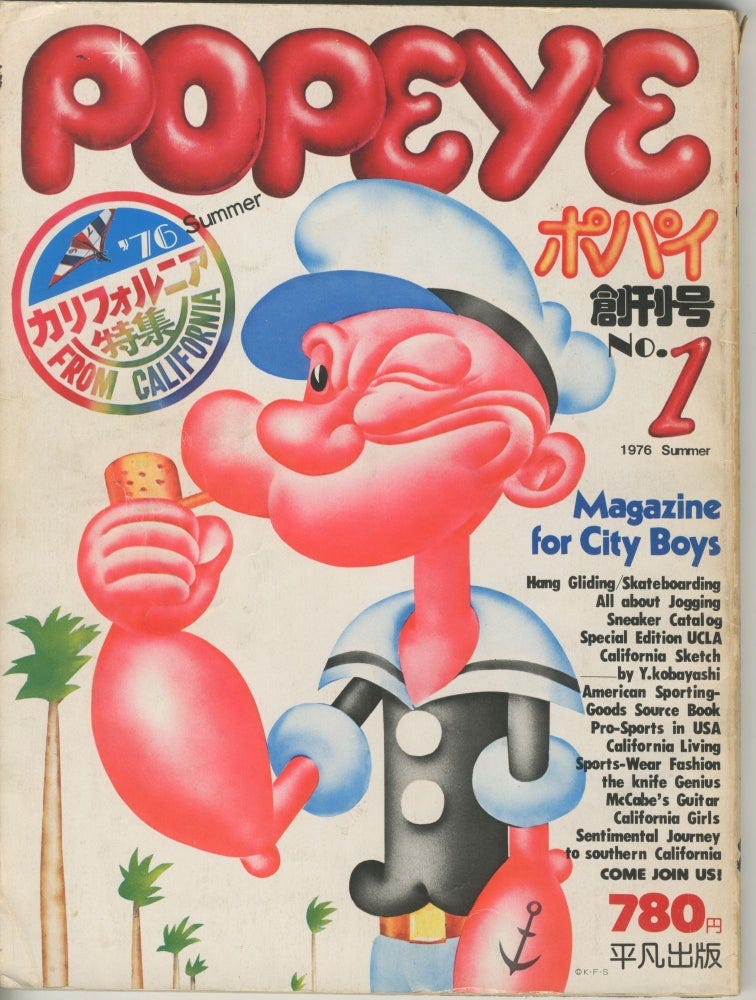
Popeye made it work in 1976, a glossy men’s magazine whose subject was not celebrities or collections but the anthropology of a style, filing its first issue, “Surf & Skate”, from California and giving its second to Ivy League campuses. American writers were still citing Popeye back issues 40 years later as a primary-source record of American collegiate style from the 1970s through the 1990s.
Hypebeast and Highsnobiety would later try to retrofit the editorial half, 15 years late.
Ralph Lauren’s polo ponies went even further, where the line references the sport, and the sport references English aristocracy.
Nike’s Air Force 1 is still visible in every BAPESTA—Swoosh swapped for a shooting star, “AIR” swapped for “APE,” patent leather and psychedelic prints replacing Nike’s white tumbled grain.
Jay-Z and Kanye cleared the Otis sample with the Redding estate directly (the estate agreed to a “featuring Otis Redding” credit on Watch the Throne) because the whole point was that you’d recognize it. Planet of the Apes (the original 1968 Charlton Heston version, not the remakes) became BAPE’s entire identity.
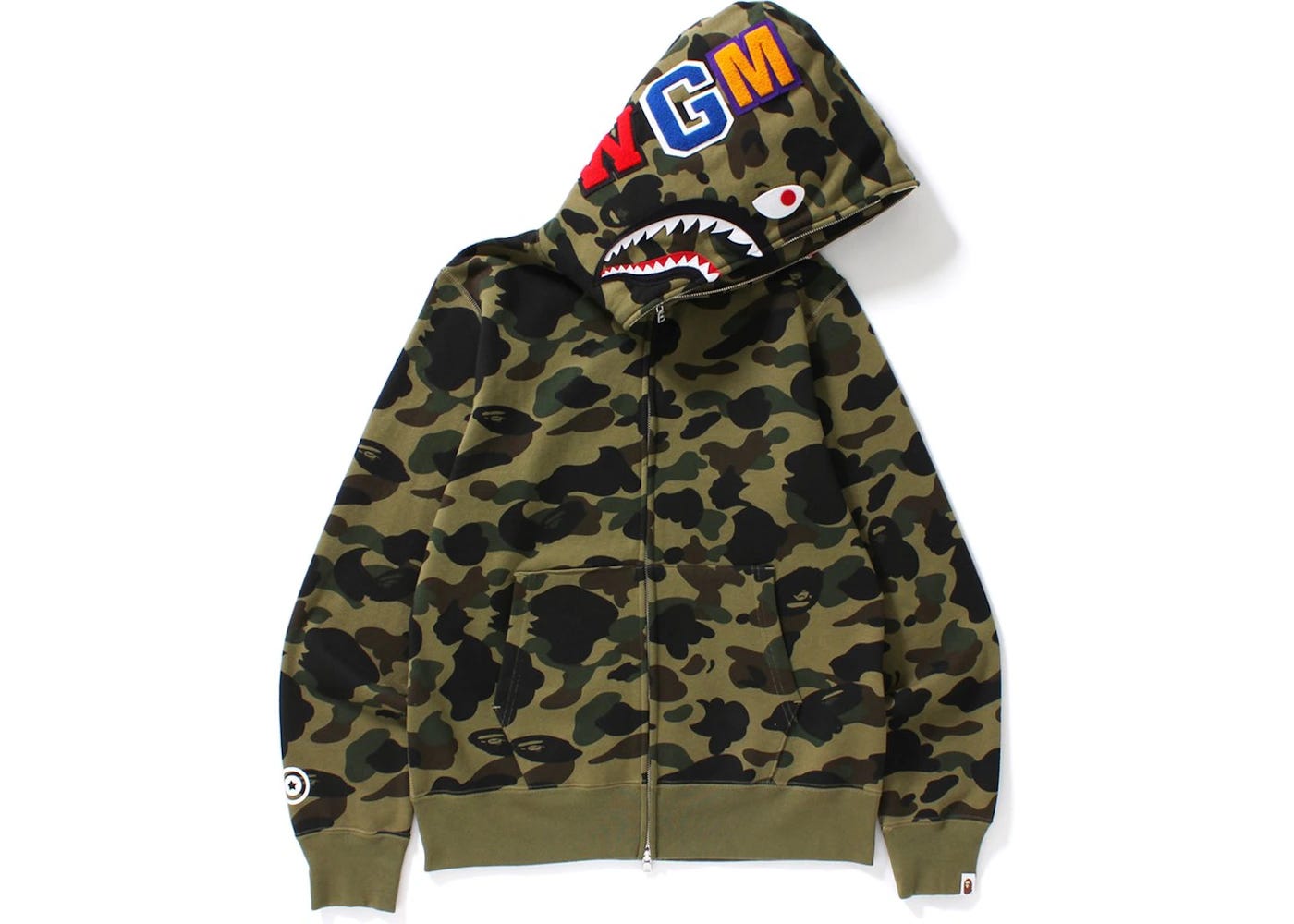
The ape head was lifted straight from the franchise. WWII fighter plane nose art became the Shark Hoodie—a full-zip design where the teeth close over the face when you pull up the hood, “WGM” patches standing for “World Gone Mad.”
NIGO’s message for the 2022 Bunka Gakuen Costume Museum exhibition The Future is in the Past—
展覧会のタイトル、未来は過去にある “THE FUTURE IS IN THE PAST” は、僕のモノ作りのテーマそのものです。
The title of my exhibition, The Future is in the Past, has always been the theme for my creations.
Virgil Abloh called BAPE “his generation’s Chanel” in a January 2018 Hypebeast interview, two months before LVMH offered him the Louis Vuitton menswear chair.
IYKYK
NIGO had pulled BAPE out of ~40 wholesale accounts in the late 90s and funneled all sales through a single Tokyo flagship. If you wanted BAPE, you went to that store and waited in line, encountering a designed space—lighting, music, staff uniforms, sneakers under glass like museum loans—so that buying something was an adventure, if not a fantastic excuse to visit Japan. Production runs were sized to fulfill roughly 10% of demand by design.
NIGO, CNN Style, April 2026—
When I started making clothes I didn’t have any money, so I could only make 30 T-shirts at a time. I’d sell them and then make the next lot. They were automatically limited edition.
NIGO had taken a stylist and editor post at Popeye before BAPE existed, and he used the magazine’s wardrobe credits as the placement engine: he styled Cornelius (Keigo Oyamada) and the hip-hop trio Scha Dara Parr for free, dressed them in BAPE on stage and in shoots, and ran them as the brand’s first walking advertisements. Similar to Nujabes’ self-promo of his own work, next to Nas vinyls at his record shop.
In 1997, NIGO launched a UK-only diffusion line called Very Ape—the only piece of BAPE distribution NIGO let out of Tokyo for years.
NIGO, Sabukaru, April 2026—
In the era of print, there was no real-time information; you had to go out and find things yourself. Everything was “limited” by default back then. By releasing these items only in specific locations, I wanted to revisit that old-school approach where you can’t buy it unless you actually show up.
NIGO ran the quality control himself. By the early 2000s, BAPE was Japan’s dominant streetwear brand, with multiple flagships in Tokyo, Osaka, and Nagoya, a domestic customer base that dwarfed any American interest.
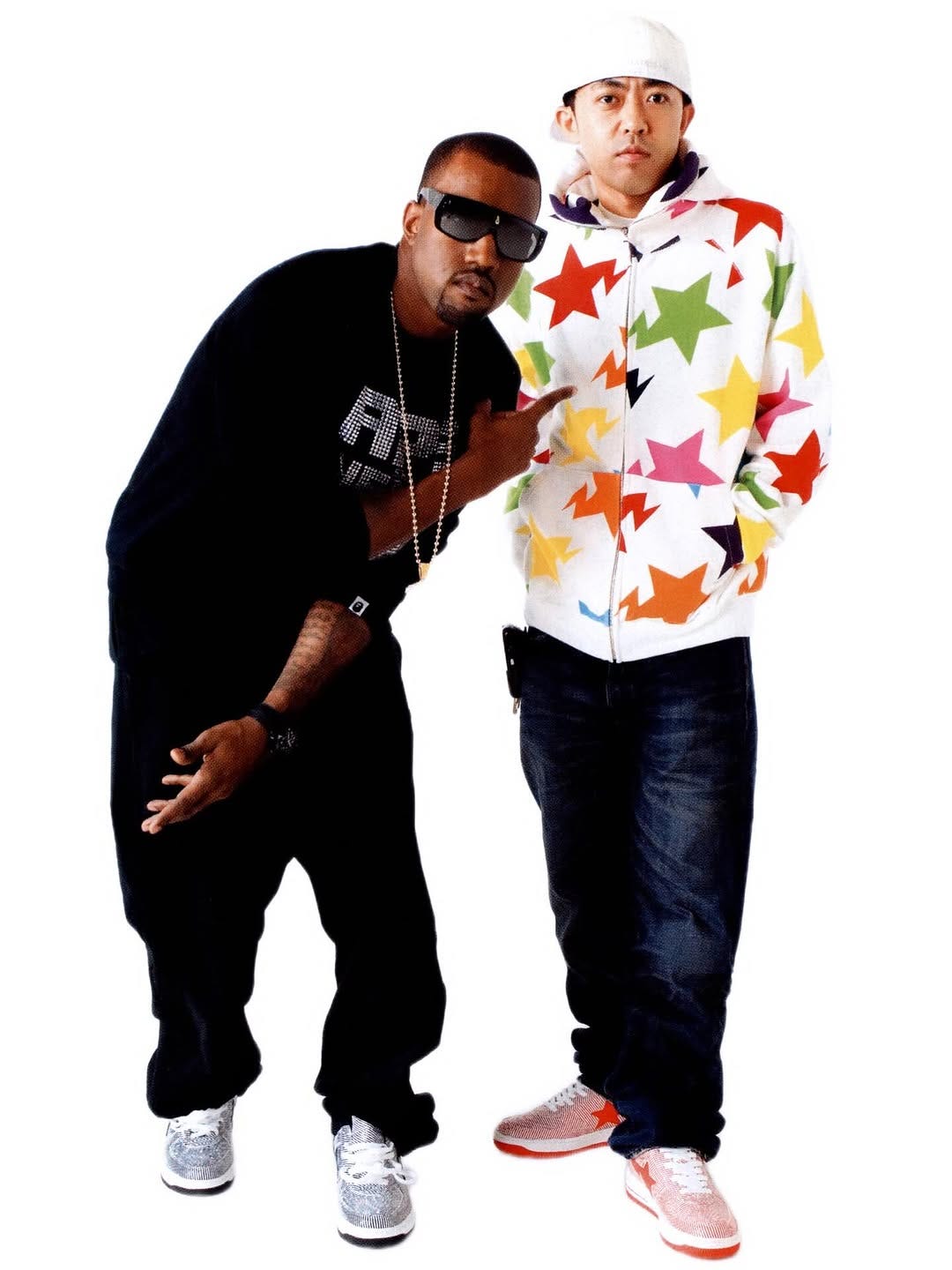
Nike cleverly weaved the 1985 Jordan ban into marketing. Hermès kept the Birkin waitlist as theater, an managed by store staff who decided which customers had earned the right to buy. Supreme ran a weekly Lafayette Street queue and an online countdown that released the bots, while BAPE elected to test scarcity as a production fact: the factory shipped 50 shirts a week, the Tokyo flagship was the only retail point, and the first generation of American fans (Pharrell, Pusha, Kanye) found the brand because they knew the designer. For most (almost all) of the American audience, the product didn’t exist.
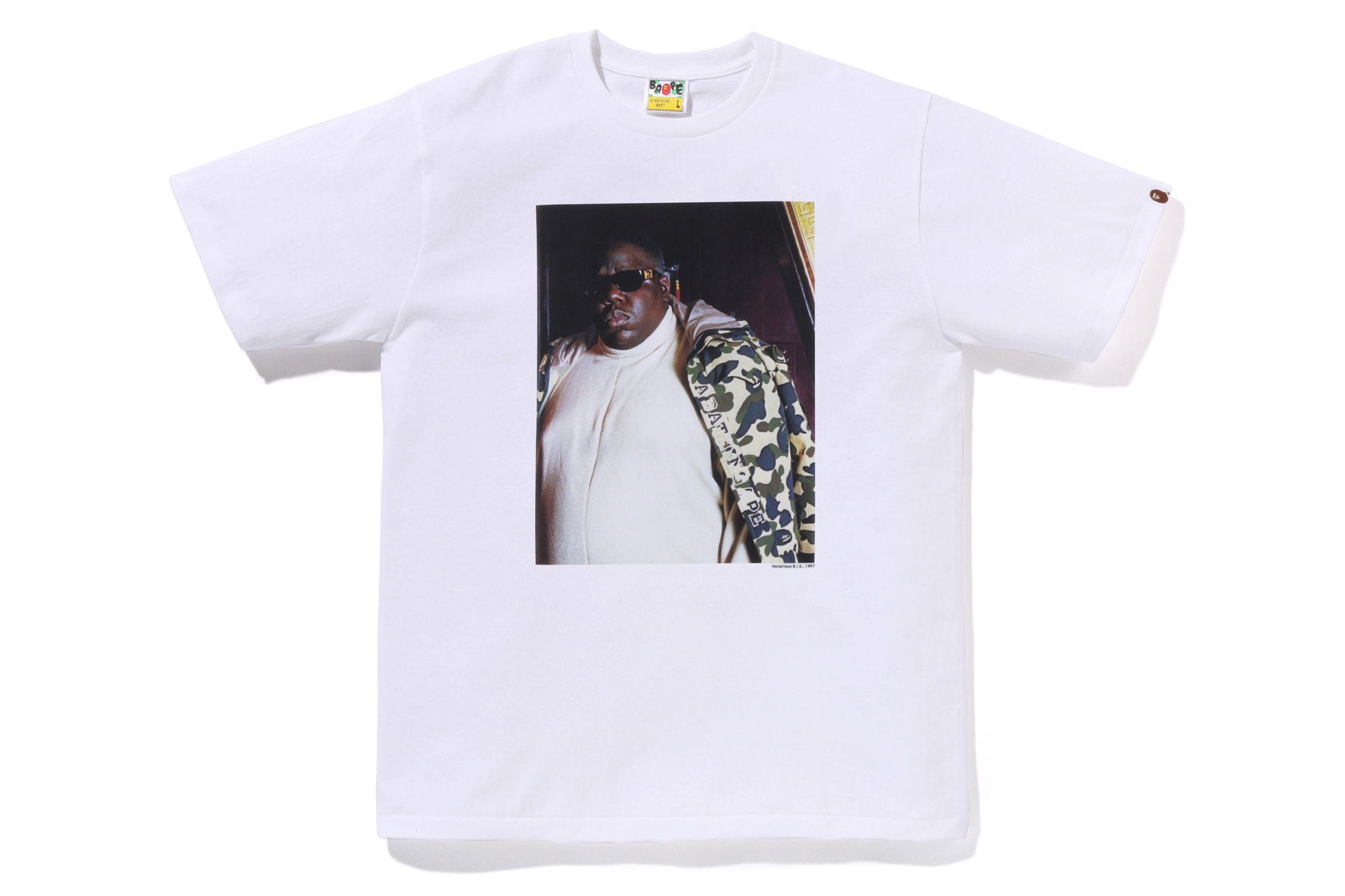
The earliest American rapper photographed in BAPE was the Notorious B.I.G.; NIGO and Mortensen later co-curated a December 2002 BAPE Gallery photo exhibition where the image was printed onto tees in runs of 50.
BAPE caught the audience hip-hop already owned—young, sharp-eyed, the kind of people who didn’t need a price tag to tell them something was exclusive. Pharrell started wearing it across every video, red carpet, and studio session in 2003.
Pharrell appeared in the “Frontin’” video, then on the Today show, then at the VMAs, always in camo, always in a shark zipper, always in something not found in any American store. The Shark Hoodie reveal came out of Fabolous’s 2004 “Tit 4 Tat” video. Kanye picked up the shot two years later in The Game’s “Wouldn’t Get Far”, unzipping his own shark.
Streetwear is Dead, Long Live Streetwear
On November 28, 1973, five American designers (Halston, Oscar de la Renta, Bill Blass, Anne Klein, and Henri Bendel’s Stephen Burrows) faced five French houses (Saint Laurent, Dior, Cardin, Givenchy, Ungaro) at the Grand Divertissement à Versailles, a fundraiser staged by Eleanor Lambert for the palace’s restoration. Of 36 American models, 10 were Black:
Pat Cleveland
Bethann Hardison
Billie Blair
Alva Chinn
Norma Jean Darden
Jennifer Brice
Ramona Saunders
Charlene Dash
Barbara Jackson
Amina Warsuma
Hardison co-founded the Black Girls Coalition with Iman in 1988 to keep working the modeling exclusions.
Karl Lagerfeld remembered Hardison at Versailles 40 years later—
Elle avait cette sauvagerie, cette attitude impériale… Elle a jeté à un parterre de têtes couronnées le regard le plus noir. Ils étaient terrorisés.
She had that savagery, that imperial bearing. She cast on a parterre of crowned heads the blackest of looks. They were terrified.
Christelle Bakima Poundza, author of Corps Noirs, told Bondy Blog that Versailles is not part of the French fashion curriculum, and that French casting culture still runs the line fille black, mais pas trop—Black, but not too much.
Patrick Kelly moved from Mississippi to New York, then to Paris, and in 1988 became the first American admitted into the Chambre Syndicale du Prêt-à-Porter—the Paris system that had been deciding who counted since the 19th century. He died in Paris on New Year’s Day, 1990, at 35. What remained got divided between museums and private collections.
Jay Jaxon cut for Saint Laurent, then Dior under Marc Bohan, then Jean-Louis Scherrer, where he was running the atelier before 30. Paris finally gave him a museum exhibition in 2018, more than a decade after he died.
Brazzaville’s Sapeurs built their own answer to Paris from the other side of the Atlantic. The Société des Ambianceurs et des Personnes Élégantes—the Afro-Congolese tailoring movement that crystallized in the 1970s and split into rival Brazzaville and Kinshasa schools through the ’80s—studied Parisian and Italian luxury with religious precision: Yamamoto, Versace, Gaultier, obsessively coordinated in cities where almost nobody could reasonably afford any of it. Daniele Tamagni’s Gentlemen of Bacongo finally forced Europe to notice something Brazzaville had already understood for decades.
Daniel Day AKA Dapper Dan, opened his Harlem boutique on 125th Street in 1982 after discovering wholesale houses would not sell to him because he was Black. Years earlier, on a 1968 trip to Africa with the Urban League, he sold the American clothes he’d brought and came back in tailored African suits instead.
Dapper Dan, Made in Harlem, 2019—
They fit me better than anything I’d ever bought or shoplifted from a store in New York.
Day ran every layer of it himself, stamping Gucci, Louis Vuitton, MCM, and Fendi monograms onto the leather by hand, sampling the houses’ logos directly. Eric B. & Rakim, Salt-N-Pepa, and Mike Tyson before title fights all wore custom pieces, sold direct.
What he couldn’t do was sew—“I can’t sew at all,” he wrote, “I’m an observer and a people person.” The garments came off a night crew of 11 Senegalese tailors in a 2,000-square-foot room on 120th Street, machines running dusk to dawn. His best tailor was Sekou—“Big Sek”—whom customers kept mistaking for Dapper Dan himself; Big Sek would send them back across the room: “There is the couturier.”
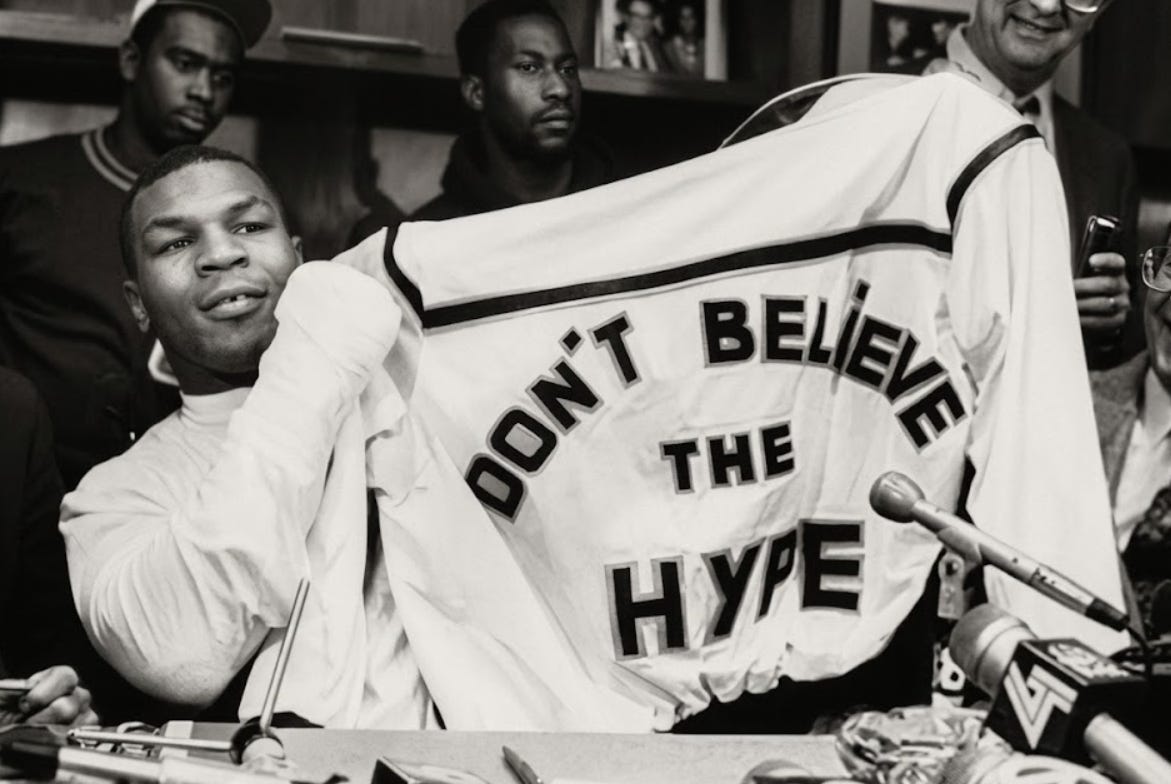
Around 4:30AM on August 23, 1988, Tyson walked in to pick up an $850 leather jacket stitched with “DON’T BELIEVE THE HYPE,” walked back outside, ran into Mitch Green on the sidewalk, and shattered his hand on Green’s face.
Before she reached the Supreme Court, Sonia Sotomayor was a partner at Pavia & Harcourt handling Fendi’s anti-counterfeiting cases. By the early ’90s, a pileup of lawsuits and coordinated luxury-brand raids finally shut Dapper Dan’s shop down.
Day’s clientele put him outside both the white luxury establishment and the Black bourgeois press. He told W in 2017 that Jet and Ebony covered the era’s other Black designers and refused to cover him:
It broke my heart… My whole life was about bucking the system. You ain’t gonna let me in? Bam! Here I come.
Dapper Dan, Made in Harlem, 2019—
We created this universe of culture that came out of Harlem, and it was parallel to this universe that was coming out of Europe.
Willi Smith’s WilliWear was generating over $25 million annually before his death in 1987 at 39. The Cooper Hewitt began corrective work in 2020.
Bobby Garnett ran a warehouse in Lynn, Massachusetts, stacked with tens of thousands of pieces (1920s workwear, 1950s denim, Savile Row suits), all bought by purchasing entire failing department store inventories at once. Ralph Lauren’s design team sourced inspiration from Garnett’s archive for decades; so did Tom Ford and Marc Jacobs. The Times ran his obituary in the “Overlooked” column.
FUBU hit $350 million by 1998. Cross Colours cleared $80 million in under two years before a retail partner’s bankruptcy dragged it under. April Walker debuted Walker Wear in 1992, dressing Method Man, Tupac, Biggie, and Queen Latifah directly out of a Brooklyn storefront.
Cross Colours closed $40 million in its first year on Afrocentric sweatsuits with a “Clothing Without Prejudice” tag; Walker Wear worked the post-Rodney-King, pre-O.J. moment when Black male style had just become the most photographed aesthetic on earth. In 2021 she sued Virgil Abloh’s Off-White, alleging a $2,234 monogram bomber had lifted her overlapping ‘WW’ mark; it settled in 2022.
The CFDA wouldn’t give its Geoffrey Beene Lifetime Achievement Award to a hip-hop-era designer until 2021, when Dapper Dan became the first Black designer to receive it—29 years after Walker Wear debuted in Brooklyn and 39 years after he opened at 125th and Lenox.
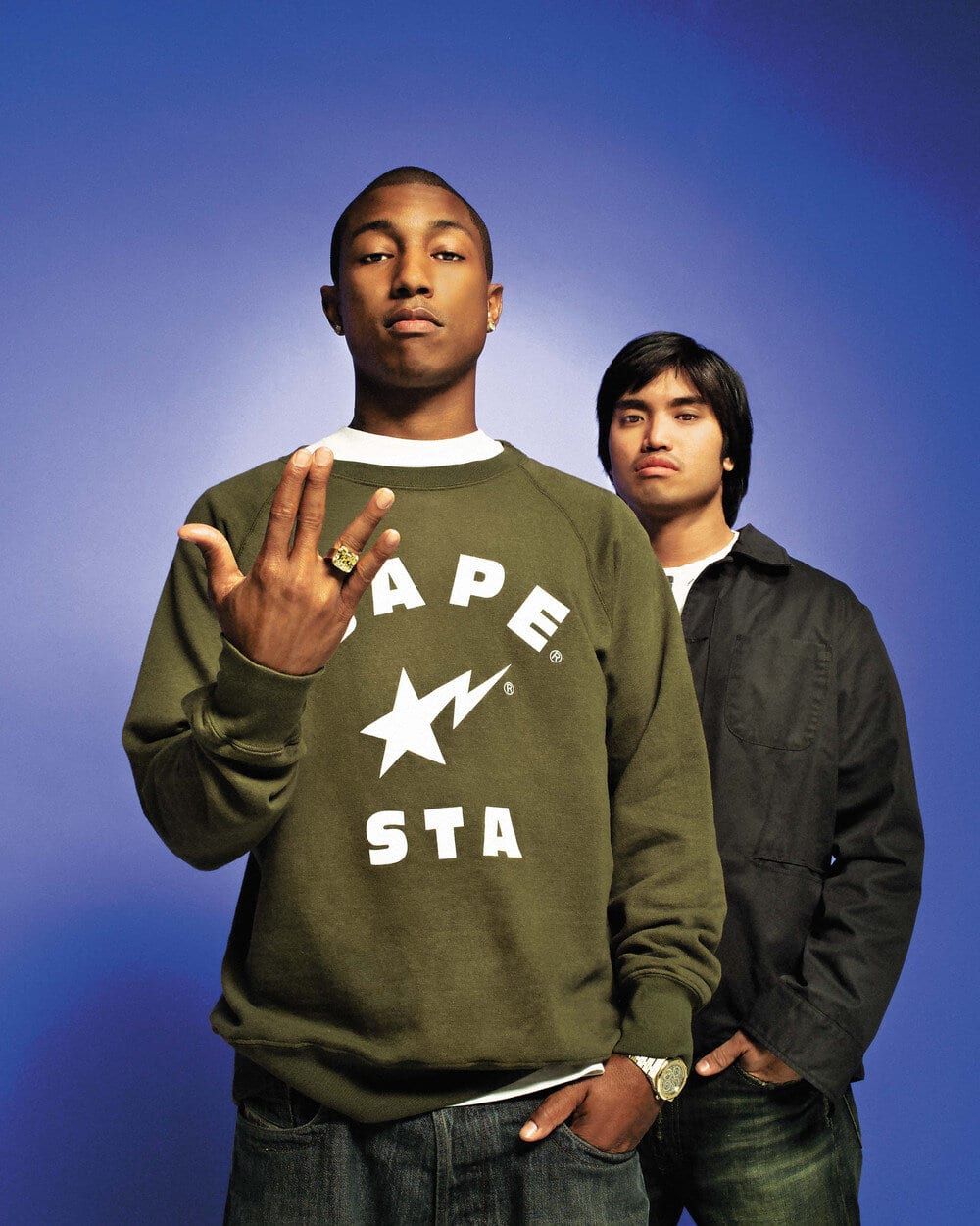
Virginia Beach: Something in the Water
A conservative military town at the mouth of the Chesapeake produced Pharrell, Timbaland, Missy Elliott, and the Clipse within a 15-mile radius, outside the orbit of Atlanta bass, New York boom-bap, LA gangsta rap, and Houston chopped-and-screwed.
Hampton Roads was a military and shipyard region with a Black middle-class population that had been going to church one Sunday and the roller rink the next since the ’70s. Every kid inside that radius grew up on those records—go-go drifting down from D.C., bass floating up from Miami, gospel from the church choirs, and whatever was spinning in the barbershop that week. The Neptunes sound came directly out of that overlap: percussive, sparse, funk-informed, rhythmically strange to anybody raised on East Coast boom-bap, so that half the industry thought the drums were unfinished.
Teddy Riley moved from Harlem to Virginia Beach in 1990 and opened Future Recording Studios. He discovered The Neptunes (Pharrell and Chad Hugo) at a high school talent show in 1992.
Hugo was the invisible half: a multi-instrumentalist who could voice a chord six different ways and build arrangements that sounded simple on the surface but contained layers that revealed themselves on the fourth listen. The Neptunes’ signature was Hugo’s as much as Pharrell’s melody.
Hugo stayed behind the boards while Pharrell became the face. They co-founded Star Trak together in 2001.
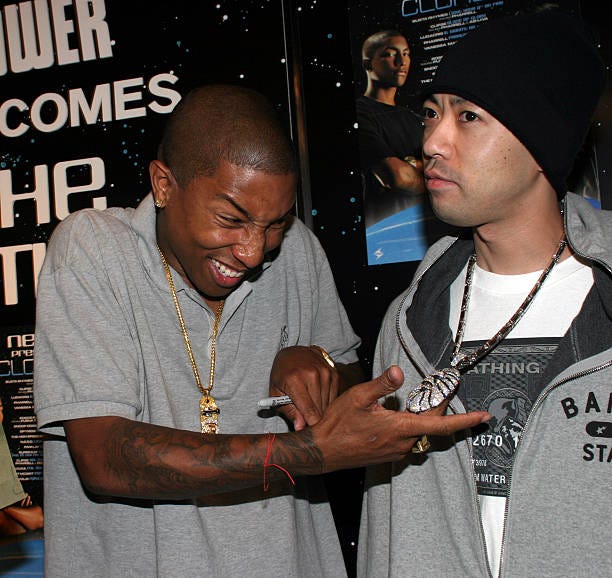
N.E.R.D. (Pharrell, Hugo, and Shay Haley) gave Pharrell a visual platform that session production never could: a band to stand in front of, a stage persona, and an aesthetic identity. Every N.E.R.D. video and tour was a surface for the clothes (the BAPE, the BBC prototypes, and the Icecream sneakers), all of it debuting on N.E.R.D.’s body before it debuted anywhere else.
Pharrell’s solo debut single “Frontin’” featuring Jay-Z peaked at No. 5 on the Billboard Hot 100 in summer 2003.
Pusha T, 2015 VIBE interview—
I just started getting boxes of clothes at my house in 2002 because Nigo was a fan of a record called “Grindin’.” Some kids he didn’t know from Virginia making 100% dopeboy music—he just liked it.
The Clipse were Pusha T and his older brother Malice, born in the Bronx, raised at the mouth of the Chesapeake, trafficking in the mid-Atlantic corridor between D.C. and Norfolk where cocaine economics in the late 1990s ran through strip-mall barbershops and highway motels. “Grindin’” dropped on Star Trak in March 2002, a drum-heavy Neptunes beat built from a lunchroom-table knock pattern, Pusha and Malice trading coke-rap couplets in a dialect so specific to the Tidewater.
NIGO heard it on a CD someone had pressed him in Tokyo, and though he did not speak Virginia Beach English, what came through was a scene refusing to speak to anyone outside it, and a hit record built around that refusal.
Fujiwara carried the Bronx into Tokyo by hand. Two decades later, NIGO was moving Virginia Beach the other way, box by box.
Pusha’s boxes shaped Clipse merchandise for a decade. The Re-Up Gang launched their own label in 2006 with T-shirts drop-printed in limited runs and priced at the high end. Hell Hath No Fury arrived delayed through the Jive labyrinth and sold 78,000 copies its debut week despite the label refusing promotion. The delay trained Pusha in the politics of label ownership as he watched his brother’s career get hostage-held in contract paperwork. His 2022 It’s Almost Dry split its sides between Pharrell and Kanye, the two producers NIGO had dressed for two decades, each taking half a record.
In 2023—3 years ago today—Pharrell cast Pusha in his Louis Vuitton debut, and a Virginia Beach coke rapper walked the Pont Neuf in a damoflage coat.
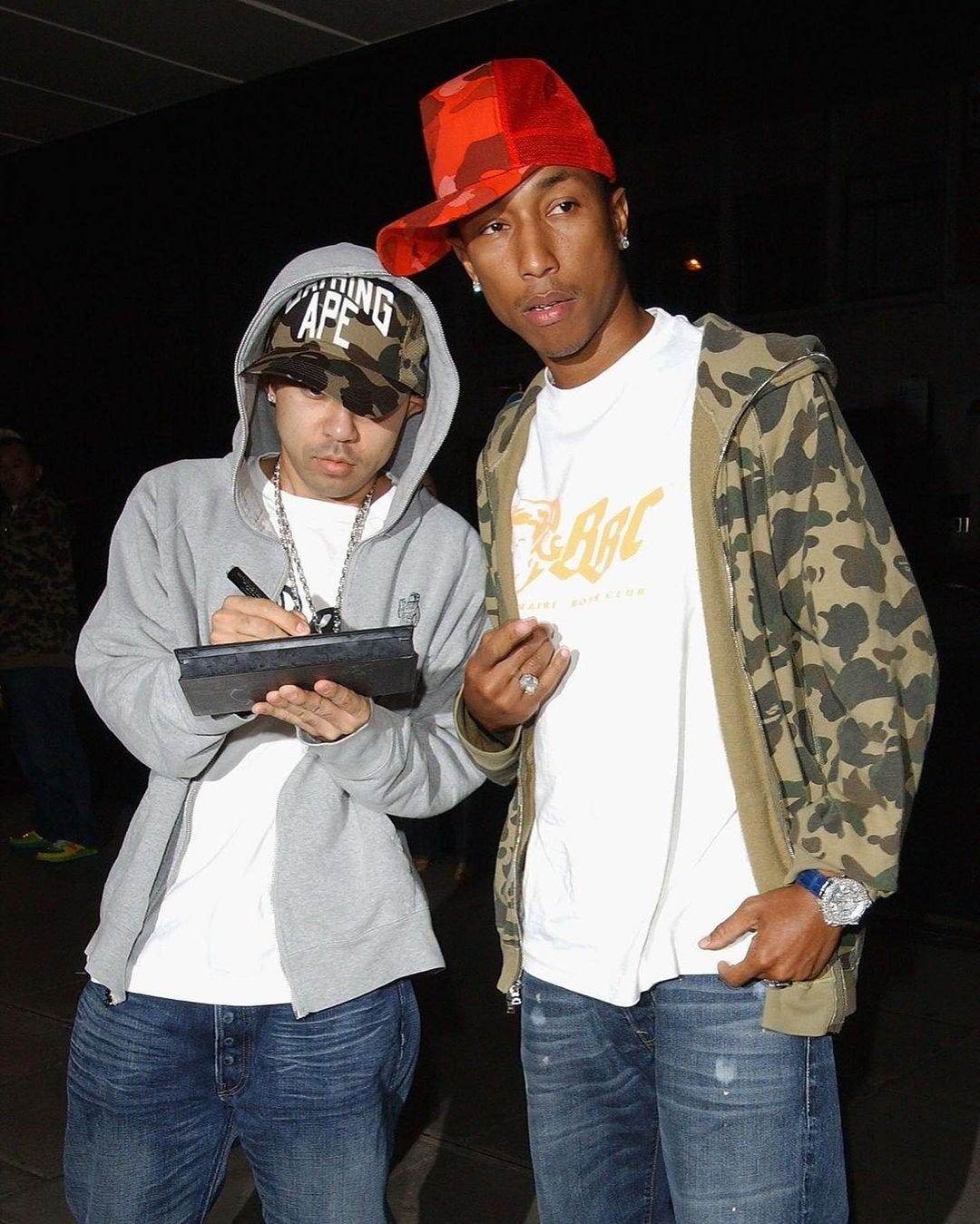
Don’t Blink or You’ll Miss It
Pharrell and NIGO co-founded BILLIONAIRE BOYS CLUB and its sister sneaker line Icecream (2003). Over dinner, Pharrell explained his vision to NIGO and Toby Feltwell, NIGO’s chief of staff. NIGO agreed immediately with one condition: he wouldn’t do it for anyone else, which meant giving up the methods he’d built alone and never shared. The first Icecream sneakers shipped through a licensing deal with Reebok—the Board Flip launched in 2005 as the shoe for BBC’s mostly-Black skate team, after a $4 million lawsuit against Reebok over quality control forced a 2005 settlement.
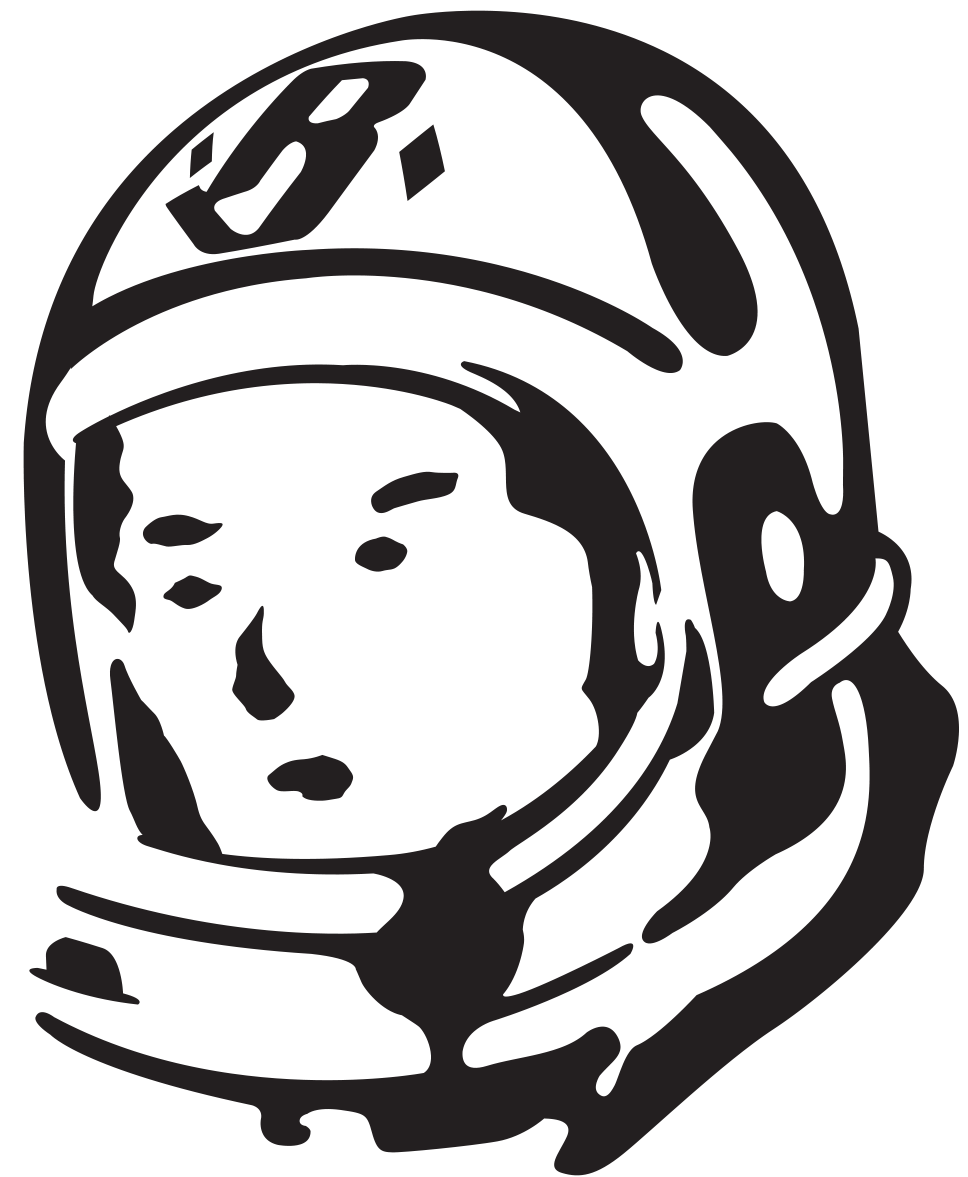
That night, SK8THING sketched the astronaut logo—the helmet-headed spaceman that would land on every BBC tee for the next two decades.
BBC’s motto:
Wealth is of the Heart and Mind, Not the Pocket.
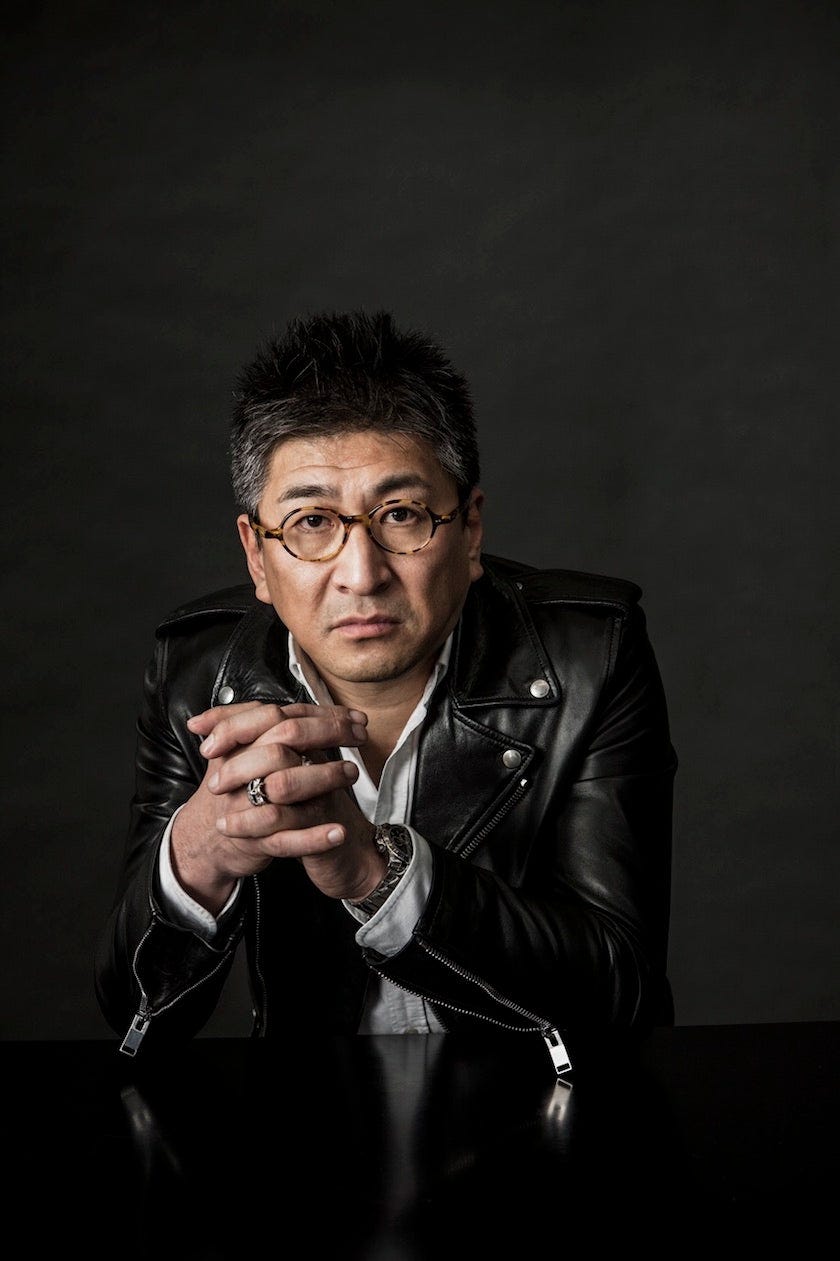
Masamichi Katayama, the Wonderwall founder who’d designed NIGO’s BAPE stores in Tokyo, built BBC and Icecream’s retail spaces after NIGO made the introduction.
Katayama, Places and Spaces I’ve Been, 2012—
A 2-D expression within a 3-D space, creating a provocative experience that feels neither ordinary nor extraordinary, as if you have stepped inside the world of manga.
For a decade NIGO had refused collaboration requests, and Pharrell walked in and got it all. BBC changed BAPE’s craft discipline into an American hip-hop palette. Play Cloths, Pastelle, and Golf Wang followed.
Everybody Was Recycling America
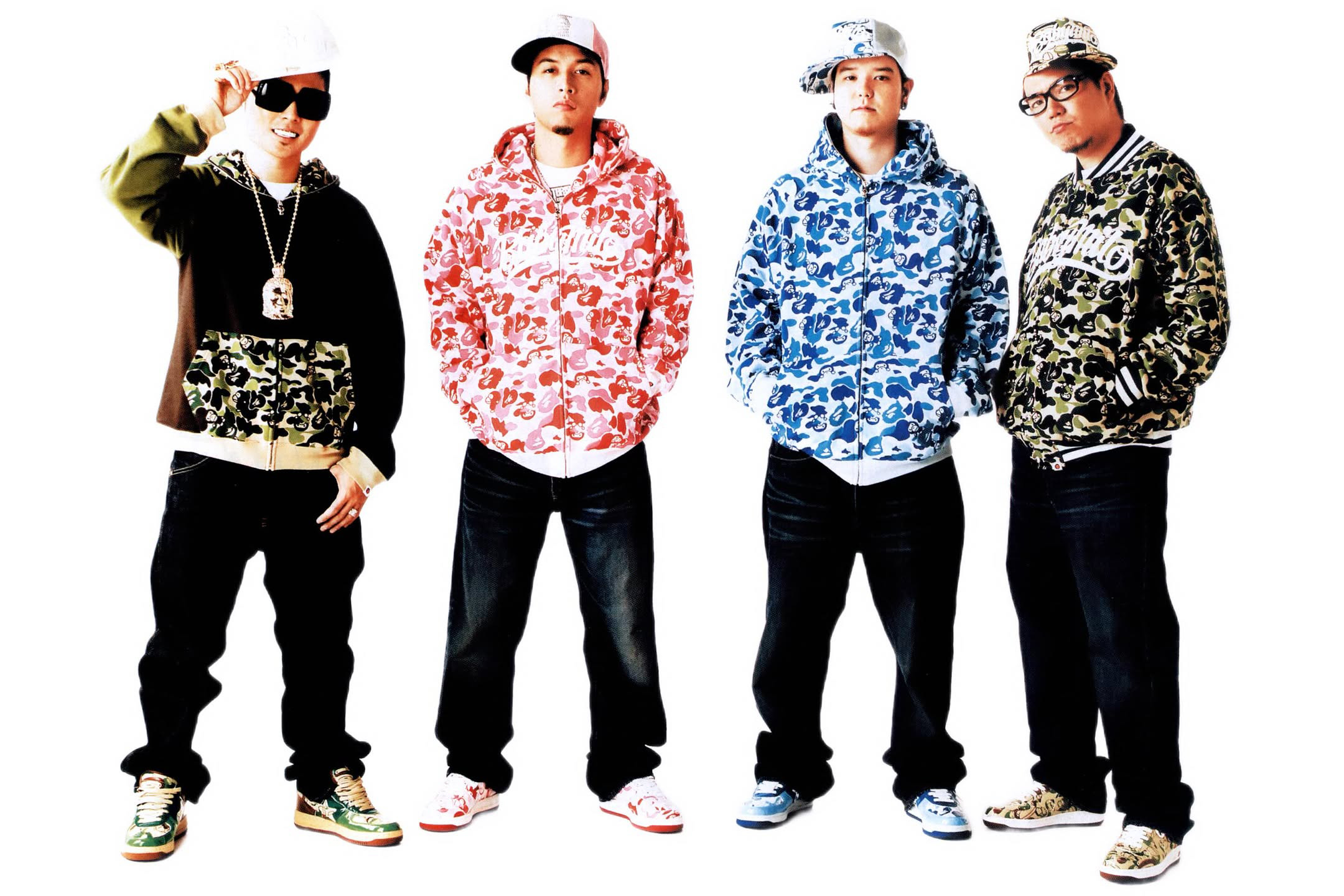
NIGO founded a record label and assembled the Teriyaki Boyz—five MCs from across Tokyo’s hip-hop scene, recruited by a fashion designer who couldn’t rap. Beef or Chicken (2005) was released through Def Jam Recordings with production from Daft Punk, The Neptunes, and Just Blaze.
By 2022, NIGO’s solo album I Know NIGO! featured A$AP Rocky, Tyler the Creator, Pusha T, and Pharrell—20 years after the first boxes landed at Pusha’s house.
The Teriyaki Boyz were five men. One of them was Verbal, of m-flo; his wife, Yoon Ahn, was already designing alongside him on the AMBUSH side.
Standard major-label contracts in the early 2000s offered new artists royalties of 12-14% of suggested retail, before deductions for packaging, breakage, producer points, and recoupment, so that most artists saw less than $1 per album sold.
TLC, after moving over 7.7 million copies of CrazySexyCool domestically, two No. 1 singles in “Creep” and “Waterfalls”—earned 56¢ per album split three ways. Lisa “Left Eye” Lopes laid it out on VH1’s Behind the Music, 1999, breaking the royalty structure down to arithmetic:
There’s 100 points on an album. TLC had 7. Every point is equal to 8¢. 7 times 8, 56¢.
Under 19¢ per member per album, three women at the peak of American pop music, filed for Chapter 11 in 1995, declaring $3.5 million in debt.
For a generation of rappers who had watched TLC go bankrupt off a diamond album, who had seen artists lose master recordings, publishing rights, and their own names to label deals, the hoodie was physical proof of an idea working, though the real product was finally owning the receipts.
Napster was first in June 1999, then iTunes in April 2003. Spotify reached the U.S. several years later in July 2011, and the job was done. If you were an artist on a standard record deal, you got to watch the thing you owned a fraction of shrink from a disc, to a file, to a drip from someone else’s tap, priced in thousandths of a cent. Meanwhile, in Tokyo, a $500 Shark Hoodie sold straight out of Nowhere could put more money in its maker’s pocket than a platinum album put in the writer’s.
Pusha T and No Malice of the Clipse were the next Virginia Beach names—Neptunes-produced, wearing BAPE ahead of most of American hip-hop outside Pharrell’s immediate circle.
BAPE CAFE!? on the ground floor, plates and chairs and saucers wrapped in 1st camo. BAPE CUTS down the block, the hair salon. The Aoyama compound—a basement and three floors above ground—staged like a private archive. The Rolls-Royce out front, painted in BAPE camo down to the door handles.
On Hell Hath No Fury (2006), their Neptunes-produced record, Pusha rapped on “Ain’t Cha”: “Closet like Planet of the BAPEs.” Stalled by Jive Records for over two years, they dropped We Got It 4 Cheap Vol. 2 in 2005: 18 tracks over jacked beats, distributed free.
Pusha and Malice launched Play Cloths in 2008. Pusha was explicit about the debt: “The only reason I probably did a streetwear line was because of BAPE.”
Lil Wayne started wearing BAPESTAs in his 2005 “Fireman” video. The Clipse took it as theft. Their single “Mr. Me Too” (May 2006), produced by Pharrell, was a direct attack, actors dressed head-to-toe in BAPE filling the video.
In August 2002, Kanye West spotted Pharrell backstage at Jay-Z’s Dynasty Tour in Chicago—a moment caught in Coodie & Chike’s jeen-yuhs footage. If you were in the Roc-A-Fella/Neptunes orbit, you saw what Pharrell and Jay-Z were wearing before the public did.
Kanye, Places and Spaces I’ve Been, in 2012—
That was before everybody said swag, or when we were out in Japan. How could you communicate through people? We’re not even understanding the language but we knew the visual language, we knew the spirit, we knew the ideas, we knew the reference points.
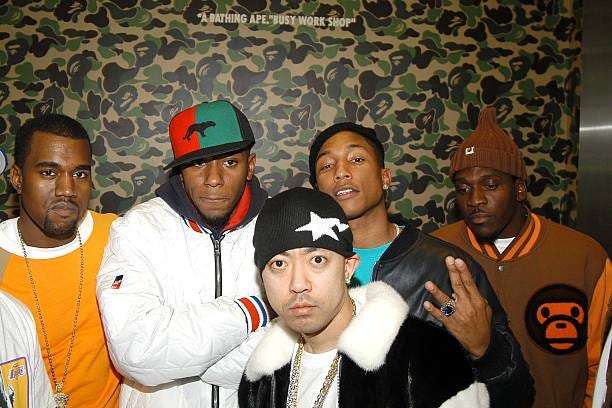
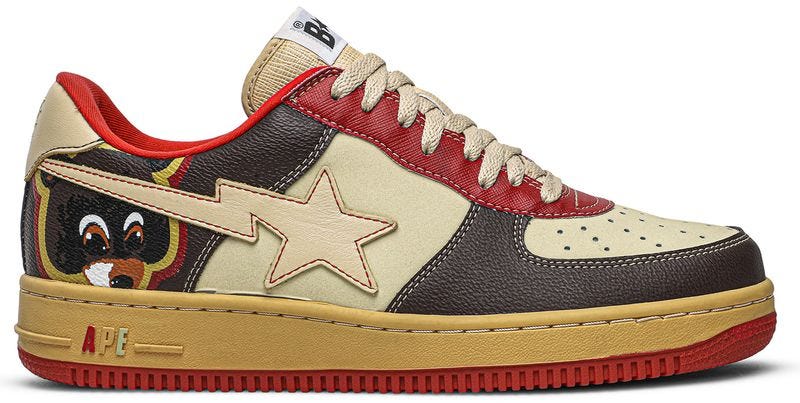
Kanye attended the 2005 NYC Bape flagship opening at 91 Greene Street alongside NIGO, Pharrell, Mos Def, ?uestlove, Common, Faith Evans, Pusha T, and Spike Lee; in January 2007, he released a special-edition Kanye x BAPESTA featuring his Dropout Bear mascot.
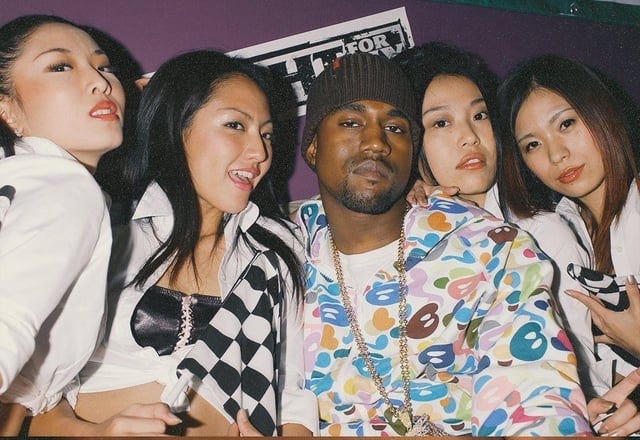
Kanye West: Student of Streetwear
Before he touched a sketch pad, Kanye West wore BAPE head to toe during the College Dropout era—camo hoodies and pink BAPESTAs so consistent they became part of that album cycle’s visual identity. For Graduation (2007), he hired Takashi Murakami to design the album cover.
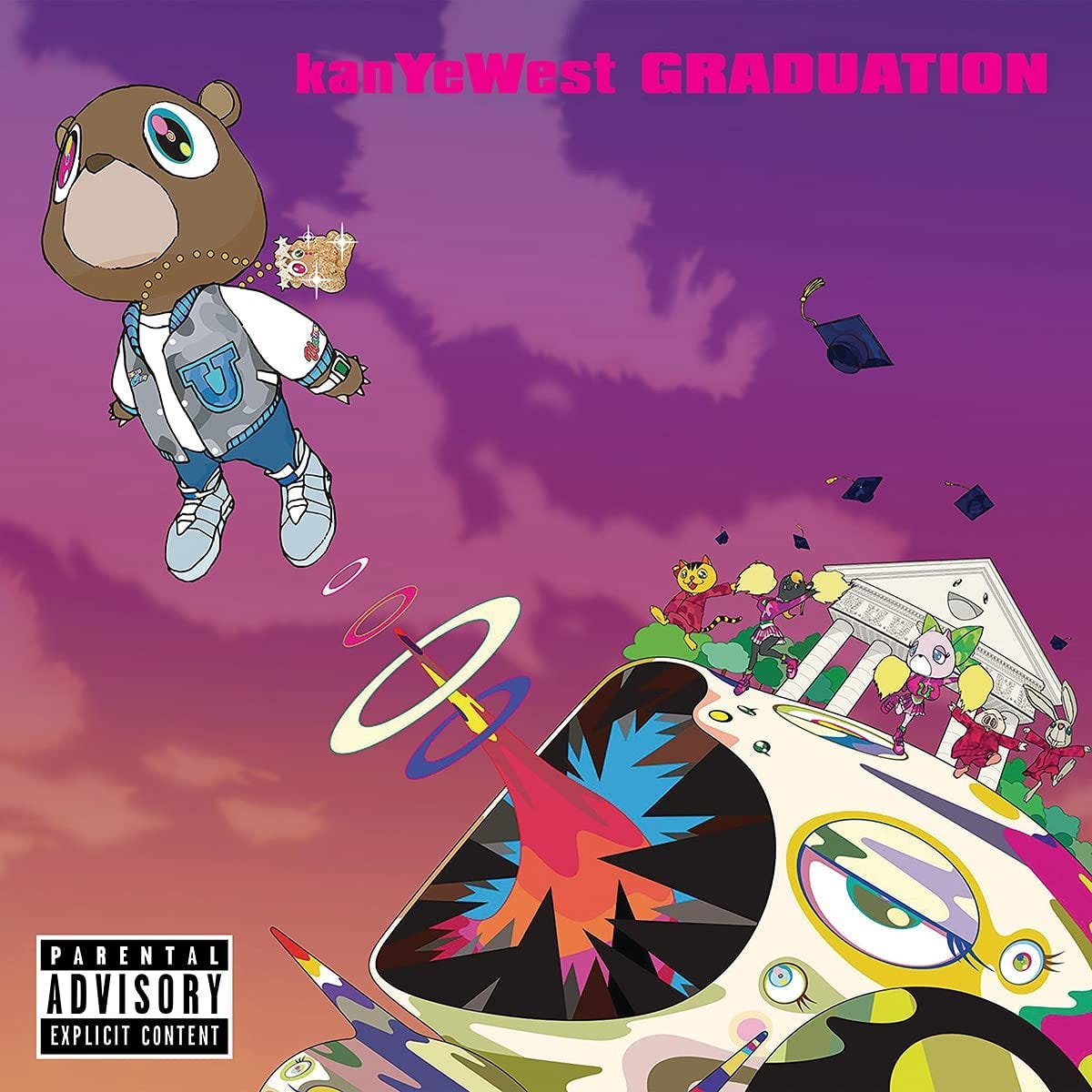
Kanye’s signature production technique—chipmunk soul—was its own flavor. He wore three hats as a designer, producer, and artist, during College Dropout’s rollout.
From there he moved through Raf Simons and into a Fendi internship in Rome alongside Virgil Abloh, both paid $500 a month, fetching cappuccinos and making photocopies.
Louis Vuitton sneakers at Paris Fashion Week in 2009 (the first hip-hop artist to design a full sneaker collection for a heritage luxury house). Nike Air Yeezy 1 (2009) and Air Yeezy 2 (2012) sold out instantly and commanded $10,000+ resale.
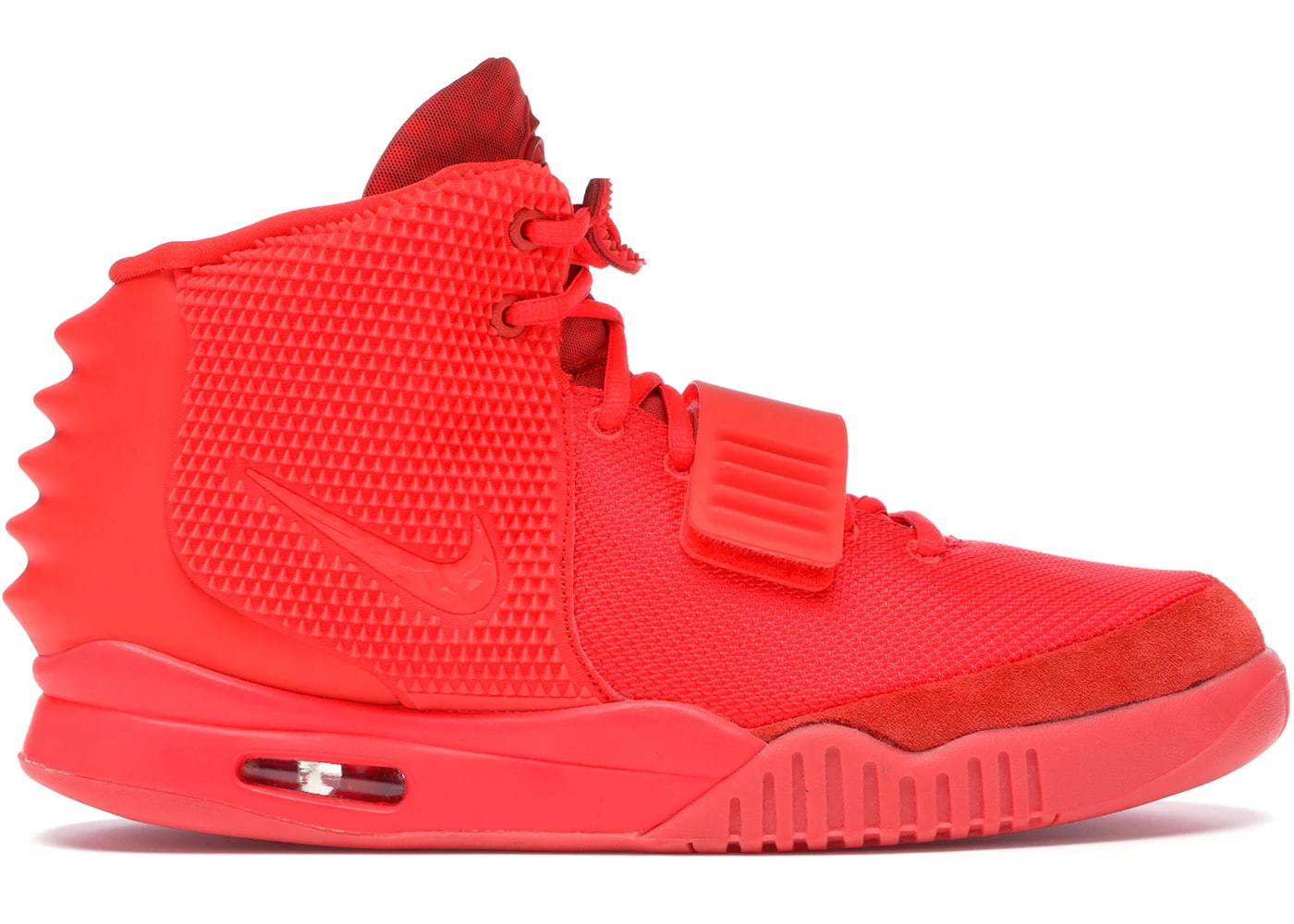
Nike refused to pay royalties; the policy reserved them for professional athletes, and a designer, no matter how famous, got a flat endorsement check instead. Kanye wanted a piece of every unit sold, and when Nike refused he went to Adidas. Adidas agreed to 15% of wholesale and full Yeezy trademark ownership—the first time a Western athletic-apparel major had handed a hip-hop figure a piece of every pair.
Yeezy-Adidas generated $1.7 billion in 2021 sales alone, roughly 7% of Adidas revenue and a reported $300 million in operating profit.
In June 2020, Gap announced a 10-year partnership with West targeting $1 billion in annual revenue by the fifth year. The first product, the $200 Round Jacket, went up for pre-order in June 2021 and—by former Gap CEO Mickey Drexler’s account—did roughly $7 million in sales overnight. Yeezy Gap Engineered by Balenciaga, announced in January 2022 with Demna Gvasalia, folded a luxury hand into Gap’s mass-retail pricing. Kanye was briefly the only designer in history running a streetwear brand with Adidas, a mass-retail line with Gap, and a luxury collaboration with Kering’s most avant-garde house.
October 3, 2022, Kanye wore a “White Lives Matter” shirt at the Yeezy Season 9 Paris show, and within weeks he made antisemitic statements on Drink Champs and Twitter that triggered immediate institutional exits: Balenciaga cut ties, Gap paused and then ended it, and Adidas, after two weeks of public pressure, terminated on October 25, forfeiting €1.2 billion in projected 2023 revenue and €500 million in operating profit—the Yeezy stock behind it left unsold in warehouses. Adidas released the remaining inventory in phased drops through 2023 and 2024 under a settlement that still paid West a royalty on sold units.
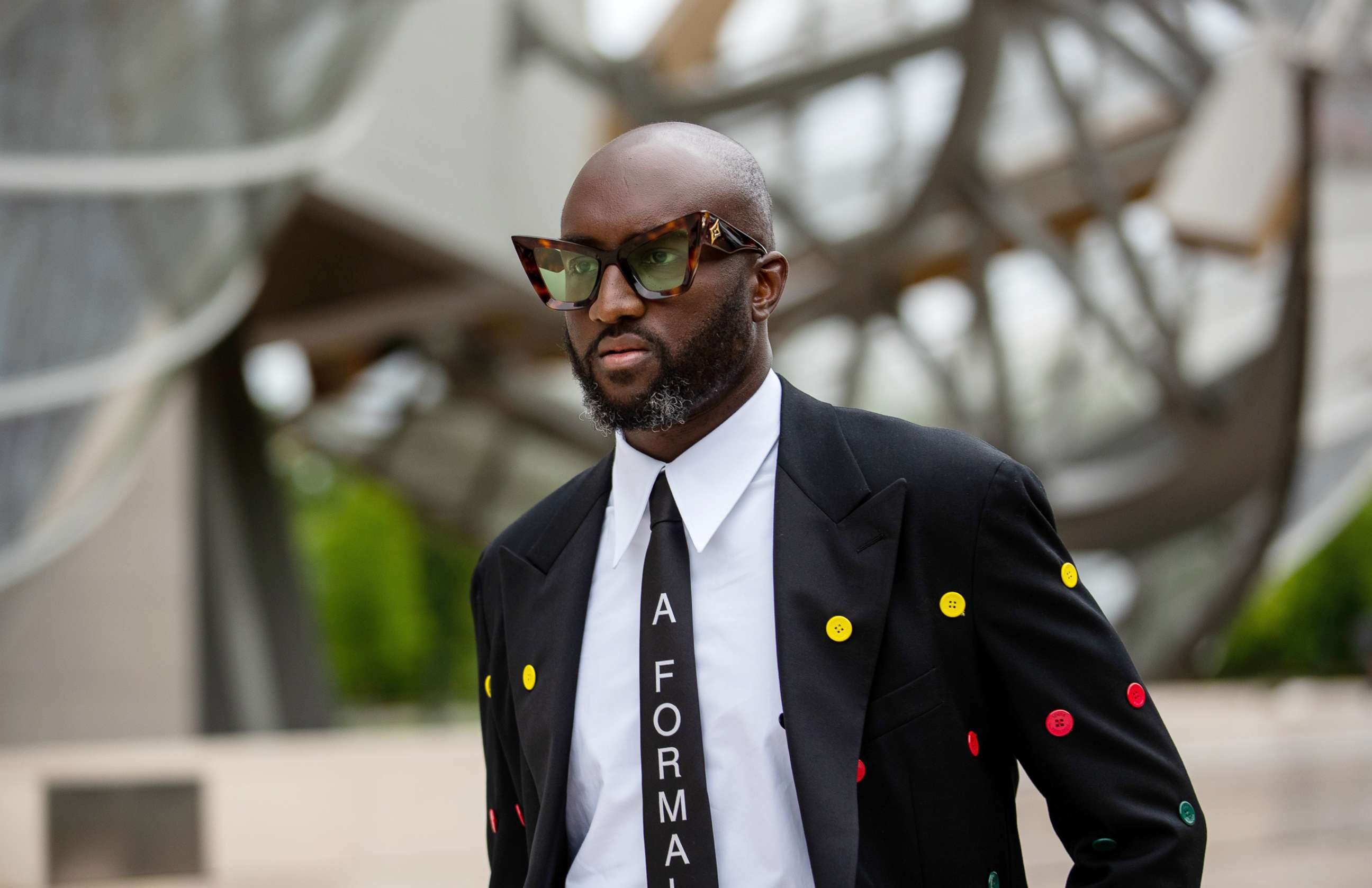
Virgil Abloh: Larger Than Life
Virgil: a Ghanaian-American kid from Rockford, engineering at Madison, architecture at IIT, Chicago screen-print shops, Kanye’s orbit.
Pyrex Vision (2012) was his first solo play: he purchased deadstock Ralph Lauren Rugby flannel shirts for about $40 each and screen-printed “PYREX 23” on the back and sold them for $550. Complex exposed the provenance.
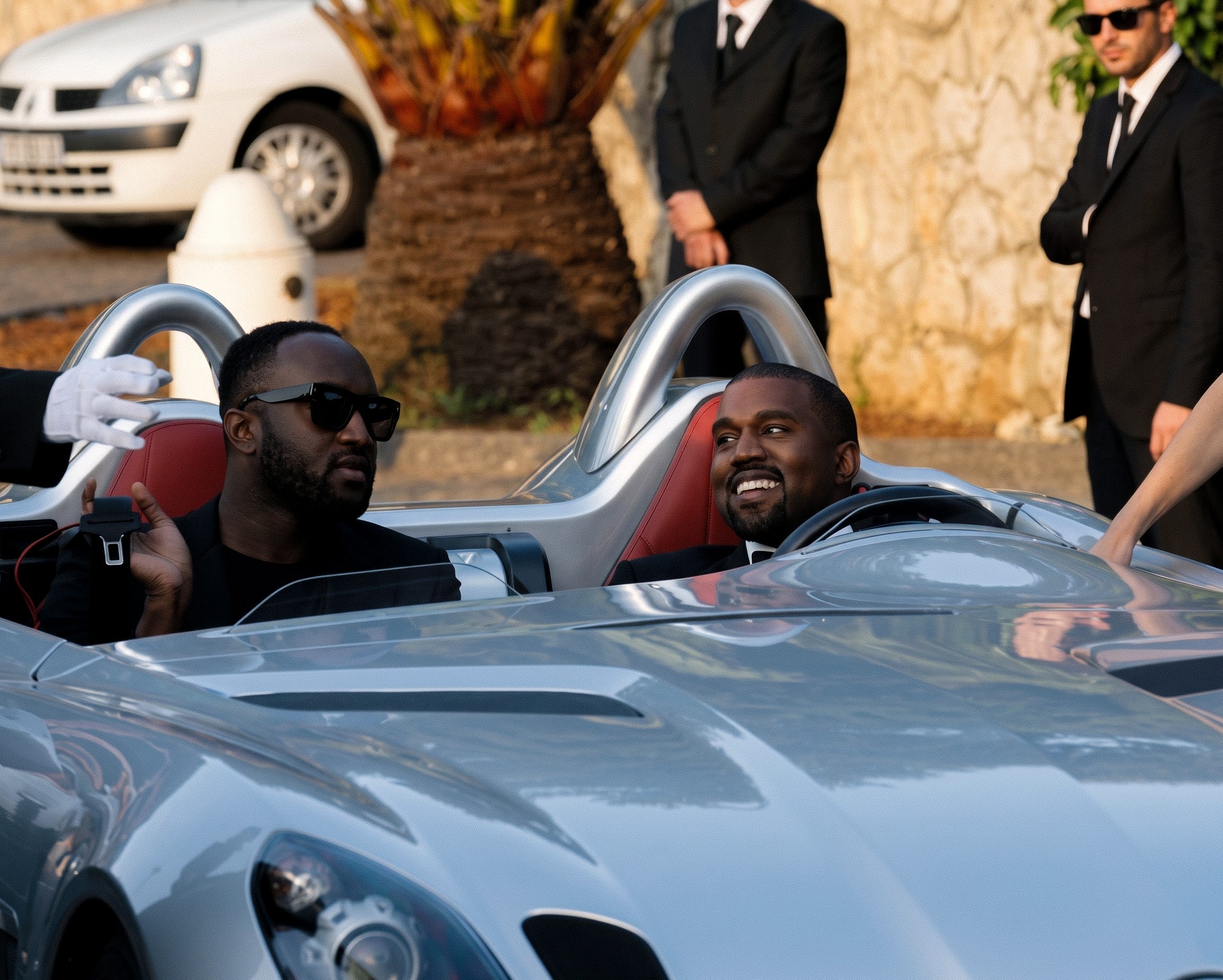
NIGO had already figured the trick out back in 1993: take Polo Ralph Lauren blanks, hand-screen them in a Harajuku workshop, and turn old American status symbols into something stranger and cooler than the originals, which is exactly what Virgil was doing in a Chicago basement 19 years on, working Rugby flannels with a screen-printer and the understanding that America has always been weirdly eager to discard the symbols it spent years selling to itself.
At Harvard GSD in October 2017, Abloh laid out his design philosophy:
Things are intriguing to me when they’re slightly edited. I was only interested in restraining myself, and only editing it 3%. […]
It’s like hip-hop. It’s sampling. I take James Brown, I chop it up, I make a new song.
It was simple: take an object the world had agreed to stop looking at and shift it 3% off-center, moving the Swoosh back half an inch, putting quotation marks around “SHOELACES” like he was letting you in on the joke, leaving the zip tie dangling because it was never about perfection.
In January 2017, Kim Jones (then Louis Vuitton’s Men’s Artistic Director) showed a Supreme collaboration at the house’s Paris runway—Damier monogram reworked with Supreme’s box logo, branded hoodies, a backpack that sold at $2,760. The collection moved at a reported $100 million at retail across its limited drops. LVMH hired Virgil 15 months later.
Louis Vuitton named him Men’s Artistic Director on March 26, 2018, the first person of African descent to hold the position.
At the debut show, Kid Cudi and Playboi Carti walked alongside professional models, and as Abloh took his final bow, he and Kanye collapsed into each other’s arms, sobbing.
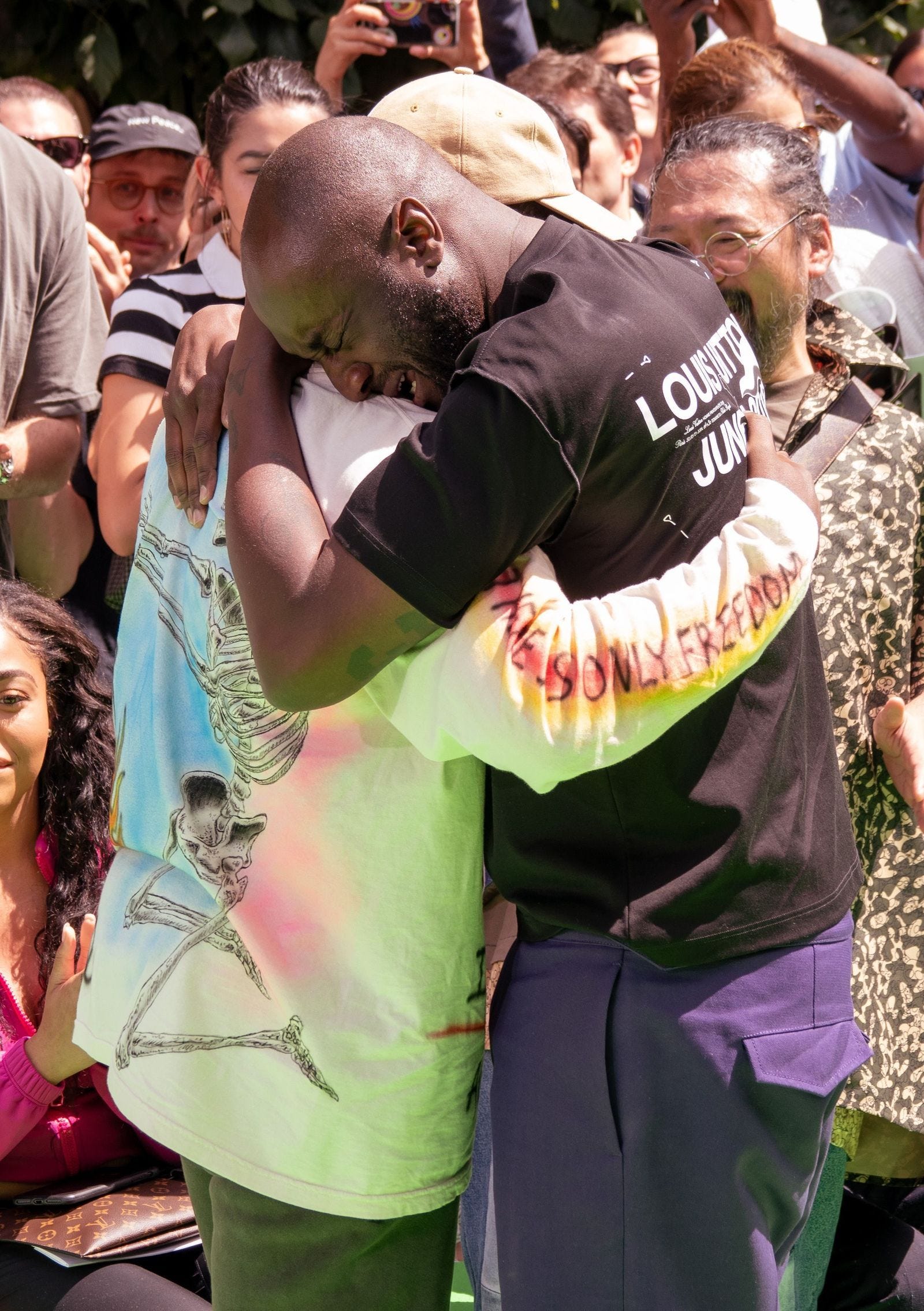
Abloh died of cardiac angiosarcoma on November 28, 2021, at 41:
We are devastated to announce the passing of our beloved Virgil Abloh, a fiercely devoted father, husband, son, brother, and friend. He is survived by his loving wife Shannon Abloh, his children Lowe Abloh and Grey Abloh, his sister Edwina Abloh, his parents Nee and Eunice Abloh, and numerous dear friends and colleagues.
For over two years, Virgil valiantly battled a rare, aggressive form of cancer, cardiac angiosarcoma. He chose to endure his battle privately since his diagnosis in 2019, undergoing numerous challenging treatments, all while helming several significant institutions that span fashion, art, and culture.
Through it all, his work ethic, infinite curiosity, and optimism never wavered. Virgil was driven by his dedication to his craft and to his mission to open doors for others and create pathways for greater equality in art and design. He often said, “Everything I do is for the 17-year-old version of myself,” believing deeply in the power of art to inspire future generations.
We thank you all for your love and support, and we ask for privacy as we grieve and celebrate Virgil’s life.
Virgil Abloh
September 30, 1980 – November 28, 2021
Less than three years later, LVMH sold Off-White to Bluestar Alliance in 2024 for a fraction of what they’d paid. Pharrell Williams was named Men’s Creative Director of Louis Vuitton 15 months after Abloh’s death. Pharrell had walked through NIGO’s collection in 2000, and walked into Bernard Arnault’s corner office in late 2022 to discuss the largest menswear role in luxury.
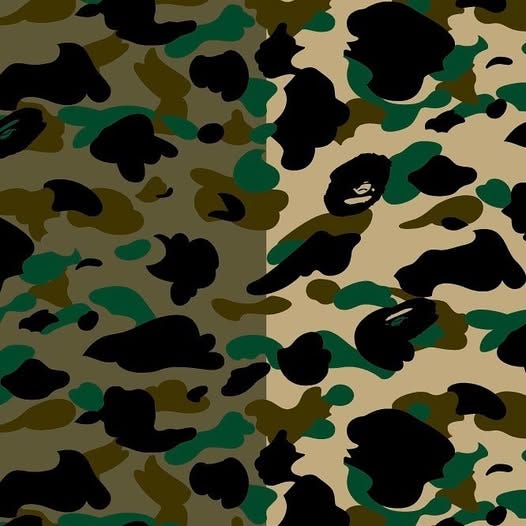
His debut in in June of 2023, held on the Pont Neuf after sunset with Jay-Z performing, was engineered as spectacle. LVMH closed the bridge and reskinned it in gold. The Damier check came back in pixelated camouflage—Louis Vuitton’s 1888 house pattern crossed with BAPE’s 1996 1st camo.
Pearls became the season’s signature. Pharrell had been wearing pearl necklaces since the early 2000s; inside Louis Vuitton, the pearls became bag straps, jacket trims, and the Speedy Pearl in pastel python. The Millionaire sunglasses, originally designed by Pharrell and Marc Jacobs for the house in 2004, came back in expanded colorways.
Tyler, the Creator’s Golf Wang deployed a visual language so specific (pastel palettes, Le Fleur florals, and 1970s tennis culture) that it couldn’t be mistaken for anyone else’s, and he never licensed any of it.
A$AP Rocky broadcast Raf Simons so relentlessly that vintage dealers coined the “Rocky Effect” to explain the spike in archival resale prices.
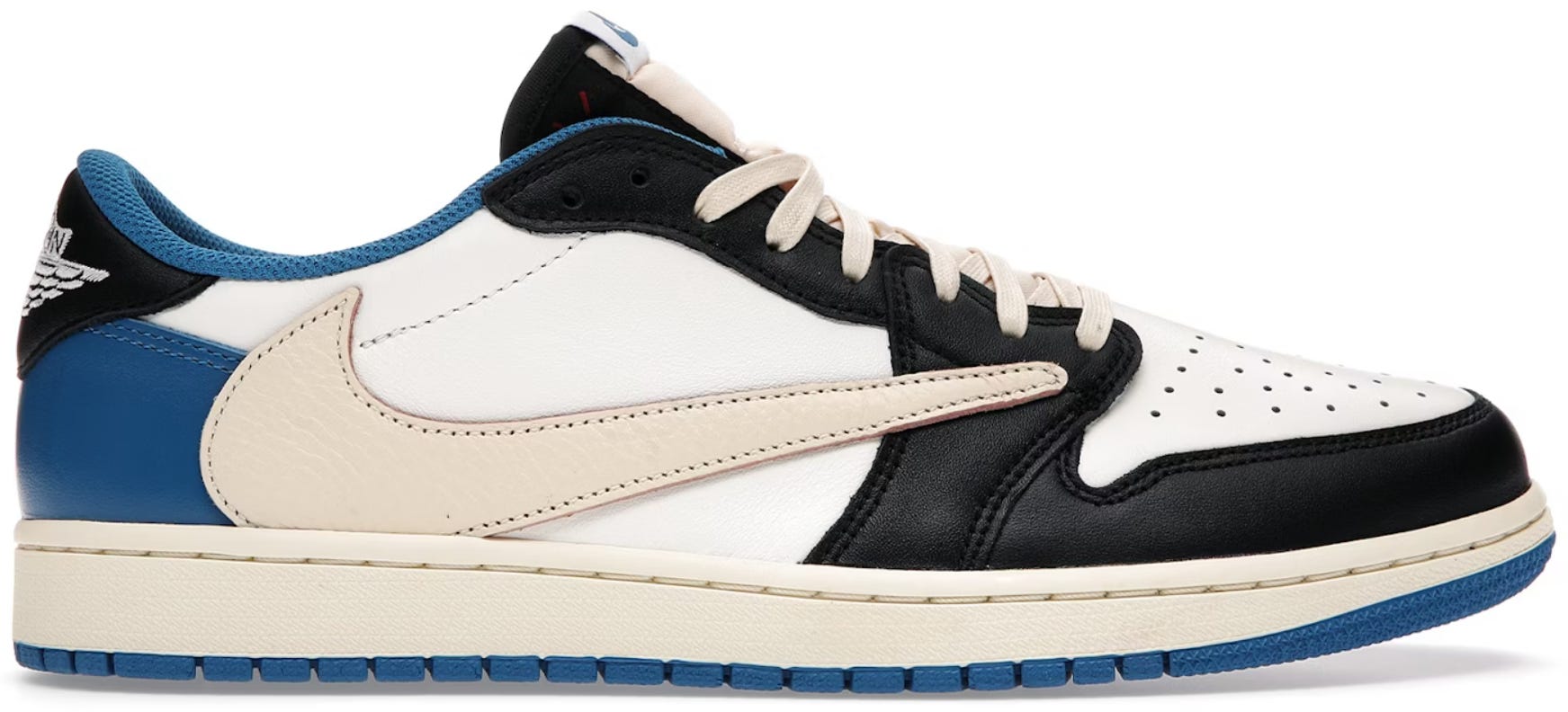
Travis Scott’s reverse Swoosh on the Air Jordan 1 was the most literal application: Dennis Rodman’s Nike Air Darwin had flipped the Swoosh backward in 1994, then the silhouette sat dead in Nike’s archive for 25 years until Scott dug it out. Rodman noticed: “Travis Scott has copied my shoe.”
Scott told Nike the reverse Swoosh was necessary because “Virgil had the orange tabs. We gotta do something.”
In September 2021, LVMH named NIGO Artistic Director of Kenzo—the first Japanese designer to lead the house since Kenzo Takada’s 1999 retirement. Takada’s death from COVID-19 in 2020 closed an arc LVMH had spent the prior 22 years trying to extend through three European creative directors, none of whom returned the brand to relevance. To LVMH, the hire read as a curator with runway credibility and direct lines to Pharrell, Kanye, and every hip-hop artist the house wanted at its shows, while to NIGO it read as the first time a Japanese designer could run a Paris house without mimicking European tailoring as the price of admission.
NIGO explained more in a Fashionsnap interview at his Paris atelier the day before Kenzo FW23:
ストリートとラグジュアリーは対極にあるものと認識していたので、LV²が受け入れられるとは思っていませんでした。ラグジュアリーは好きでしたが、買えるだけでよかったんです。しかし、今こうしてモノを作るようになったのは、まだ不思議な感じですね。きっとヴァージルがドアを開けたから、僕は入っていけた。
I thought of street and luxury as polar opposites—I never expected LV² to be accepted. I loved luxury, but being able to buy it was enough. So the fact that I’m now actually making things at this level still feels strange. It’s because Virgil opened the door that I was able to walk through it.
The 2019 LV² capsule with Abloh—NIGO’s first cross with Louis Vuitton—arrived two years before Kenzo. Abloh’s Vuitton chair, won on the architecture-degree-and-Harvard-lectern legitimacy frame, gave the suits a bridge figure: someone fluent in streetwear and institutional luxury; someone Paris could credential.
NIGO’s January 2022 Kenzo debut revolved around the “Boke Flower,” a Japanese quince blossom installed as the house’s new monogram. The original, Kenzo Takada’s Poppy Flower, had filtered Japan through a French house’s French eye.
The first collection sampled varsity jackets, collegiate knitwear, and American workwear. A Levi’s jacket milled on Japanese looms Levi’s itself had discarded in the 1970s, recut by a Harajuku designer who learned the craft from Fujiwara, who learned it from Ishizu, now walked a Kenzo runway in Paris.
In a Fashionsnap sit-down, NIGO frames it less as authorship than custodianship:
ケンゾーは高田賢三のブランドであって、主役は僕ではありません。賢三さんのデザインが生き続けていくことが重要です。自分の解釈で発表するだけの、”Nigoのケンゾー”にはしたくない。
Kenzo is Takada Kenzō’s brand. I’m not the protagonist. What matters is that Kenzō-san’s design keeps living. I don’t want it to become merely “NIGO’s Kenzo”—just my own interpretations on display.
NIGO’s first collection triggered a spike in wholesale bookings and lifted e-commerce traffic. Successive shows continued the Boke Flower across sneakers, bags, and knitwear. By late 2024, Kenzo had reopened flagships in New York’s SoHo and on Rue Saint-Honoré.
Yohji Yamamoto and Rei Kawakubo walked into Paris Fashion Week in the early 1980s, an arrival the European press first read as “Hiroshima chic” and the Japanese-domestic press as the milder pua rūku—poor look. Yamamoto’s 2021 Nikkei Watashi no Rirekisho serial autobiography frames the period in his own words. Issey Miyake had been showing in Paris since 1973.
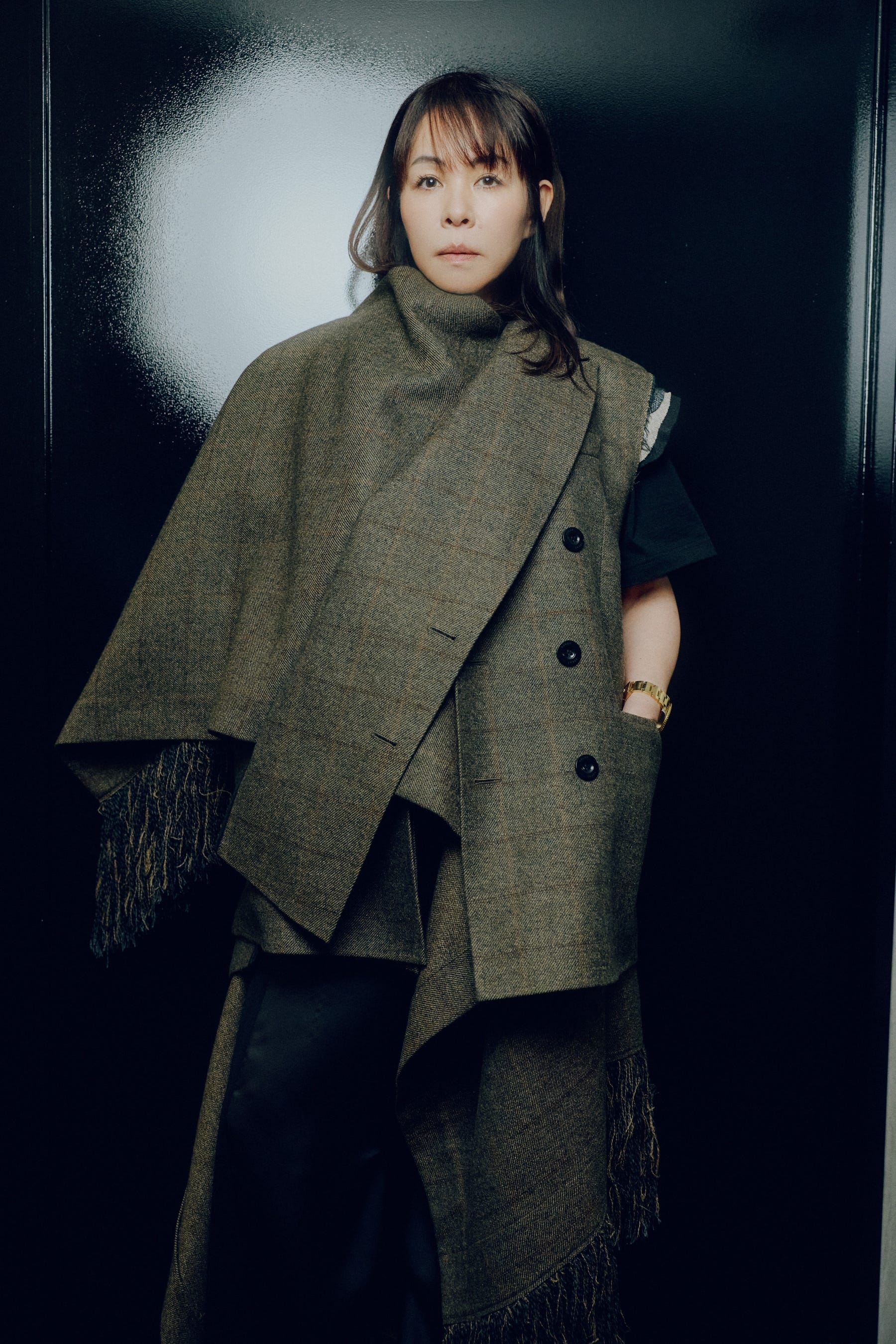
Abe—who spent years at Comme des Garçons as a patternmaker under Kawakubo and then on Junya Watanabe’s team before founding Sacai in 1999—cuts two finished garments apart and sews them into one: a military bomber spliced horizontally onto a tailored blazer, a trench coat fused with a knit cardigan, cargo pants folded upward into skirts.
Every figure who’d opened a shop off Cat Street in the 1990s had, by 2025, either retired, collaborated with a luxury house, or taken a creative-director role inside one. Japan had placed a structural generation of designers inside the French luxury establishment without those designers first becoming French.
BAPE’s heir is Cav Empt, founded in 2011 by Toby Feltwell, SK8THING, and Hishiyama. There was no flagship, just rotating drops through the brand’s own website and a small set of global stockists, with graphics cycling through obscure references—pixelated internet-age science fiction, cyberpunk fonts, logotype arrangements that read as half-corporate and half-paranoid.
Most of the original Ura-Harajuku brands either scaled up or burned out: BAPE under I.T, Undercover into Paris Fashion Week, Neighborhood into international flagships.
Cav Empt’s three founders were all men, while a few blocks away Chitose Abe was quietly taking garments apart and rebuilding them. Junya Watanabe, who came up under Kawakubo as she had, got his own label under the Comme des Garçons umbrella in 1992; Abe left and built Sacai herself in 1999.
& Still
Legally, hip-hop sampling was contested: Grand Upright Music, Ltd. v. Warner Bros. Records Inc. (1991) ended uncleared sampling overnight. Judge Kevin Thomas Duffy opened his opinion with four words from the Seventh Commandment: “Thou shalt not steal.” He referred Biz Markie for criminal prosecution after Markie sampled Gilbert O’Sullivan’s “Alone Again (Naturally)” without clearance.
Three years later, Campbell v. Acuff-Rose Music (1994) restored fair-use parody as a defense—2 Live Crew’s “Pretty Woman” survived on the Supreme Court’s ruling that a commercial parody can still qualify as fair use. The door was cracked back open for parody, but straight sampling still required clearance or a check.
After Grand Upright, every non-parody sample had to be cleared or it got you sued, so the Bomb Squad’s production style for Public Enemy, dozens of layered samples per track, became financially impossible (and outside of feasibility) inside a year.
Biz Markie got dragged into federal court over three sampled seconds while NIGO spent a decade selling near-identical BAPESTAs in patent leather camouflage with barely a lawyer in sight.
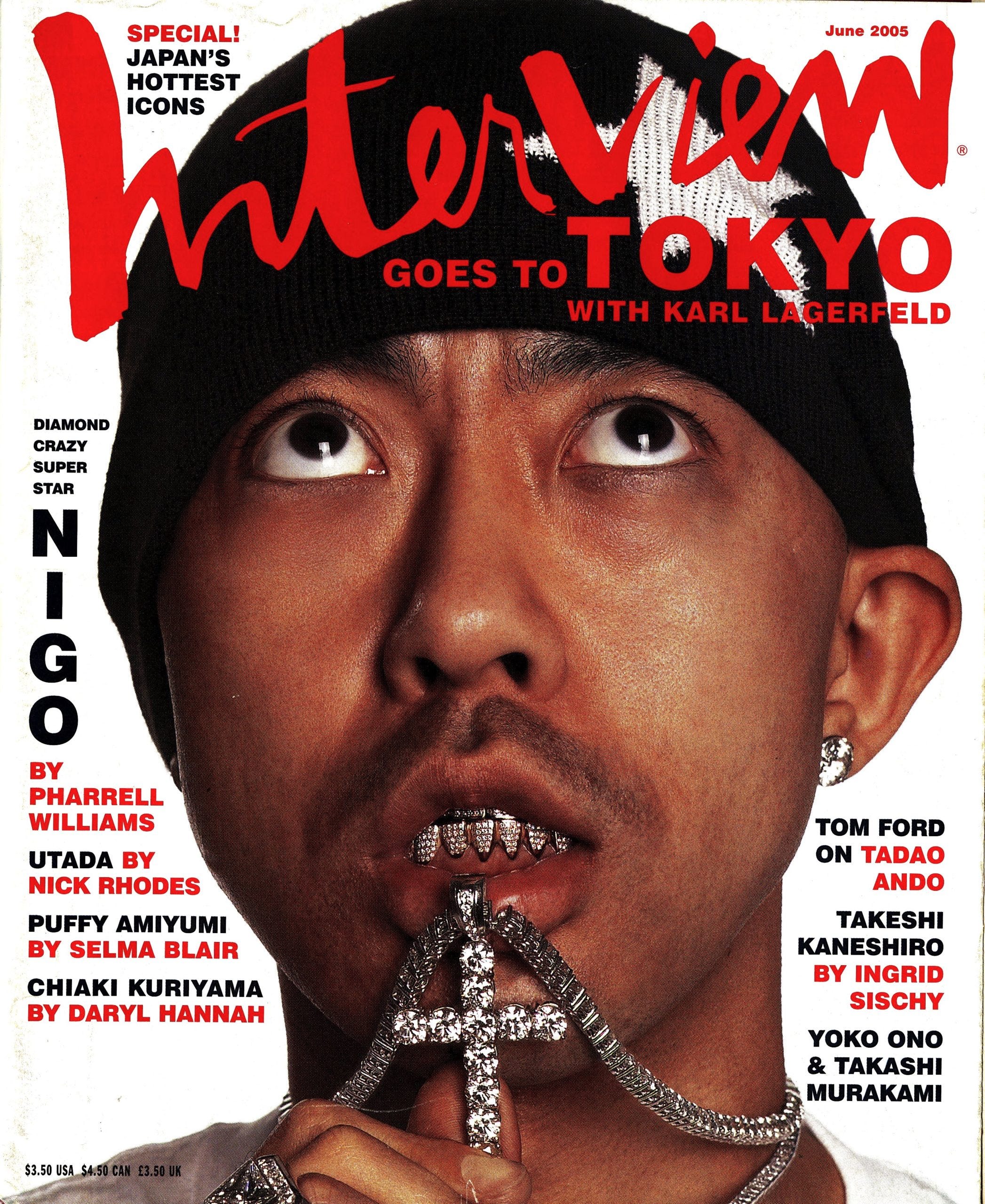
Interview asked NIGO what he had to say to bootleggers in 2005—
That if you have enough creativity, or energy to be a bootlegger, why don’t you just make your own thing? But then it also shows my own status and how successful my line is, because nobody bothers to rip off what you do unless you’ve succeeded.
Nike didn’t even register the Air Force 1’s trade dress until 2008—26 years after the shoe debuted. In 2009, Nike’s VP of footwear flew to Tokyo twice to confront BAPE over the BAPESTA; BAPE rejected a proposed licensing agreement and quietly reduced its U.S. presence but continued selling BAPESTAs for another 12 years.
In 2021, BAPE—now backed by Hong Kong investment money—scaled up production and reintroduced the BAPESTA at industrial volume. Nike sued for trademark infringement in 2023, alleging five BAPE models were “near verbatim copies” of the Air Force 1, Air Jordan 1, and Nike Dunk. The April 2024 settlement forced BAPE to discontinue three models and redesign two others.
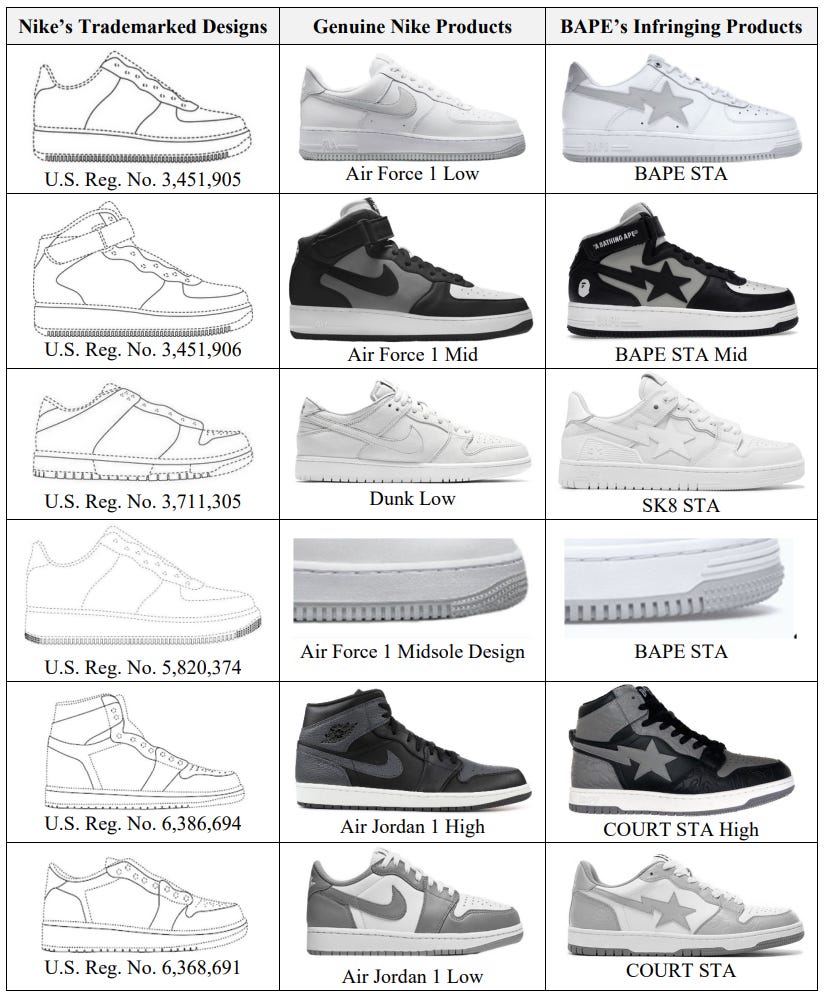
NIGO returned to the BAPESTA in GQ’s Design Museum coverage two years later, after Nike had signed him onto an Air Force 3 and an LO2 Air Force 1.
NIGO, GQ, April 2026—
I’ve always loved Nike. There was a time when I was designing things that were inspired by Nike out of respect for them.
Capital Has Momentum, Not Taste
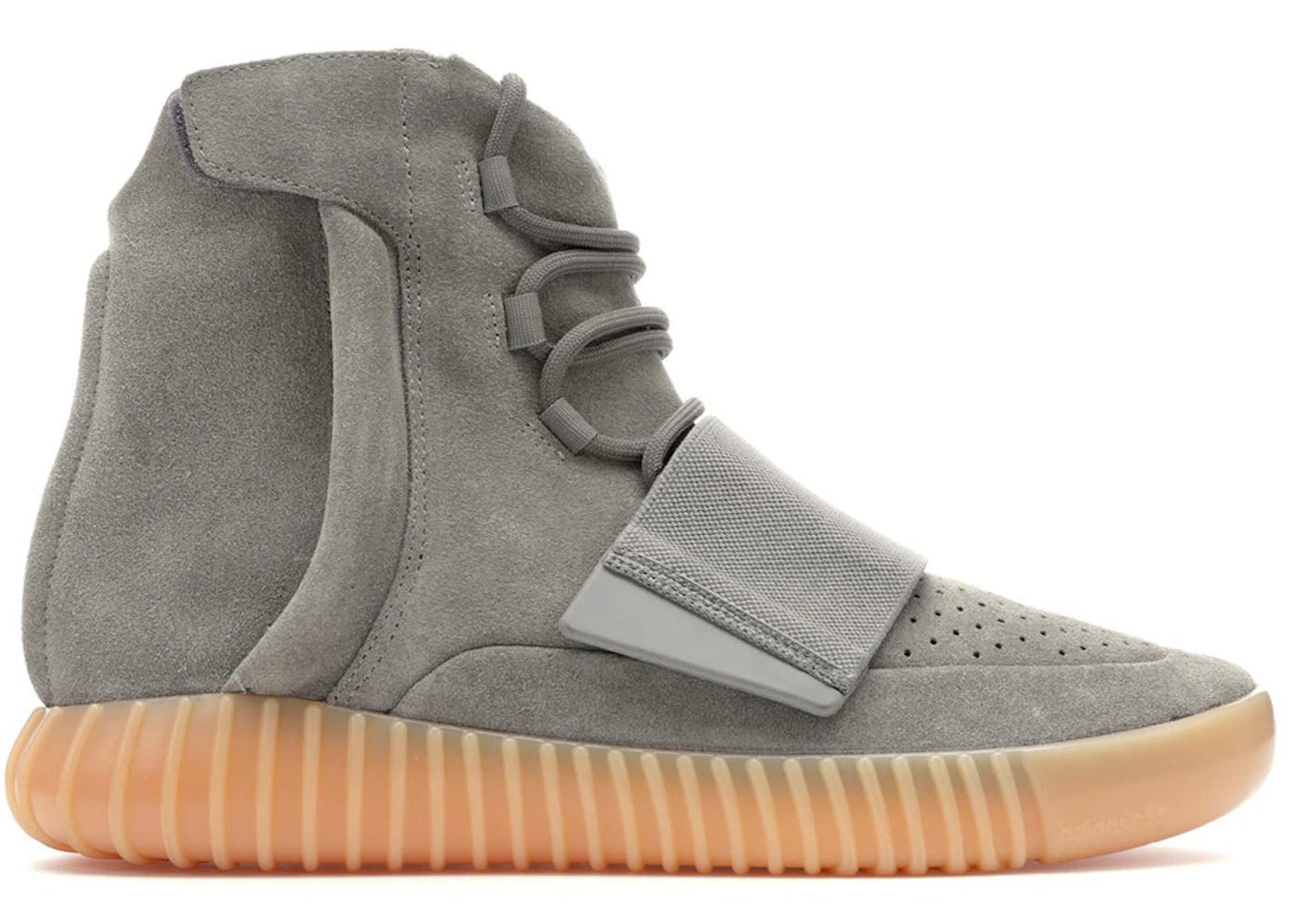
The first Yeezy Boost 750 drop in February 2015: 9,000 pairs worldwide, $350 retail, gone in 10 minutes. By 2021, $1.7 billion in annual revenue.
BILLIONAIRE BOYS CLUB entered a 2012 joint venture with Iconix Brands (the licensing conglomerate behind Rocawear) before Pharrell bought back Iconix’s 50% stake in January 2016 amid Iconix’s SEC investigation and $300 million debt crunch. NIGO sold 90% of BAPE to I.T Limited in 2011 for roughly $2.8 million—a deal Toby Feltwell used his law training to negotiate before leaving with SK8THING to launch Cav Empt later that year. By the time I.T arrived, NIGO’s parent company Nowhere Co. carried ¥1.25 billion in net liabilities and roughly ¥4.31 billion in bank loans and shop leases that I.T absorbed; NIGO told WWD the brand had grown past what he could handle, with the company having spread into BAPE CAFE!?, the BAPE CUTS hair salon, and a string of other ventures alongside the apparel core.
Nine years on, NIGO described the exit on J-WAVE’s Roppongi Passion Pit as a Lehman-shock collapse he could no longer outrun:
自分的に「ファンが望むモノづくり」というのが苦手で、どうしてもいつもマンネリズムになって自分の思うようなモノづくりができなかった。
I’m bad at making things fans want. I always ended up in mannerism and couldn’t make things the way I wanted.
The old Cyzo-era image of NIGO looked like the logical endpoint of Harajuku excess. NIGO’s post-sale business-card joke: 代表取締役用務員, Daihyō-torishimari yakumuin—Representative Director Janitor, which, for somebody who spent three decades archiving, sorting, rebuilding, and sweeping through American culture by hand, was probably closer to the truth anyway.
GQ asked NIGO about the sale 15 years later—
Looking back at my life, Bape was actually a big mistake. But in a good way. Because if I hadn’t had that, then I wouldn’t have had Human Made. I wouldn’t have been able to enjoy my life as I do.
He reached for a Tokugawa Ieyasu legend to explain it—
Maybe not so much a mistake. Maybe more as a battle that I lost. Because I ended up having to sell the company. Otherwise, I could have still been running it.
Supreme moved even faster: VF bought it in 2020. EssilorLuxottica picked it up four years later for $1.5 billion. By then the brand mattered less than its resale price; StockX and GOAT had turned the drops into line items, and the line outside the store had moved to a laptop.
Bernard Arnault built LVMH on the premise that the brand name is the only thing worth owning while the designer is a hire you can replace (€86.2 billion in LVMH revenue in 2023).
Under Jebbia, Supreme ran on intentional scarcity—weekly drops out of Lafayette Street. Under VF it became a revenue line that had to justify a depreciation schedule, and by 2024, when EssilorLuxottica arrived, the brand had been quietly marked down.
It’s All About Timing
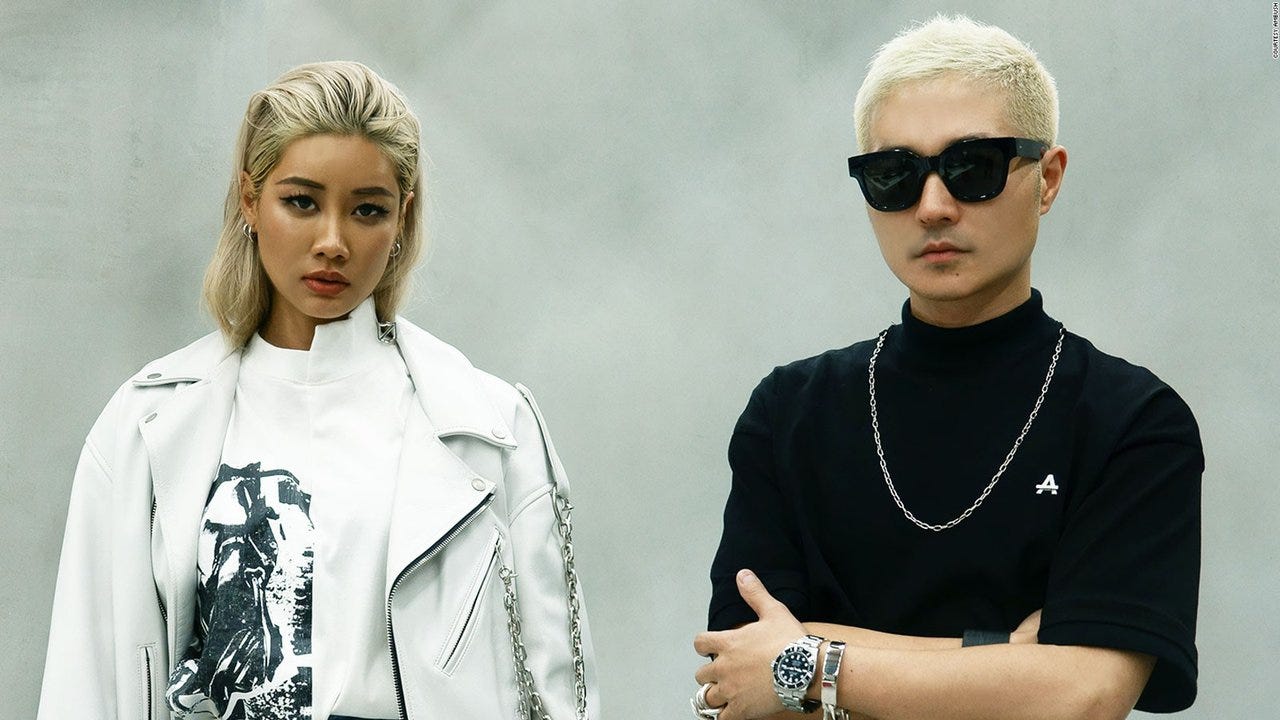
Missy Elliott was already wearing oversized sportswear on camera before Pharrell got to Tokyo. Yoon Ahn co-founded AMBUSH in 2008 and was appointed Dior Men’s jewelry designer by Kim Jones a decade later, the only woman in the extended room to enter a luxury house in her own name, and she entered as jewelry rather than menswear.
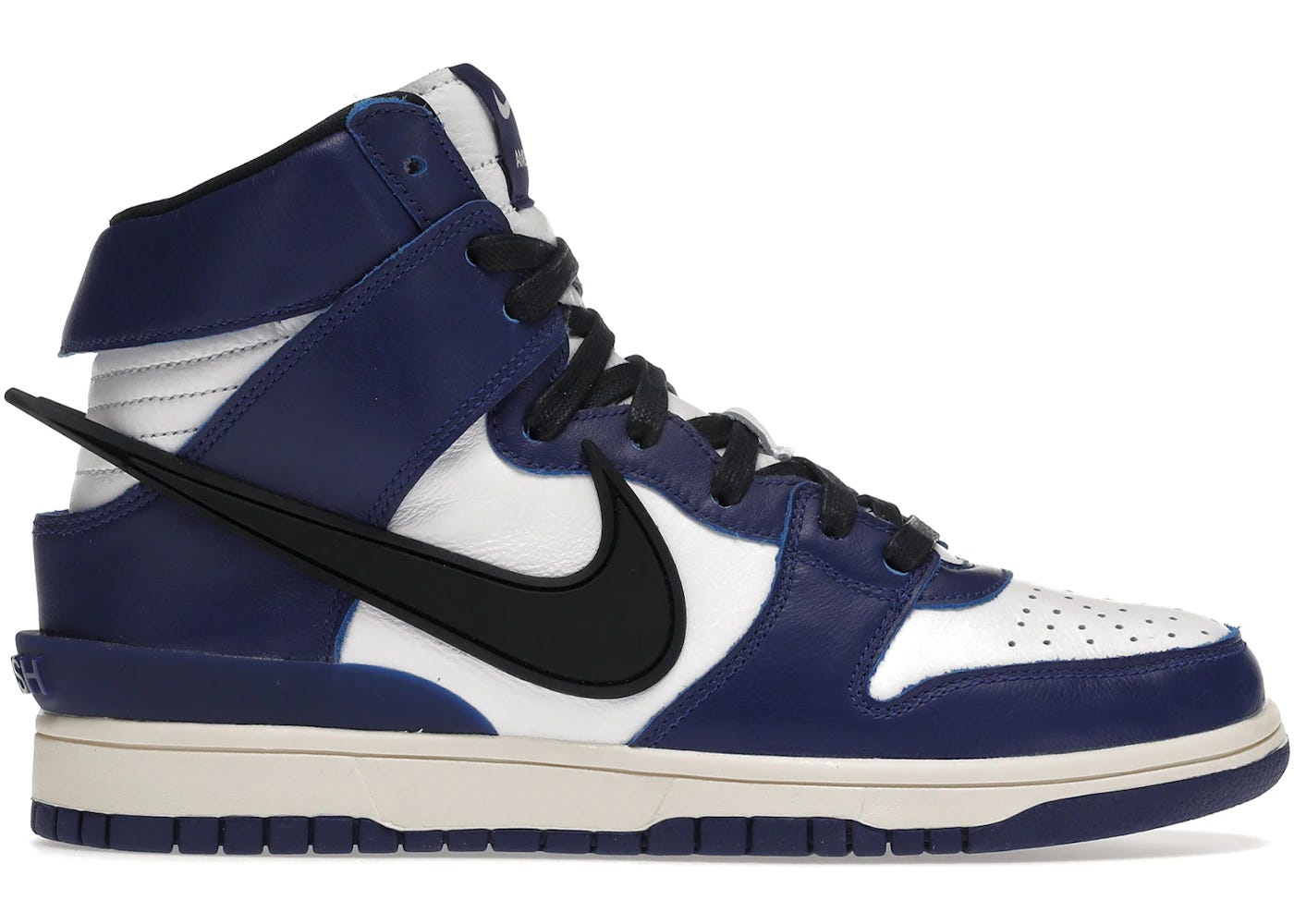
Es Devlin designed the stages for Kanye’s tours—the twin cubes of Watch the Throne, the “Mount Yeezus” volcano he rapped from. Vashtie Kola directed the video for CRS, Kanye and Pharrell’s trio with Lupe Fiasco, became the first woman to design an Air Jordan, and ran the creative for Pharrell’s Icecream women’s line.
Rihanna’s Fenty clothing line, launched under LVMH in 2019 and paused in 2021 citing it as a WIP, was the first Black-owned house the conglomerate had ever opened in its 32-year history, and it lasted two years while the menswear chairs around it have lasted decades:
Rihanna and LVMH have jointly made the decision to put on hold the RTW activity, based in Europe, pending better conditions,” LVMH told WWD.
Virgil said it first, in a Dazed cover story in December 2019—
In my mind, how many more T-shirts can we have? How many more hoodies?
Streetwear, in my mind, is gonna die, you know?
Adidas was writing Yeezy billion-dollar checks and LVMH had pulled Virgil, NIGO, and Pharrell into its orbit.
NIGO, Sabukaru, April 2026—
It was something that could only have happened in that specific era. If I tried to start it now, I’m sure I couldn’t pull it off. It was only possible because of the lack of information at the time, our youth, and our own ignorance.
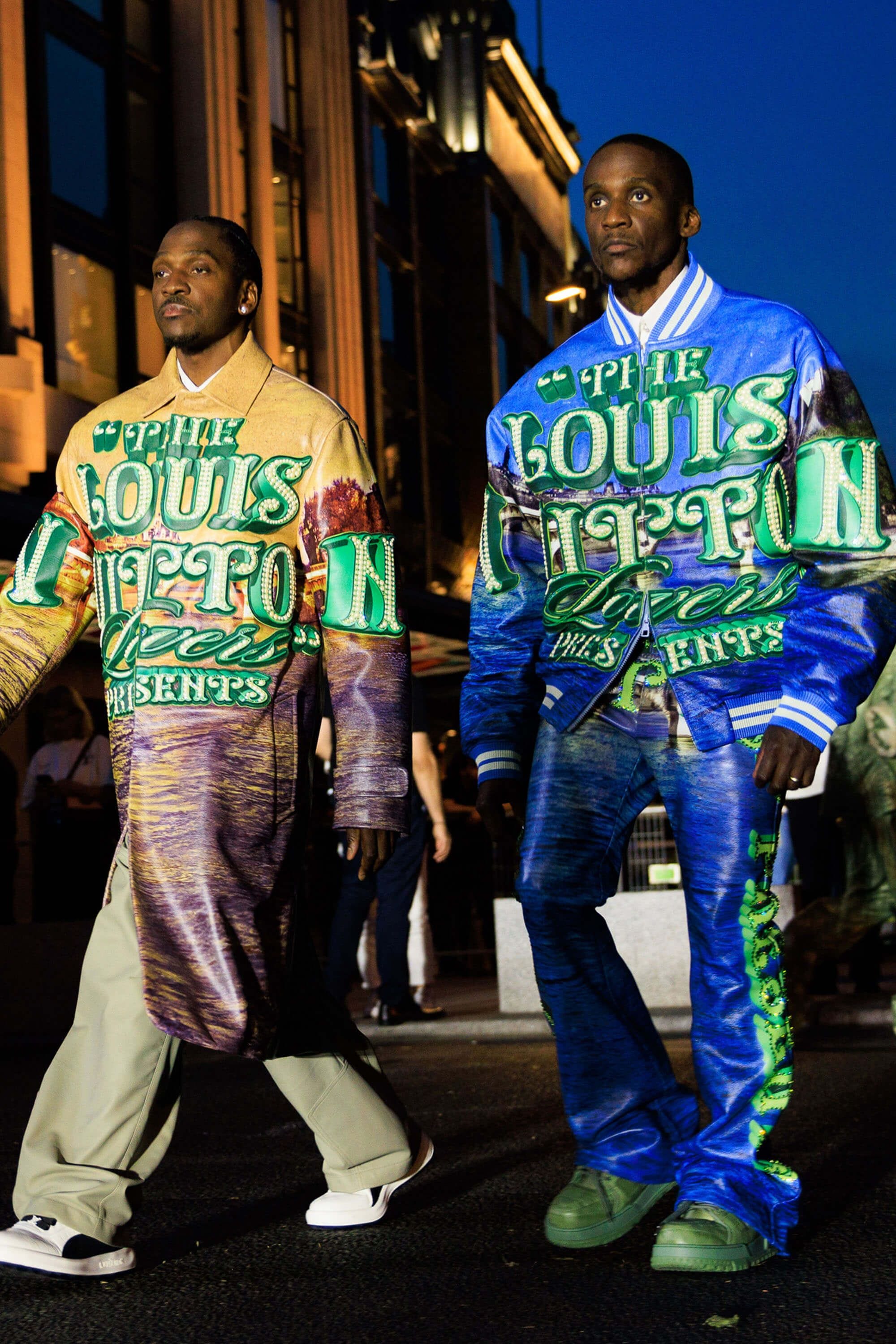
Frontin’ at the Afterparty
In the years between losing BAPE and taking over Kenzo, NIGO quietly rebuilt with HUMAN MADE—a single Tokyo storefront called Cold Coffee, open weekends, small-batch.
NIGO took over Kenzo in September 2021 (the first Japanese designer to lead the house since founder Kenzo Takada retired in 1999)—a house LVMH had long considered an underperformer, barely breaking even at roughly €150 million in annual sales.
January 2025 brought a collection co-designed with NIGO—“Damier Phriendship” trunks embossed with both creators’ profiles, kimono-inspired jackets, and a set designed by Tokyo’s Wonderwall agency.
Late 2024 brought NIGO’s first official Nike collaboration—a Nike Air Force 3, a 1988 silhouette that had sat dead in Nike’s archive for over three decades. He stamped “NIGO FORCE” on the heel and put one colorway in pony hair, a reference to Planet of the Apes. Nike had sent a VP to Tokyo in 2009 to shut the BAPESTA down, and 15 years later they handed NIGO a silhouette from their vault.
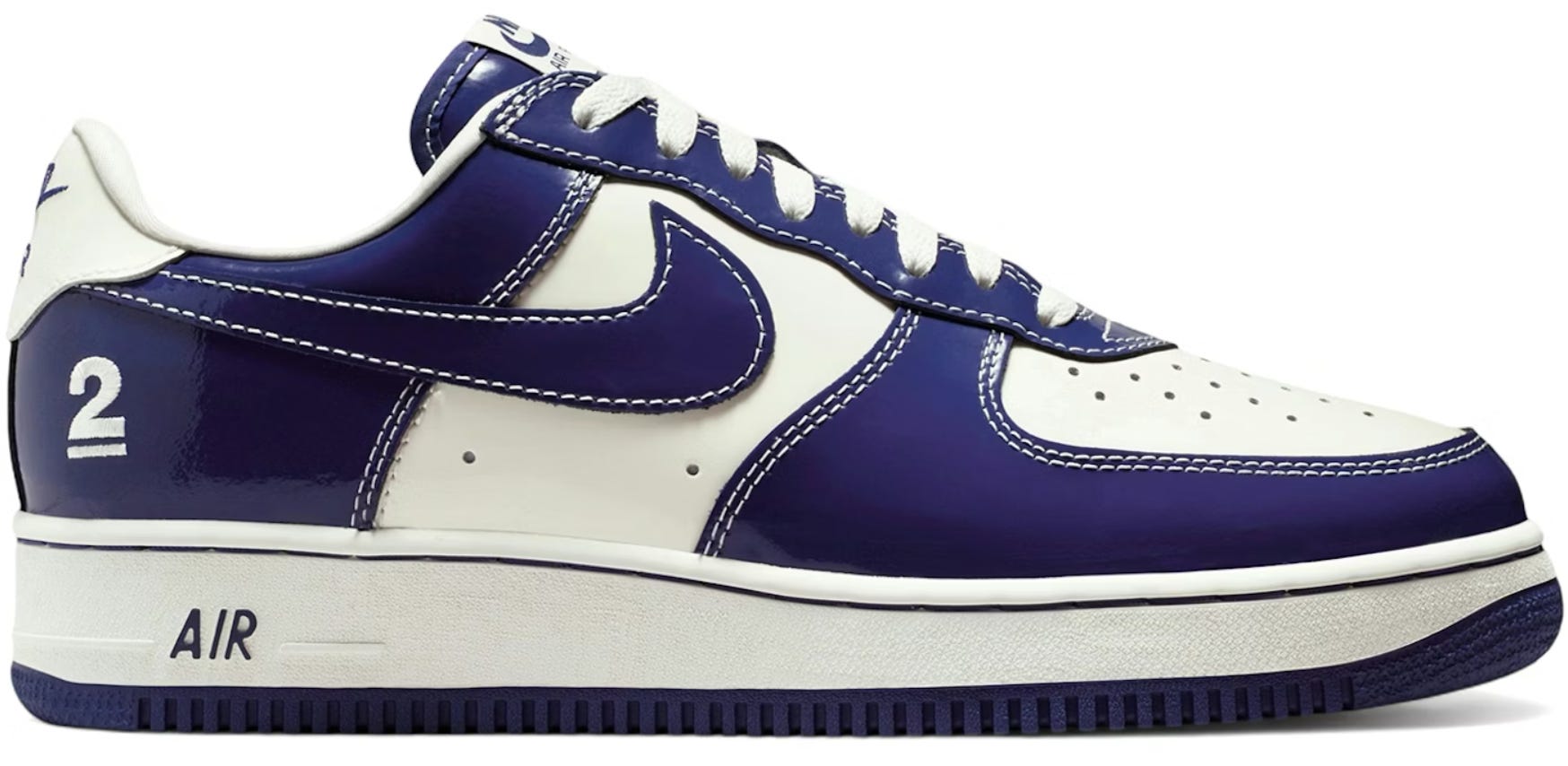
In April 2026 Nike revealed a NIGO × Jun Takahashi “Last Orgy 2” Air Force 1 Low ’01—the first retro of the 2001-cut AF1 last, Sail and Loyal Blue patent leather pulled from the 1993 NOWHERE storefront sign, “LO2” stamped on the foxing and sock liner, “NIGO AIR” in place of “AIR” on the tongue, a “2” on the lateral heel.
The release coincided with “NIGO: From Japan with Love” at London’s Design Museum: more than 700 objects, a reconstruction of his teenage bedroom in Maebashi, hand-thrown ceramics, archival clothing, a glass tea house built directly onto the gallery floor.
GQ asked NIGO at the close of the same interview what advice he’d give anyone trying to walk the same path now:
Well, I think they should look at the exhibition. And then do something completely different.
On June 15, 2026, NIGO’s Human Made, by then a company listed on the Tokyo Stock Exchange, agreed in principle to take all of Undercover. A nonbinding letter of intent for 100% of Jun Takahashi’s house, the share purchase targeted for September, the handover for early 2027, the price left blank pending a valuation.
In 1993 the two of them had split one wire-netted room on Cat Street, Undercover on one side, NIGO’s venture on the other.
33 years later the netting comes down, from NIGO’s side.
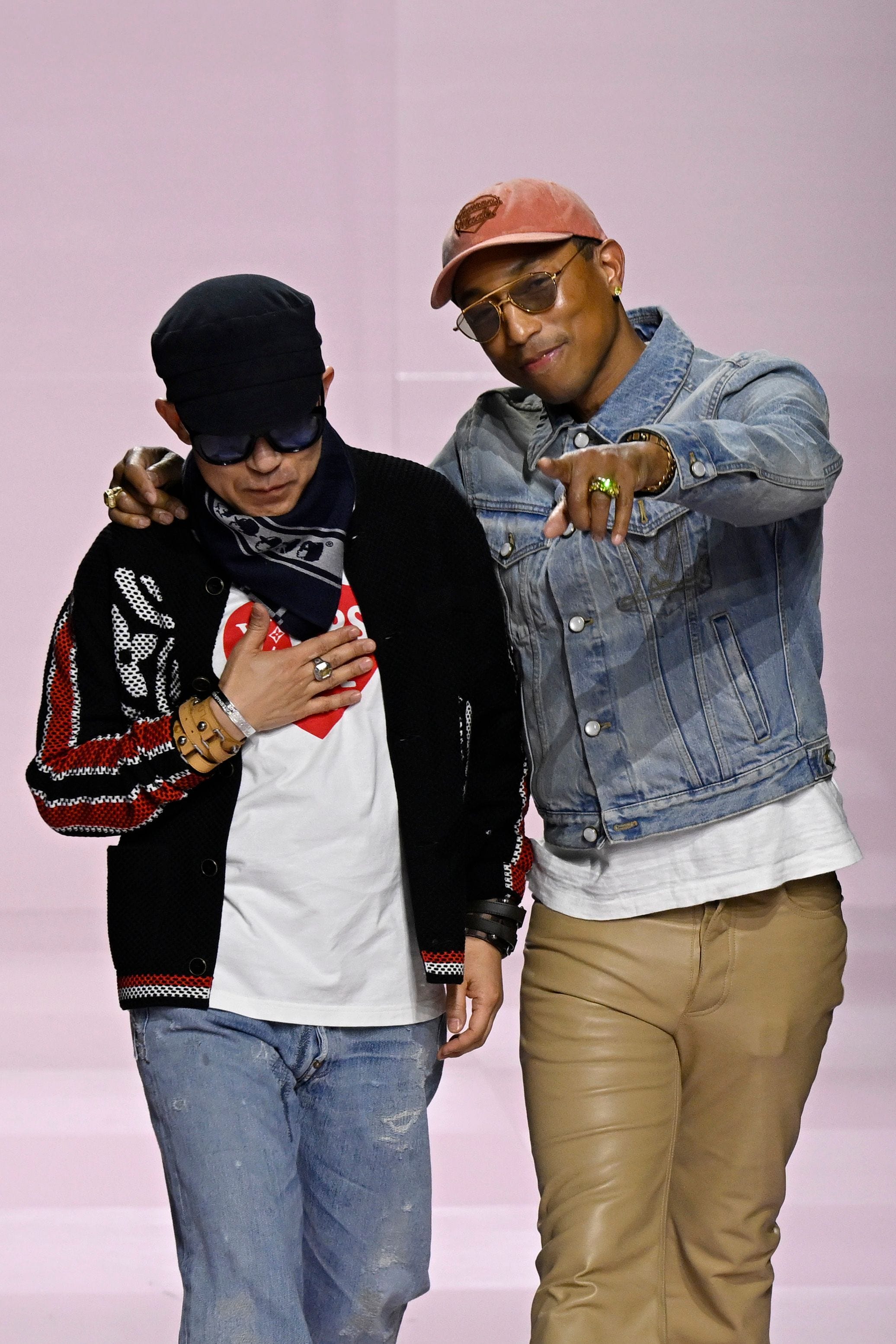
If you like this piece, you may enjoy:
The Immortal Legacy of Seba “Nujabes” Jun

My thanks to Seba Jun’s family and contributors for their trust and support in bringing this piece to life.