
Bubblegum and Barricades
How S.E.S., Girls' Generation, and IVE taught K-pop the one thing every label has spent 30 years chasing—survival.


Girl groups within Korean pop music are an unparalleled achievement of engineering within music. Watch the lights die at a stadium show at Olympic Park any day of the week: tens of thousands of lightsticks holding one color in the dark, the roll-call chant—every member’s name, in order, as always—then the voices fade in. Nothing in pop is built more carefully, or to last less; all built and carefully planned with intention down to the split second.
A debut, comeback optimized for the evening charts, and an unforgiving renewal cliff. Underneath, somebody’s whole adolescence—loved for a while, then remembered quietly.
Hundreds of groups have run this exact arc since 1997, but three were the same group. Different faces, eras, and companies—but anyone who stood in those crowds long enough could see it: the same silhouette, reappearing.
DISCLAIMER:
This article constitutes opinion, cultural commentary, and criticism.
Original translations are unofficial and non-authoritative.
This piece is the third and final piece in my K-pop trilogy; the other two can be found here:
200 Voices, 0 Microphones
On a campus in western Seoul, during the sweltering summer of 2016, ~200 students linked arms in a corridor against a line of riot police. Their university had tried to push a degree program through without them. An estimated 1,600 officers arrived—eight for every student in the hallway, not a single microphone or megaphone in sight.
The song they sang dropped just short of a decade prior, “Into the New World,” cut by nine teenagers at SM Entertainment, assembled as its female counterpart to Super Junior—Girls’ Generation, SNSD or 소녀시대 to fans. It was their debut single.
Asked afterward why not something from further back—why none of the old movement songs—a 23-year-old student said:
민중가요는 부르고 싶지 않았다.
I didn’t want to sing minjung-gayo.
Ewha Womans University’s president resigned. By that autumn the song had moved into the candlelight vigils that brought down the Park Geun-hye administration.
A total of approximately 17 million people in all and 2,400 organizations took part in 23 such rallies between October 29, 2016 and April 29, 2017, and voluntary donations amounted to as much as US$3.5 million —Korea.net
In December 2024, eight years later, hundreds of thousands outside the National Assembly sang along to the same chorus while calling for another president’s impeachment.
SM was building for a relaxing Sunday afternoon, not a police line. One wide shot, with a hand already on the remote. The whole group has to entertain the viewer before the channel flips. The styling has to land in Tokyo and in a living room in K-town with nobody there to translate it. The unit—the name, the fandom, the catalog, the cultural capital it holds, the trends it sets—has to outlive the people in it: the members who leave, the contracts that run out, and finally, the platform it was built for going dark underneath it.
Fin.K.L. moved the same Korean numbers as S.E.S. from 1998 to 2000, and never got past a few promo dates in Japan. Tokyo Dome went to KARA in January 2013, and their Korean lineup came apart anyway. 2NE1 cracked global press, then disbanded inside the very subculture that made it.
Each generation of K-pop inherited the same impossible bargain: solve one of the three design problems—the wide shot, the untranslated styling, the churn—and the other two came looking for you. Every great girl group chose which wound it could survive; three refused this and solved theirs outright, one era at a time.
In 1997 that meant cassettes, and by the next autumn a Roppongi nightclub, with Bada onstage at 18. In 2009 it meant nine girls in a shop window, sporting primary-color jeans. In 2021 it was six inches of glass.
S.E.S. taught K-pop how to leave home. Girls’ Generation taught it how to survive itself. IVE taught it how to live in your hand.
Spiritual Succession
The groups’ aesthetics share little: chiffon and pastels for S.E.S., the clean pep-rally polish on SNSD, and a carefully curated Miu Miu-coded mood board around IVE. Fans see something that plainly continues, can’t draw it on a family tree, and land on “spiritual succession.”
Even the professionals drew it late: the first book-length Korean study of the subject arrived only in 2011, its H.O.T.-to-SNSD lineage chapter co-written by Cha Woo-jin—a critic reviewing records since 1999 who traces his own attention to K-pop back to hearing “Gee” in 2009, two years before he wrote the history of it.
One branch is signed: Min Hee-jin, the SM art director who would later operate NewJeans at ADOR, is the name behind SNSD’s visuals.
The two biggest groups in IVE’s album-buyer data at one Korean retailer are women in their 40s and teenage girls. The women grew up able to name S.E.S. and SNSD without ever following either.
Writing more than 30 years before K-pop existed as an industry, Christopher Alexander observed—
[E]very design problem begins with an effort to achieve fitness between two entities: the form in question and its context.
The form is the solution to the problem; the context defines the problem.
Fit itself is invisible in his account—“it is much easier to explain the misfit of a wrong button than to justify the congruity of one which fits.”
Alexander’s conclusion runs counter to everything this industry does. Good fit, in his account, belongs to unselfconscious cultures, where forms get corrected slowly and there is little thought about design.
Korea doesn’t do unselfconscious; there’s a ministry for it.
Cassettes? What are those?
SM pointed everything it had at three teenagers: the trainee pipeline, the role splits, the variety bookings, the MV shoots—and three biographies that between them happened to cover Korean television, the Japanese market, and the diaspora.
SM Entertainment released the self-titled debut album in late 1997, “(’Cause) I’m Your Girl” as its lead single; the debut broadcast ran on SBS on Nov. 28, a week after the finance minister took the country to the IMF. The album sold anyway—600,000 or 650,000 depending on who you ask, since the industry had no chart until August 1998.
That roster ran three deep, and two of the three were the reason it reached overseas. Eugene (Kim Yoo-jin) was born in Seoul and raised partly in Guam, where she met Lee Soo-man at the airport on an H.O.T. visit and had an offer by that spring. Shoo (Yoo Soo-young) had been born and raised in Japan.
Bada handled lead vocals and the stage center. Visuals and the English were Eugene’s. Shoo took on variety-show warmth, vocal texture, and the Japanese end of things.
John Lie wrote the standard economic history of this industry. H.O.T. and “its female analogue, S.E.S.,” were “speedily assembled”; the music and dance and videos were, “to put it charitably, amateurish and asinine,” a simple imported formula applied diligently for domestic consumption. He is right that it was fast, cheap, and imported. That was the point—a formula this easy to copy is a formula that worked, and the copies came in waves: Sechs Kies in April 1997, NRG, Baby V.O.X. that July, S.E.S. that November, then Fin.K.L. the following year.
Fin.K.L. debuted in May 1998 at 대성기획, the agency later renamed DSP Media, as a planned trio that became a quartet when Lee Hyori was added late. 영원한 사랑—“Eternal Love”—took the national monthly album chart in May 1999, at 472,660 copies in 19 days.
DSP had not built the proper depth around them that SM had: the diaspora positioning via Eugene and Shoo had no Fin.K.L. equivalent, and group activity wound down after the 2002 fourth album. Hyori’s 2003 solo turn established the Korean female solo template SNSD members would adapt a decade later: a waltz through dramas, CFs, and hosting that made popularity and relevance survivable when the music was in off-cycles.
SM spent years figuring out how to make H.O.T. impossible to ignore, while S.E.S. proved the girls had been the easy part all along. When S.E.S. arrived, the contracts had been signed in spirit, the rehearsal rooms ready, and the television studios expecting them; the girls were the only surprise.
Korea’s first girl groups had played to soldiers. From the Kim Sisters to the Pearl Sisters, they worked the U.S. military club circuit in a style meant for the men at the tables: cheeky, flirtatious, just dangerous enough to earn another encore. S.E.S. was different. Cabaret gave way to fairy tales, and the barracks gave way to the living room; innocence crossed borders more easily than seduction.
The room changed at home, too. A feature remembers the S.E.S. audience as schoolboys, university students, soldiers, and the salaryman necktie brigade—later christened as ‘uncle fans.’ As Kyung Hyun Kim notes, before 2000 it was ordinary for teenage girls to devote themselves to girl groups. The surprise was the men lining up behind them. S.E.S. didn’t steal the audience, they doubled it. Looking back, Bada laughed that S.E.S. was probably the only girl group that needed bodyguards; fans of the boy groups, jealous she figured, mailed them things like razor blades instead.
Kim Dae-jung’s 1999 Framework Act on the Promotion of Cultural Industries pivoted national policy toward cultural export by name and put sound recordings in one list with film, video games, publishing, and broadcasting. Pop was one of the few industries on the list the post-crisis state could still afford to grow.
Japan in 1998 came through VAP Records: Korea announced the first-stage lifting of its own ban on Japanese culture on Oct. 20—film, video, and comics, with music still held back—and めぐりあう世界 (“Meguriau Sekai”) came out the next day. At home, Korean sales reached about 3.55 million by 2002, during a period when piracy was eating most of the market alive.
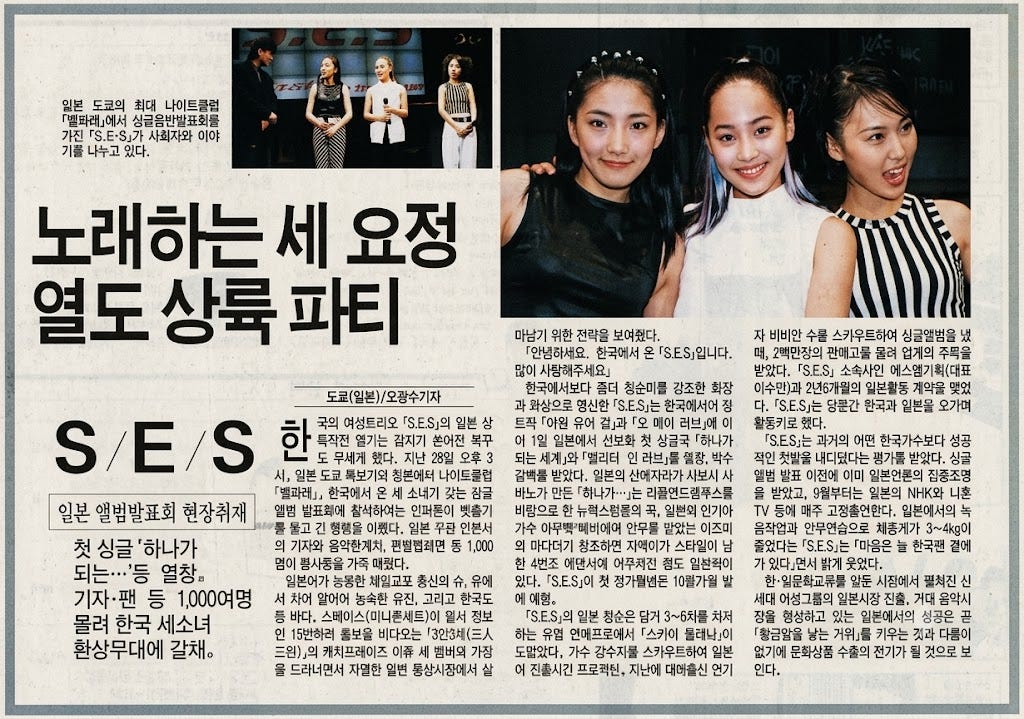
On Aug. 28, 1998, S.E.S. introduced themselves to Japan at Velfarre in Roppongi, and a thousand people—Japanese reporters, music-industry staff, fanclub members—filled the hall. Bada was 18. Eugene and Shoo were younger.
S.E.S. broke up in December 2002 after Eugene’s contract talks fell apart with SM. Bada and Shoo were still negotiating; the group was over before their meetings were. The renewal cliff has been doing that across K-pop labels, big and small, ever since.

Beyond 9
Girls’ Generation debuted on SBS’s Sunday-afternoon Inkigayo on Aug. 5, 2007, with a song that had already been shelved once—“Into the New World.”
Kenzie had written it as the title track of M.I.L.K.’s unmade second album; that group came apart before the record could be made, and the song sat shelved until the nine of them got it.
By 2007 three was no longer enough. The CD business was done, ringtones and digital downloads had swallowed the revenue model, and members were earning outside the group. Japan had opened up; China stayed restrictive but reachable.
Wonder Girls got there first—the English-language “Nobody” entered the Billboard Hot 100 at No. 76 in late October 2009, the first Korean act on the chart—and JYP bet the group on the United States. The bet didn’t pay off; they announced their breakup two weeks short of their tenth anniversary.
SM flipped it: keep SNSD running across Korea, Japan, and Southeast Asia, while expanding outward in sequence instead of in one campaign. Variety acted as a second product line, not promotional overflow, and the fanclub did unpaid work the label would otherwise have had to staff for—still true today for nearly every major group. After Jessica’s exit in 2014, the eight remaining members kept going.
S.E.S. ran a fixed center. Girls’ Generation moved its center of gravity from cycle to cycle. Taeyeon and Jessica traded vocal lead depending on the song, as the variety slot went to whichever member had a show booked that week.
In October 2017, three years after Jessica’s exit, Tiffany, Sooyoung, and Seohyun departed SM; the company said it was not yet an official disbandment. Subunits had picked up the work the full nine could not do at once: TaeTiSeo from 2012, Oh!GG in 2018.
“Gee” in 2009 was the skinny-jeans movement, “I Got A Boy” went organized chaos in 2013, and “Lion Heart” settled into broadcast glamour by 2015. It was a TV-friendly register, and a range competing groups burned whole album cycles inside.
Min Hee-jin strolled into SM through open recruitment in 2002, and by the “Gee” cycle she was working on the group directly—white-T-shirt-and-jeans era, and the “Genie” marine gloss. Interviewers kept steering her toward the art-school credibility of f(x) and SHINee. She told GQ in 2015 what else was hers:
대중적으로 히트한 소녀시대의 ‘Gee’나 ‘소원을 말해봐’ 또한 내 작업이다.
The mainstream hits—Girls’ Generation’s “Gee,” “Genie”—those are my work too.

Her working rule, as she gave it to W Korea:
디자인을 할수록 이상하게 뭔가를 자꾸 빼게 된다
The more I design, the more I strangely keep taking things away.
Suk-Young Kim’s K-pop Live has Min playing “a triple role as a graphic designer, a visual director, and an art director,” and quotes her at length—
My work consists of producing an overarching concept, graphic arts, and the overall visual presentation of an album. It is not simply to decorate an album jacket and interpret a producer’s intention. […] When I listen to the artist’s music, I first visualize a central item and ask the stylist to execute it.
Any given idol company’s entire competence is more or less making its girls look unlike anyone else. Despite this, Girls’ Generation won by dressing like everyone else—an image engineered so far toward ordinary it appeared flawless; the ordinary schoolgirl could complete it out of her closet, or off any rack from a clothing store nearby. Min made visual direction legible to the public as a job rather than a service, and in 2016 Mnet gave her a named award for it—best visual and art director, a technical category, 14 years after joining.
The Boys tin case won at Red Dot and iF in 2014—Min’s name nowhere to be found on either.

Girls’ Generation did not arrive with universal support; at Dream Concert in Jamsil, June 7, 2008, an alliance of rival fandoms refused to cheer. Seven months later, “Gee” came out and nobody had to organize the buying. The song, a rare smash in K-pop, breached stores, classrooms, TV screens, and eventually wardrobes of anyone and everyone who was part of the idol economy—by February 2009, the online mall Auction moved 2,000+ pairs a day of primary-color skinny jeans. Gee became culture.
A product—in this case, the song—was designed inside a company and broke into mainstream lanes, though China was where that expansion came to a halt. SNSD spent years building regional momentum there, but in 2016, Korea’s THAAD deployment triggered Beijing’s informal hallyu ban: cancelled concerts, dramas pulled from streaming, even artists edited out of variety shows.
Time Stays Undefeated
The Ewha occupation lasted 86 days, ending on Oct. 21, 2016. The students had not gone looking for a revolutionary anthem nor on a quest to summon history; they had gone looking for something everyone already knew. That was the least mystical explanation they gave afterward. They needed a song that could survive a hallway full of people singing it together—they chose “Into the New World.”
Reuters found a 24-year-old dancing to it at the 2020 Thai anti-government rallies, the wire identifying it as the song from the protests that brought down Park Geun-hye; marchers at the Seoul Queer Culture Festival danced to it as what the Korea Times called the country’s pride anthem.
By December 2024 the song had traveled back home again; outside the National Assembly, hundreds of thousands were calling for Yoon Suk Yeol’s impeachment. Speaker Woo Won-shik read the tally aloud—204 to 85, as the motion passed.
Outside, the crowd sang along to the words, including the line 이 세상 속에서 반복되는 슬픔 이젠 안녕, ‘goodbye now to the sorrows that repeat in this world.’ Yuri, one of the nine, pre-paid a kimbap shop for the fans standing in the cold that week.
The industry may have created the song, but time decided who it was for.
Nobody Smuggled Anything
Starship was founded in 2008 by someone who had already learned the trade at SM. By then, the recipe had escaped on its own. The way H.O.T. had been built, and S.E.S. had been raised, no longer belonged to the company that invented it. It belonged to K-pop. When IVE arrived, every label was still cooking from the same recipe, even if Girls’ Generation had started to dress like yesterday’s future.
The playbook’s ancestor was Berry Gordy’s Artist Development model—mentioned at length in my other piece:
Korea Welcomes the World

This piece is as much about Korean music as it is about learning a culture I was born into but never fully handed. To everyone who handed me what I was missing along the way—thank you!
Girls’ Generation took this template and threw it onstage themselves. Suk-Young Kim reads a segment of TaeTiSeo’s 2012 “Twinkle”—black musicians onstage, the three singers silhouetted in a blinding light—as closely approximating a Motown stage performance.
Even a group’s debut had become a place where companies could save time. Yujin and Wonyoung came in from IZ*ONE already famous; Gaeul, Rei, Liz, and Leeseo came up through the traditional trainee route and filled out the rest of the group.
The IZ*ONE chapter: Mnet’s 2018 Produce 48 ran AKB48 Group members and Korean trainees through a public vote. Prosecutors indicted the producers for rigging the vote across every season of the franchise, and Mnet PD Ahn Joon-young was sentenced to two years in May 2020—the term upheld on appeal that November. Wonyoung’s first-place finish on her 14th birthday sat inside one of those seasons. The Seoul High Court named the 12 trainees the rigging had cut, two of them from her season; every defendant it convicted worked behind the cameras.
The IVE debut went forward as scheduled.

“Did you see that on TikTok?”
On Dec. 1, 2021, six teenagers walked onto a stage, debuting “Eleven.”
First-week sales came in at 152,229 on Hanteo, and four months later “Love Dive” landed at 338,100—a number “After Like” passed in a single day on its way to 924,363.
By 2021, short-form video had become the first audition stage, globally, for music. Decades of trainee systems, vocal lessons, dance practice, and concept meetings eventually arrived at a stranger with a thumb. IVE’s approach went back to S.E.S.’—a fixed center.
Wonyoung occupies the It Girl archetype the 2000s gossip machine perfected—nowhere more so than at home. What looks in industry-press coverage like meritocratic discovery—the street-cast moment, the talented unknown discovered in a crowd—has an actual filter underneath: a parent who can field the housing, the lessons, the years off school, and the legal counsel for the contract. Wonyoung has told the story herself, cast while tagging along to her older sister’s graduation.
WWD reported in 2024 that on Xiaohongshu (a/k/a RedNote), China’s social-commerce platform, her name had been mentioned more than 3 billion times. The Starship lane is what Korean fandom calls the chaebol crush concept: luxury-self framing, confident-aspirational femininity, high-prestige styling, and a first-person authorial “I” running through almost every single’s lyrical stance:
“Narcissistic, my God I love it.”
That “I” has an author.
Seo Ji-eum wrote the lyrics for all three of the singles it appears in—“Eleven,” “Love Dive,” “After Like”—and had written TaeTiSeo’s “Twinkle” nine years before. She has said she wanted songs in which the “I” outweighs the “you,” against the convention that makes a love lyric magnify whoever it is addressed to.
This idea wasn’t new, though.
Lee Hyori had planted the flag with “U-Go-Girl” in 2008. Western pop before that, for decades. S.E.S. debuted during the IMF crisis, when collective survival was a nationwide priority, SNSD reached its peak during Lee Myung-bak’s “Global Korea” period, and IVE during Hell Joseon—an entire generation counting the things it had quietly surrendered, from dating, marriage, children, and housing, to relationships, dreams, and in many cases, hope itself.
Into this gloomy societal landscape, the K-pop industry adjusted the grammar—literally—to be suspiciously endearing and motivational: nothing is to be given up, or impossible; you can do it.
The stance escaped the label the way the song once escaped SM. In a video posted to IVE’s YouTube channel in September 2023, Wonyoung stands in a bakery in Spain and the customer ahead of her has just bought out what she came for.
She turns to the camera—
앞 사람이 제가 사려는 빵을 다 사 가서 너무 럭키하게 제가 새로 갓 나온 빵을 받게 됐지 뭐예요? 역시 행운의 여신은 나의 편이야.
The person in front bought all the bread I was going to get, so luckily I end up with the batch that just came out. The goddess of luck really is on my side.
Fans took the joke and built 원영적 사고—Wonyoung-style thinking—out of it, a real self-help idiom for young Koreans, months after the company had shot and shipped the video.
Kim Young-dae, the late critic who sat on the Korean Music Awards selection committee, thought the thing worked: writing in 2023, he credited IVE with making a self-possessed woman legible—unafraid of being hurt, and not asking permission—and said in the same breath that this was part of a thoroughly calculated and elaborately devised industrial strategy.
Now, the earworms and content alike are tuned for what a 17-year-old in São Paulo who has never heard Korean finds on her own feed, and the group works the short-form floor the way SNSD worked a variety couch. “Love Dive” closed 2022 at No. 1 on TikTok’s Korean year-end playlist, with 2.39 million videos still built on the sound seven months after promotions had ended, and when the next single came, Starship premiered the title track on TikTok a day ahead of the record. A lyric written in the first person films as a selfie without anyone rewriting it for the format.
SNSD had entered Southeast Asia, then Japan, then the United States, in sequence. IVE reached all of them inside the first album cycle; Kakao Entertainment had absorbed Melon by 2021, which put Korea’s dominant streaming data inside the same group as Starship’s production.
The redundancy the nine-piece had as a group now lives inside each IVE member—short-form clips, music shows, livestreams, brand campaigns, variety appearances—capable of surviving the algorithm wherever it decides to surface her. Before a debut song reaches the public, the average aspiring singer has already spent 31 months rehearsing for audiences she hasn’t met yet.
S.E.S. fixed it. SNSD rotated it. IVE nailed it back down. Rotation belonged to broadcast television, when every member eventually found her camera. TikTok belongs to the first face that stops a stranger’s thumb. Every generation solved a different technical problem. They were all chasing the same thing: survival.
S.E.S. hit the renewal cliff in 2002 and disappeared all at once. SNSD hit the same cliff and kept going—one member left, then three more—and what remained ran subunits, anniversaries, and solo careers, a brand learning to outlive the people who built it.
Which is why none of this, by itself, explains why “Into the New World” wound up outside the National Assembly.
Korea had no shortage of songs people could sing together that day at Ewha. The students chose this one because of everything it wasn’t. It wasn’t a typical go-to anthem, the kind that arrives with politics already baked in. It wasn’t written at anyone. It wasn’t even hot at the time. Nine years of ordinary life had worn the fingerprints off it until it belonged to nobody in particular.
Christopher Alexander spent a career arguing that the best fit often arrives after design stops announcing itself. He never had to account for K-pop, though. Nothing about the song was unselfconscious when it was made. Every frame, every hook, every color had been argued over by professionals in conference rooms and dinner meetings downtown.
What became unselfconscious was everything that happened afterward.
The Control Group
The corporate distance between SM and Starship closed in 2023: Lee Soo-man sold most of his holding, and Kakao, which had held Starship inside its group since buying LOEN in 2016, won the bidding war that HYBE quit and landed both labels under one roof.
K-pop fandom sorts itself by numbered generations, and the SNSD-to-IVE gap crosses two full generational boundaries. SM’s aespa references SNSD in its fan service and branding, and runs a deliberate Korean-Japanese-Chinese formation: the market reach S.E.S. had carried through biographical accident, cast on purpose 23 years later. Red Velvet had made the same gesture with its 2014 cover of S.E.S.’s “Be Natural.”
2NE1 contradicts this. YG built the unit in 2009 on four members, no rotating center, and a register meant to be admired, not adored. It reached further into global press than SNSD did in the same window. What it never built was the part that absorbs a departure; the unit disbanded in November 2016.
BLACKPINK is a bit more complex: four members, each individually globally famous, minimal concept rotation, and a Western-market focus that hardened in 2018 with an Interscope deal. They ignored most of the SNSD redundancy mechanics and out-scaled SNSD on the Western charts SNSD never reached, playing Coachella twice and running major fashion house contracts across all four members simultaneously.
On Dec. 6, 2023, the four renewed group contracts with YG covering group activity only; the individual contracts were not renewed. Solo deals rerouted to four different companies.
TWICE became the real test. JYP’s 2015 nine-member multinational debut (five Korean, three Japanese, one Taiwanese) put nine members on the same frequency SNSD deployed, then sustained a years-long Oricon run and a top-tier Korean chart presence from Like OOH-AHH in 2015 through Feel Special in 2019. When Mina withdrew from the Twicelights tour in July 2019 with what JYP called sudden, extreme anxiety about being onstage, the group held at eight, and she was back onstage that October for the Japan tour’s opening night.
Park Jin-young came up outside SM entirely, and JYP tried it with Sixteen. The SNSD redundancy carried over cleanly to a label with no SM staff and no SM trainee crossover. The rest of it took place through the open air: by the mid-2010s every label was reading every rival’s numbers off the same public dashboards, vying for glory.
Min Hee-jin stayed at SM into the late 2010s, and f(x)’s Pink Tape in 2013 reoriented the SM aesthetic toward the concept-driven mood-board approach the rest of the industry copied afterward. She left SM in 2018 after 16 years and joined Big Hit, later HYBE, the following July, and got a subsidiary of her own: ADOR—one group, NewJeans, which debuted in July 2022 with no pre-debut teaser cycle.
A brief look at NewJeans:
NewJeans Never Dies

K-pop. It's the most efficient hit-making machine pop music has ever built. Equal parts religion and heresy depending on who you ask, with no shortage of true believers on either side. A whole country's worth of talent, reaching every corner of the planet. Say what you want about it—at its best, nothing on earth moves a room like it.
Nothing’s Free
On July 31, 2009, Jaejoong, Yoochun, and Junsu of TVXQ filed for an injunction suspending the effect of 13-year exclusive contracts, on grounds of unfair length and profit-imbalance terms, the case Korean coverage now calls the slave-contract dispute. The Fair Trade Commission had gotten there three and a half weeks ahead of them, in July 2009. Its work had begun the previous December, after it moved against 10 agencies’ unfair terms, and it produced a standard contract form: a singer on a term longer than seven years could give notice at seven, and the contract would end six months later—the “7-year curse” that has shaped K-pop’s renewal cliffs since.
Kim Jonghyun of SHINee was 27 when he died by suicide on Dec. 18, 2017, leaving a note about depression and the pressure of the work. Sulli of f(x) had spent years being hounded online—for going without a bra, for who she was seeing—before she died on Oct. 14, 2019, at 25. Six weeks after that, Goo Hara of KARA died at 28, 14 months on from reporting a former partner over an intimate video.

Korea’s National Assembly passed the “Goo Hara Act” in her name in August 2024, letting a family court strip inheritance from a parent who had seriously failed to support a child during the child’s minority.
The labels took children out of school, ran them through years of unpaid pre-debut labor under contracts the Fair Trade Commission eventually gave them the right to walk out of at seven years, deposited them in front of a fan economy that paid by photocard and punished any deviation from the construct, and then released them at 25 into a labor market that had no slot for most of them, while the pipeline behind them refilled with the next round of trainees on the next round of the same contract.
The industry had left psychiatric care to the families and to the members themselves, and part of what replaced it is a government line item: the Korea Creative Content Agency funds up to 12 sessions a person, a psychological assessment included, for performers and trainees who apply.
Lightsum, Kep1er, Purple Kiss, and Billlie attempted similar setups in the same window and never got near IVE’s altitude; STAYC, out of High Up a year ahead of IVE, got closest: real commercial success, no general-public foothold.
The Goo Hara Act addressed inheritance rights only. A version of the design would set a floor under member ownership of the master recordings, set 15 as the youngest debut age, and open the compensation columns the companies have spent 30 years declining to share. Nothing on that list touches the wide shot, the untranslated styling, or the churn.
In 2007, nine teenagers recorded an idol single. Nine years later 200 women sang it at a police line, and eight years after that hundreds of thousands sang it outside the National Assembly while a president was impeached. Somewhere in those 17 years it had become a song of the people.
Through time, K-pop labels have stitched together hundreds of girl groups; this one kept returning for a quarter century to the same idea—S.E.S. in 1997, SNSD in 2007, IVE in 2021—stripping away what didn’t last, keeping what did, and trusting experience over novelty. The succession is obvious in the way generations often are: you recognize it instantly, then struggle to explain exactly why. No shared look, no shared sound, barely even the same industry between cassettes, ringtones, and TikTok.
The songs—the ones that define an era, become an anthem, and redraw cultural borders—never change hands. This one belonged to the company the day it was shelved, and it belonged to the company the day the tally was read aloud.
The crowd’s part was never on paper—they knew every word by heart.